
Best
SOC 2 for SaaS · 2026 Buyer's Guide
Choosing a SOC 2 platform shapes how heavy your first audit feels and how well the programme scales as more frameworks arrive. This guide compares five platforms on the criteria that decide that.

The right SOC 2 platform does more than help you prepare for certification. It can turn a recurring enterprise sales objection into something you answer quickly and confidently.
A familiar pattern plays out in enterprise deals: a promising late-stage negotiation stalls when procurement sends a long security questionnaire and asks for a SOC 2 report. If you cannot produce a Type II report on request, the deal can slow down or move to a competitor that already has one.
The lesson buyers take from this is that SOC 2 is less a cost of doing business than a revenue enabler, and that the tooling you choose affects how quickly you can get from a standing start to an audit-ready programme.
This guide compares five SOC 2 platforms for SaaS companies in 2026, drawing on public vendor documentation and hands-on use of the Venvera product. See the methodology note below.
How we compared (methodology)
Reviewed July 2026. This comparison draws on public vendor documentation and hands-on use of the Venvera product. Vanta, Drata, Sprinto and Secureframe were not tested hands-on, so their entries reflect only what could be confirmed from public documentation and are qualitative rather than scored benchmarks. Criteria were chosen for their relevance to a growing SaaS compliance programme: evidence automation, continuous monitoring, framework coverage, cross-framework mapping, data residency and pricing transparency.
Competitor pricing is not publicly listed and is shown as such rather than estimated. Where a capability could not be confirmed from the documentation reviewed, it is marked accordingly rather than assumed absent. Vendor capabilities and prices change; verify current details with each vendor before deciding.
What Actually Matters When Choosing SOC 2 Software
Before I compare platforms, let me tell you what to ignore and what to care about. Because the marketing pages all look the same, and the real differences hide in the details.
Care about: automated evidence collection. If your engineers have to screenshot AWS console settings or manually export access logs for the auditor, your tool has failed its most basic job. The best platforms pull evidence automatically from your cloud providers, identity systems, and code repositories. This is table stakes in 2026, but the depth of integration varies enormously.
Care about: continuous monitoring. SOC 2 Type II covers a period, not a point in time. You need your platform watching for control drift continuously. Someone removes MFA? Alert. An S3 bucket goes public? Alert. A terminated employee still has access? Alert. If you're only checking compliance at audit time, you're already behind.
Care about: multi-framework economics. This is the one most people miss until it's too late. SOC 2 is rarely your final compliance destination. Your German customer will ask for ISO 27001. Your healthcare prospect wants HIPAA. EU expansion means GDPR. If your SOC 2 platform charges per framework and doesn't map controls across them, your costs will compound aggressively.
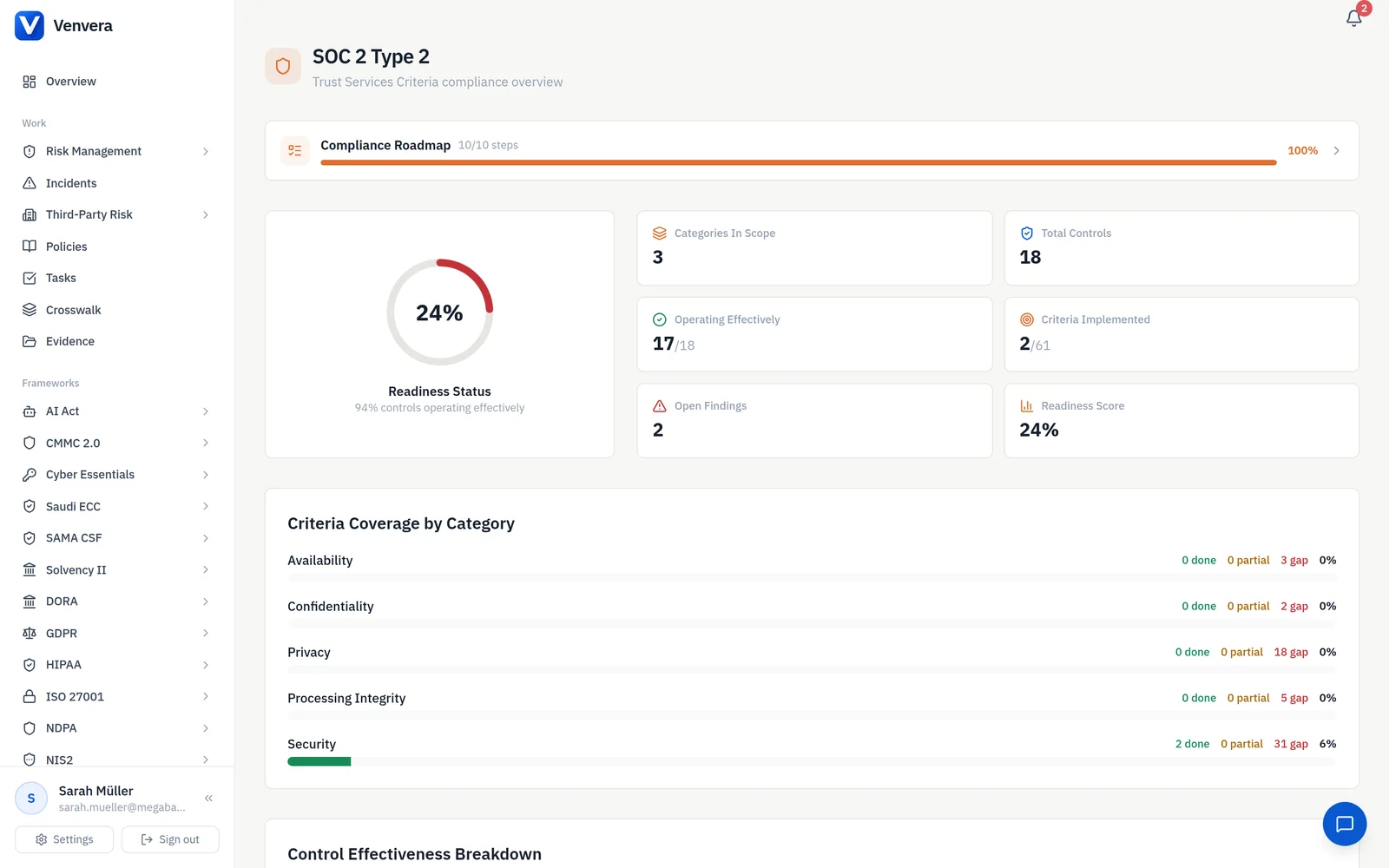
Ignore: flashy dashboards. A beautiful pie chart that says "87% compliant" doesn't help if the 13% gap is in access controls and your auditor discovers it on day one. Focus on platforms that help you close gaps, not decorate them.
Ignore: "AI-powered" marketing. Every compliance platform in 2026 claims to use AI. Some genuinely do useful things with it (like pre-filling evidence descriptions or auto-responding to security questionnaires). Most are just using the word to justify a price increase. Ask for a demo. See what the "AI" actually does. Then decide if it's worth paying extra for.
The Five Platforms, Honestly Reviewed
The notes below draw on public vendor documentation for the four competitors and on hands-on use of Venvera, focusing on what a SaaS buyer needs rather than on marketing claims.
1. Vanta - The Market Leader (With Market Leader Pricing)
Vanta is the name most people think of when they think SOC 2 compliance software. And for good reason. They've been doing this longer than most, they have the deepest integration library (200+ connectors covering AWS, GCP, Azure, Okta, GitHub, Jira, and dozens more), and their auditor network is extensive. If you're a US-based SaaS company that only needs SOC 2, Vanta is a legitimate choice.
The automated evidence collection is genuinely impressive. Vanta pulls configuration data from your cloud providers, checks your identity provider settings, monitors your code repositories for branch protection policies, and tracks employee onboarding and offboarding through your HR system. For a SaaS company running on AWS with Okta and GitHub, the setup is relatively painless.
On pricing, Vanta does not publish rates; expect a sales call, and pricing that is typically per-framework so cost rises as you add frameworks. Confirm current pricing and renewal terms with the vendor.
Coverage of NIS2, DORA, the EU AI Act and CMMC was not confirmed from the public documentation reviewed in July 2026, so if you expect to need those, check current coverage with the vendor. Hosting is US-based by default, with EU hosting listed as an option.
Best for: US-centric SaaS companies with budget flexibility that prioritise depth of cloud integrations and don't anticipate needing more than 2-3 frameworks.
2. Drata - Clean Design, Similar Trade-offs
Drata is Vanta's closest competitor, and the comparison is fair because they're solving the same problem for the same audience. Drata's UI is arguably cleaner - the dashboard is well-designed, the control status view is intuitive, and the onboarding experience is polished. They have 75+ native integrations covering the standard SaaS stack, and their continuous monitoring catches control drift reliably.
Where Drata differentiates is in their approach to customization. You can create custom controls, build custom frameworks, and tailor the platform to your specific needs more easily than Vanta. For SaaS companies with non-standard compliance requirements - maybe you have a specific customer contractual obligation that doesn't map neatly to a standard framework - this flexibility matters.
Drata's pricing is not published and is typically per-framework, so multi-framework costs rise; confirm with the vendor. Its public documentation lists SOC 2, ISO 27001, HIPAA, PCI DSS, GDPR and others; coverage of NIS2, CMMC, DORA and the EU AI Act was not confirmed from the documentation reviewed in July 2026. Data hosting is US-based, with EU hosting listed as an option.
Best for: SaaS companies that want a polished user experience, need customization flexibility, and are primarily focused on SOC 2 + ISO 27001.
3. Sprinto - The Budget-Friendly Starter
Sprinto targets a specific audience: early-stage SaaS startups that want to prepare for SOC 2 without enterprise pricing. It is often positioned as one of the more accessible options, which for pre-Series B companies can be the difference between starting the programme and postponing it. Pricing is not fully published; confirm with the vendor.
Sprinto's approach is simpler than Vanta or Drata - fewer integrations, less customization, more guided workflow. But simplicity can be a strength for teams without a dedicated compliance hire. The platform walks you through what you need to do, when, and why. For a first SOC 2 engagement, that hand-holding has genuine value.
The trade-off is the ceiling. Its public documentation lists SOC 2, ISO 27001, HIPAA and GDPR, a smaller integration library and more limited cross-framework mapping. Teams that outgrow it tend to migrate to a broader platform later, and that migration costs time and disruption. If you already know you will need several frameworks within a couple of years, starting narrow to save money now can cost more later.
Best for: Pre-Series B startups that need SOC 2 certification quickly and affordably, and are comfortable potentially migrating platforms later.
4. Secureframe - Best Hands-On Support
Secureframe's differentiator isn't the technology - it's the people. They assign a dedicated compliance manager during onboarding who walks you through the entire SOC 2 process. For SaaS teams going through their first audit without an in-house compliance expert, having someone to call when you're staring at a control description wondering "does this apply to us?" is genuinely valuable.
The platform itself is solid. Its public documentation lists cloud integrations across the standard stack (AWS, GCP, Azure, Okta, GitHub) and automated evidence collection. An AI-assisted security-questionnaire tool is offered to help teams respond to customer security assessments; it does not replace human review but can pre-fill responses. Confirm how much it helps in your own trial.
Framework coverage listed in its public documentation is similar to the others: SOC 2, ISO 27001, HIPAA, PCI DSS, GDPR. Coverage of NIS2, CMMC, DORA and the EU AI Act was not confirmed from the documentation reviewed in July 2026. Pricing is per-framework and not publicly listed; confirm with the vendor.
Best for: SaaS companies doing their first SOC 2 audit who value dedicated human support over self-service automation.
5. Venvera - The Multi-Framework Play
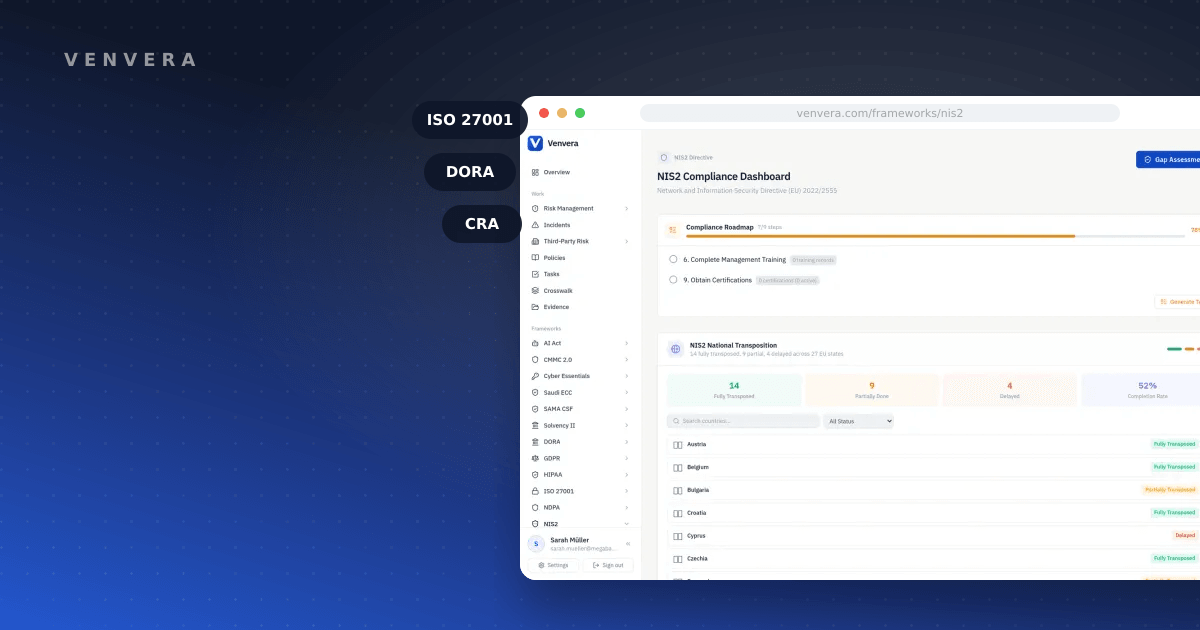
Venvera approaches SOC 2 from a different angle than the other four platforms. Rather than a SOC 2 tool with other frameworks added later, it is a multi-framework compliance platform in which SOC 2 is one of several supported frameworks. In practice it handles SOC 2 while making a second or third framework materially less work.
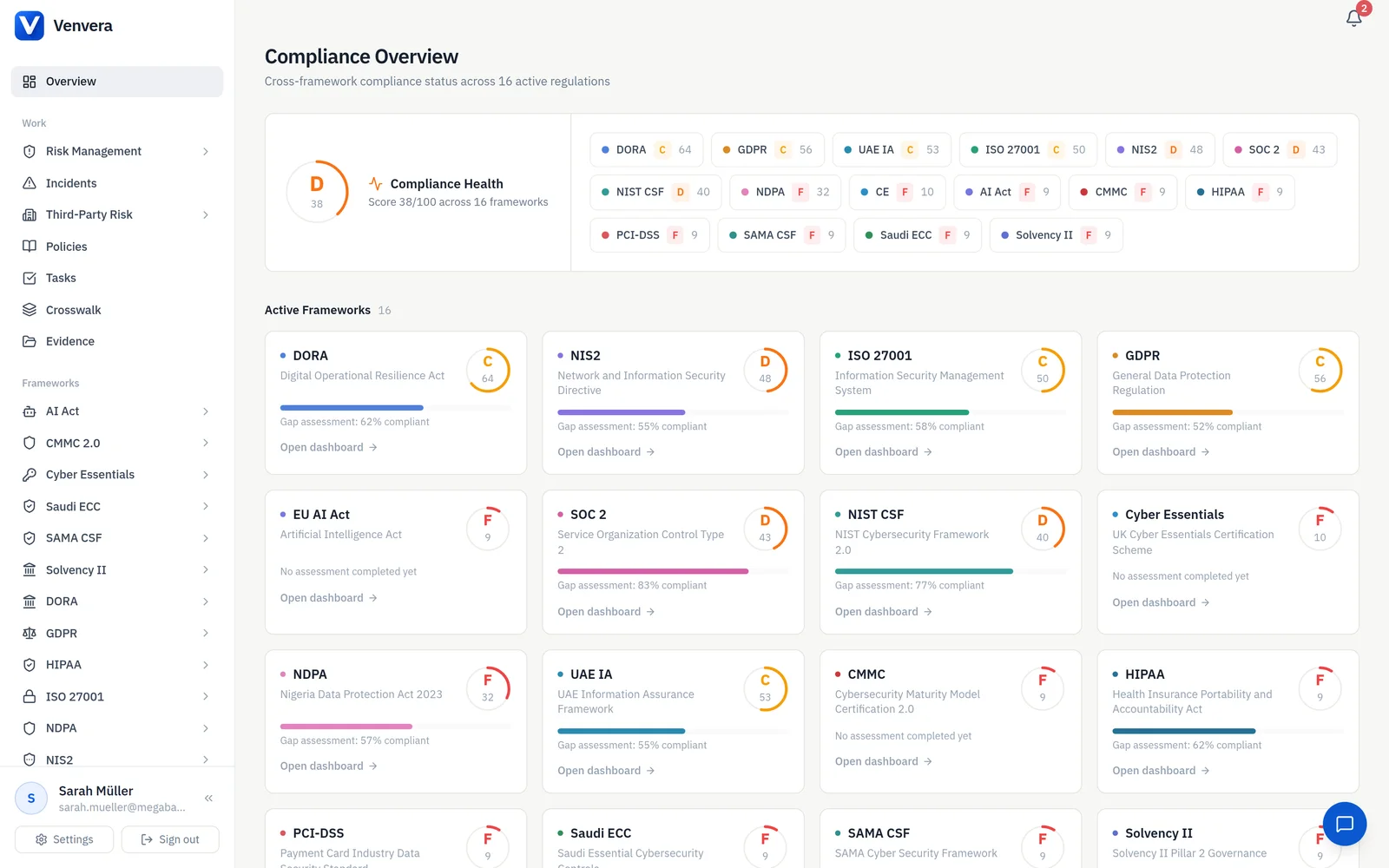
A common scenario: you close your first enterprise client in Germany. They want SOC 2, they want evidence of GDPR compliance, and your board is asking about ISO 27001 after other prospects mentioned it. Because Venvera's pricing is per plan rather than per framework, that combination sits inside one published plan (€899/month for three frameworks) rather than three separately priced add-ons. Competitor pricing is not publicly listed, so compare the total for your framework set with each vendor directly.
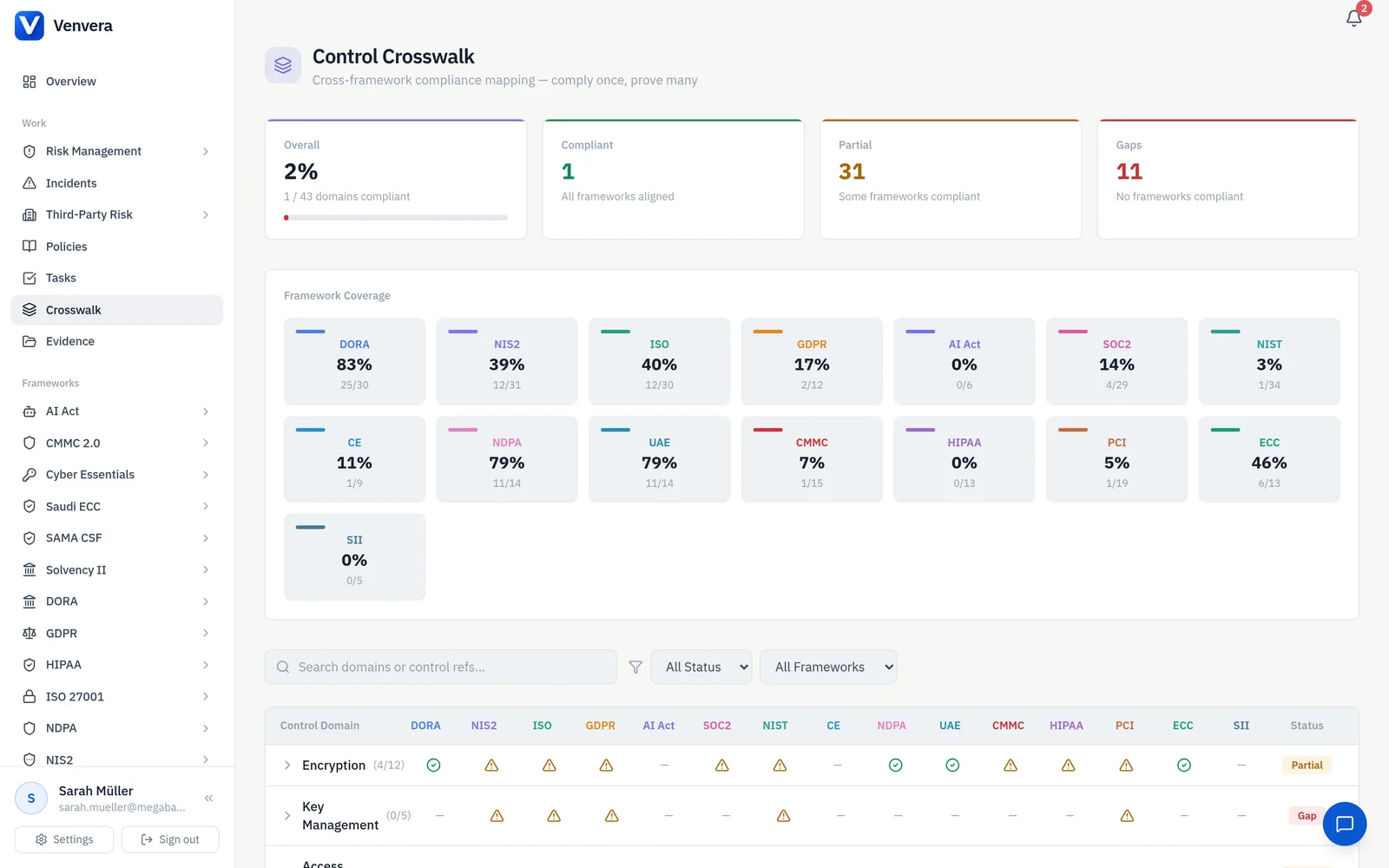
The cross-framework mapping is the practical multiplier. When you document an access-control policy for SOC 2 (CC6.1), Venvera links it to the mapped requirements in ISO 27001 (A.9), NIST CSF (PR.AC), DORA (Article 9) and GDPR (Article 32) in its crosswalk, so one documented control contributes to several frameworks at once. How much of a second framework this covers depends on how much your frameworks overlap.
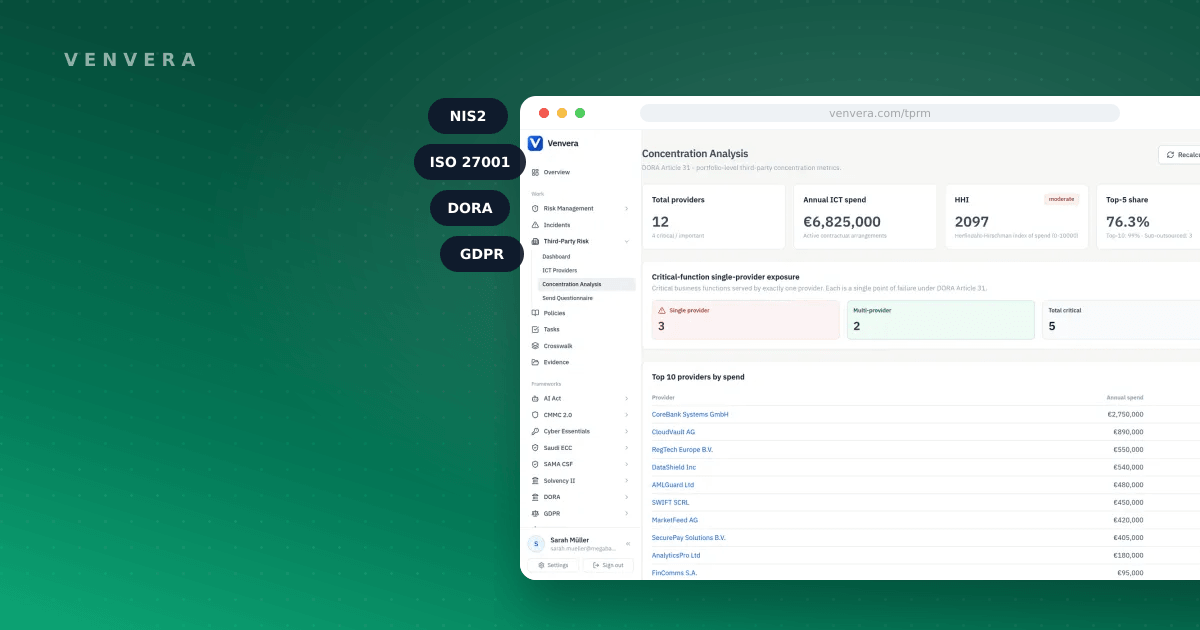
The trade-off is clear: Venvera doesn't have 200+ cloud integrations like Vanta. Its automated evidence collection from AWS and GCP is growing but not as deep. If your compliance strategy revolves entirely around automated infrastructure scanning, Vanta has more connectors today. But if your strategy revolves around efficiently managing multiple compliance frameworks without paying per-framework markup, Venvera's economics are hard to argue with.
Everything is hosted in Amsterdam with AES-256-GCM encryption and per-tenant isolation. Published pricing: €399/month for one framework, €899/month for three. Supported frameworks include SOC 2, ISO 27001, GDPR, NIS2, EU AI Act, NIST CSF, DORA, Cyber Essentials, NDPA, UAE IA, CMMC, HIPAA and PCI-DSS.
Best for: SaaS companies that need SOC 2 today and expect to need international frameworks soon, particularly those expanding into EU markets, serving financial clients or targeting government contracts, where per-plan pricing and cross-framework mapping do the most work.
The Comparison Table You Actually Need
| Feature | Vanta | Drata | Sprinto | Secureframe | Venvera |
|---|---|---|---|---|---|
| SOC 2 support | Strong | Strong | Good | Good | Full |
| Cloud integrations | 200+ | 75+ | 30+ | 100+ | Growing |
| EU + international framework coverage | Core set | Core set | Narrow | Core set | Broad |
| DORA / NIS2 / AI Act | No | No | No | No | Yes, all three |
| Cross-framework mapping | Basic | Basic | Minimal | Basic | 150+ mappings |
| EU data hosting | Option | Option | No | No | Amsterdam (default) |
| Published pricing | No | No | Partial | No | Yes |
| SOC 2 starting price | Not listed | Not listed | Not listed | Not listed | €399/mo |
| 3-framework annual cost | Not listed | Not listed | Not listed | Not listed | ~€10.8K |
How to read this: the Venvera column is verified in the product. The competitor columns reflect public vendor documentation reviewed July 2026; competitor pricing is not publicly listed, and where a capability could not be confirmed it is marked accordingly rather than assumed absent. Verify current details with each vendor.
A Note on SOC 2 Pricing
Most SaaS companies that start with SOC 2 add at least one more framework within a couple of years: often ISO 27001, because European customers ask for it; GDPR, once you have EU users; sometimes HIPAA in healthtech; or DORA and NIS2 if you serve financial institutions or critical infrastructure.
The pricing point that matters for that trajectory is the model, not a headline number. Vanta, Drata, Sprinto and Secureframe do not publish rates and are typically priced per framework, so the total tends to rise as you add frameworks. Venvera publishes per-plan pricing (€399/month for one framework, €899/month for three) that does not change with each added framework inside the plan.
Because competitor pricing is not publicly listed, do not rely on estimates: ask each vendor for a written quote covering your exact framework set and renewal terms, then compare like for like against Venvera's published plans.
The general lesson is simple: if you expect to run more than one framework, weigh how each vendor's pricing behaves as frameworks accumulate, not just the entry price.
My Actual Recommendations
After three SOC 2 audits, five platforms, and more compliance conversations than I can count, here's what I'd tell a friend:
If you only need SOC 2 and you have budget: Vanta. Deepest integrations, biggest ecosystem, most auditor options. You'll pay for it, but the product is mature and reliable.
If you only need SOC 2 and you're bootstrapped: Sprinto. Get certified affordably. Plan to switch later if your compliance needs grow.
If this is your first audit and you want hand-holding: Secureframe. The dedicated compliance manager is worth it for first-timers.
If you need SOC 2 plus one or more other frameworks: Venvera is worth a close look. Per-plan pricing keeps costs predictable as frameworks accumulate, the cross-framework mapping reduces duplicate work, and Amsterdam hosting helps once you sign your first EU customer.
The right answer depends on where your company is today and where it's going. But if there's one thing I've learned, it's this: you will need more frameworks than you think, and switching platforms later is always more painful than starting on the right one.
SOC 2 Is Just the Starting Line
Venvera gives you SOC 2 plus 12 more frameworks with cross-framework control mapping. One platform, published pricing, Amsterdam-hosted. Start at €399/month for one framework, €899 for three.