Best
If you are shopping for a Vanta alternative for third-party risk management, the honest first question is which job you are actually trying to do. There are two, and they look similar until you are three vendors deep. One is vendor security monitoring: continuously watching your suppliers for breaches and posture changes. The other is regulatory vendor governance: proving to several supervisors at once that your third-party risk is assessed, tiered, concentrated where it should not be, and documented. Vanta is very good at the first. This guide is for the compliance lead, risk manager or CISO who needs both, and needs the second done across every framework they carry without re-assessing the same vendor four times.
Claims below are classified verified (confirmed in the vendor's documentation or a product we operate), vendor-stated (claimed, not independently confirmed), or flagged. Vanta's TPRM capabilities are quoted from vanta.com as of 20 July 2026; re-check before relying on any single line.
Short answer
- Vanta is a strong fit if your priority is continuous, automated vendor security monitoring at scale: auto-discovery, AI risk scoring, breach alerts and fast questionnaire turnaround across a large integrated estate.
- Venvera is the better fit if your priority is regulatory-grade vendor governance across several regimes at once: one vendor register, one assessment that maps to NIS2, ISO 27001, DORA and GDPR third-party duties, criticality tiering, concentration-risk analysis and board reporting, EU-hosted, at published pricing.
- Many teams want both - continuous monitoring from one tool, multi-framework governance from another. The last section shows how to run the governance side once for every framework.
What third-party risk management actually has to prove
Vendor risk is not one obligation. Almost every framework you carry has its own third-party requirement, and they overlap heavily but not perfectly:
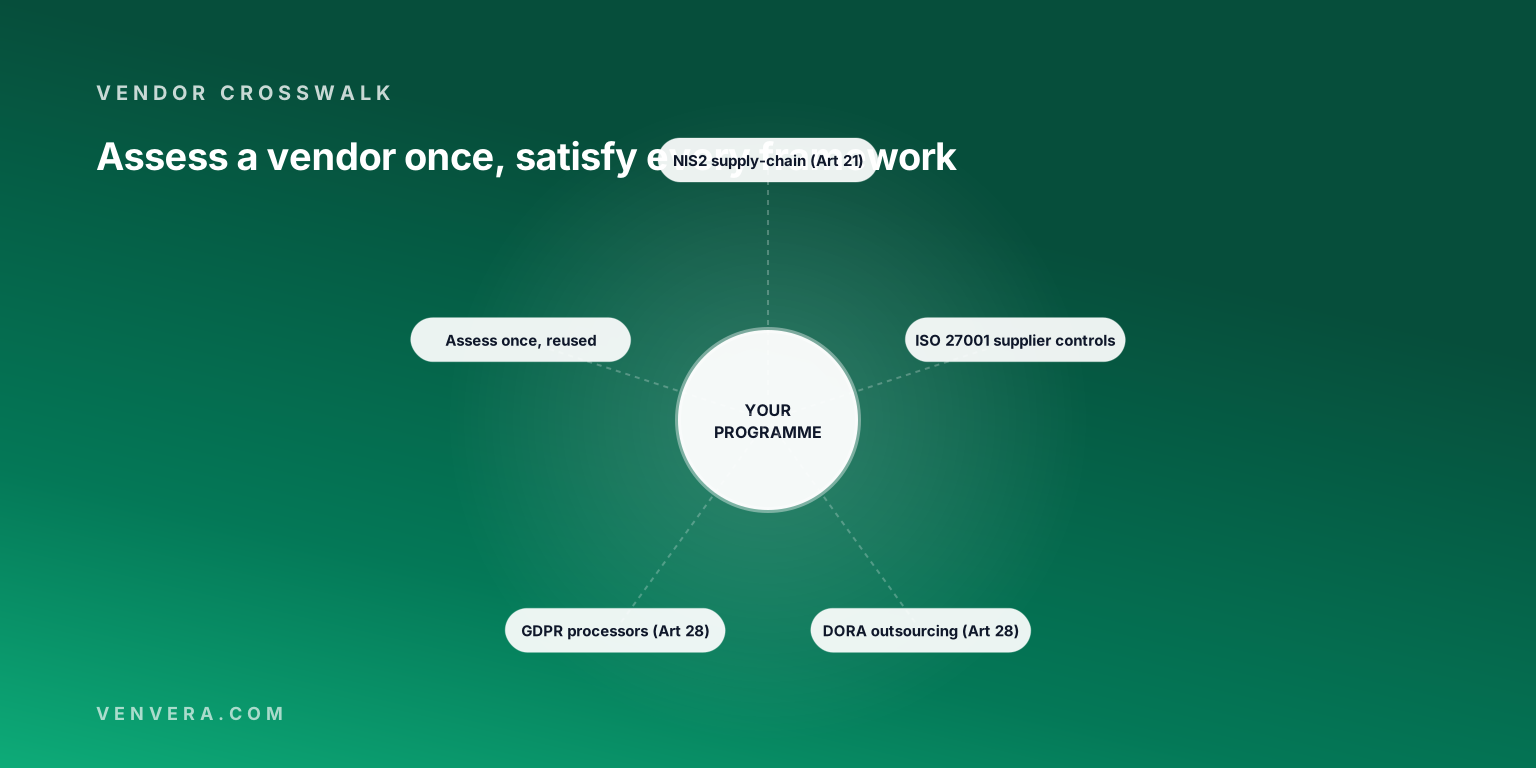
- NIS2, Article 21(2)(d) requires supply-chain security, including the security of relationships with direct suppliers and service providers.
- ISO 27001 carries supplier-relationship controls (the A.5.19 to A.5.23 set in the 2022 revision) covering supplier agreements, service delivery and cloud services.
- DORA, Article 28 governs ICT third-party arrangements for financial entities, with a maintained register of contractual arrangements and, at Article 29, concentration-risk analysis.
- GDPR, Article 28 requires processor due diligence and data-processing agreements for any vendor touching personal data.
The trap is doing these one at a time. Teams assess the same cloud provider in a NIS2 supply-chain review, again in an ISO supplier review, again for a DORA register, and again for a GDPR processor list, four assessments, four evidence stores, four review cadences, for one vendor. The real job of third-party risk software is to let you assess a vendor once and satisfy every regime from that single record.
The cost of getting this wrong is not abstract. A mid-size organisation carrying NIS2, ISO 27001, DORA and GDPR can easily run three or four separate assessments of the same critical cloud provider, each with its own questionnaire, evidence request and annual review. Multiply that by fifty vendors and you have hundreds of avoidable assessments a year, plus the drift that comes when one copy of a vendor's status is updated and the others are not. A supervisor who finds two different risk ratings for the same vendor in two different files has found a governance problem. One register removes the duplication and the drift in a single move.
What Vanta's TPRM does, honestly
Vanta's Vendor Risk Management is a genuinely strong monitoring-first product. From its own documentation (verified on vanta.com, 20 July 2026), it automatically discovers vendors and integrates with procurement systems to remove shadow IT, applies automated and customisable inherent-risk scoring with your own risk tiers, retrieves verified documentation directly from vendor Trust Centers, and automates evidence requests and follow-ups. Its TPRM Agent runs 24/7, scanning the vendor landscape for breaches and material changes and drafting tailored remediation plans. Vanta cites large time savings, on the order of fifty hours per vendor down to a few hours a week, and around 62% faster evidence collection.
If continuous vendor security monitoring at scale is your priority, that is excellent, and Venvera does not try to match the AI breach-monitoring agent or the auto-discovery breadth. Credit where it is due.
Where monitoring and regulatory governance diverge
The difference is what the tool is optimised to answer. Vanta's TPRM answers "is this vendor secure, and has anything changed?" A regulatory vendor-governance tool answers "can I prove, to every supervisor I report to, that my third-party risk is governed?" Those need different things:
- Multi-framework mapping of one assessment. A single vendor record that simultaneously satisfies the NIS2, ISO 27001, DORA and GDPR third-party duties, rather than a security score you then re-document per framework.
- Criticality tiering for regulatory purposes, not only inherent security risk, because DORA and NIS2 care which providers are critical or important to your operation.
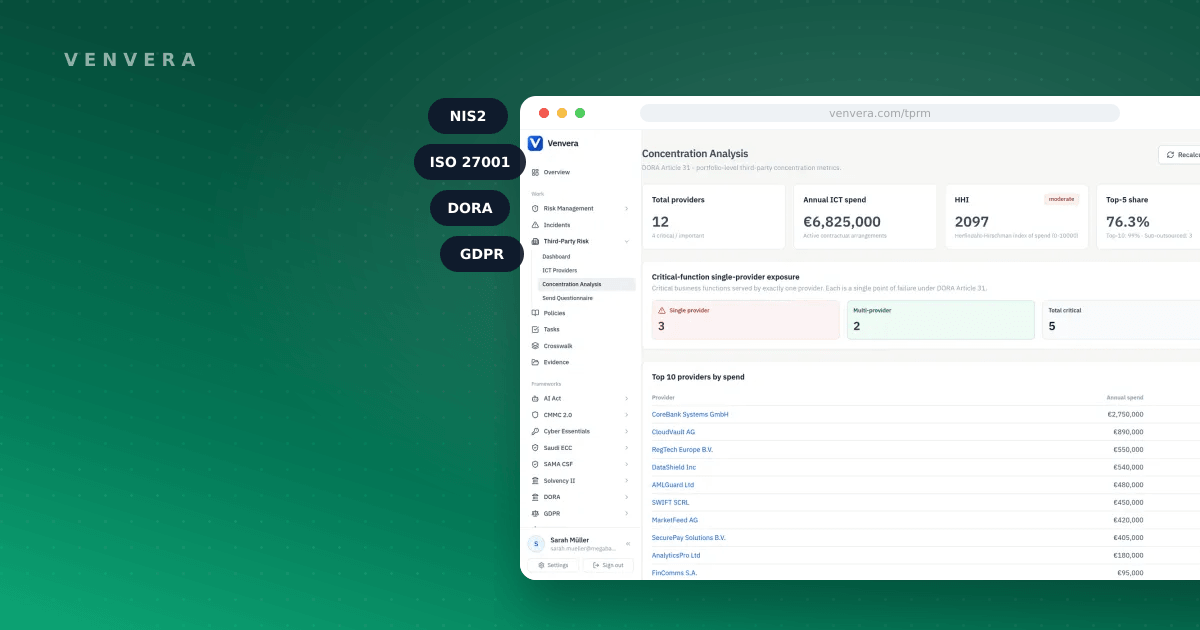
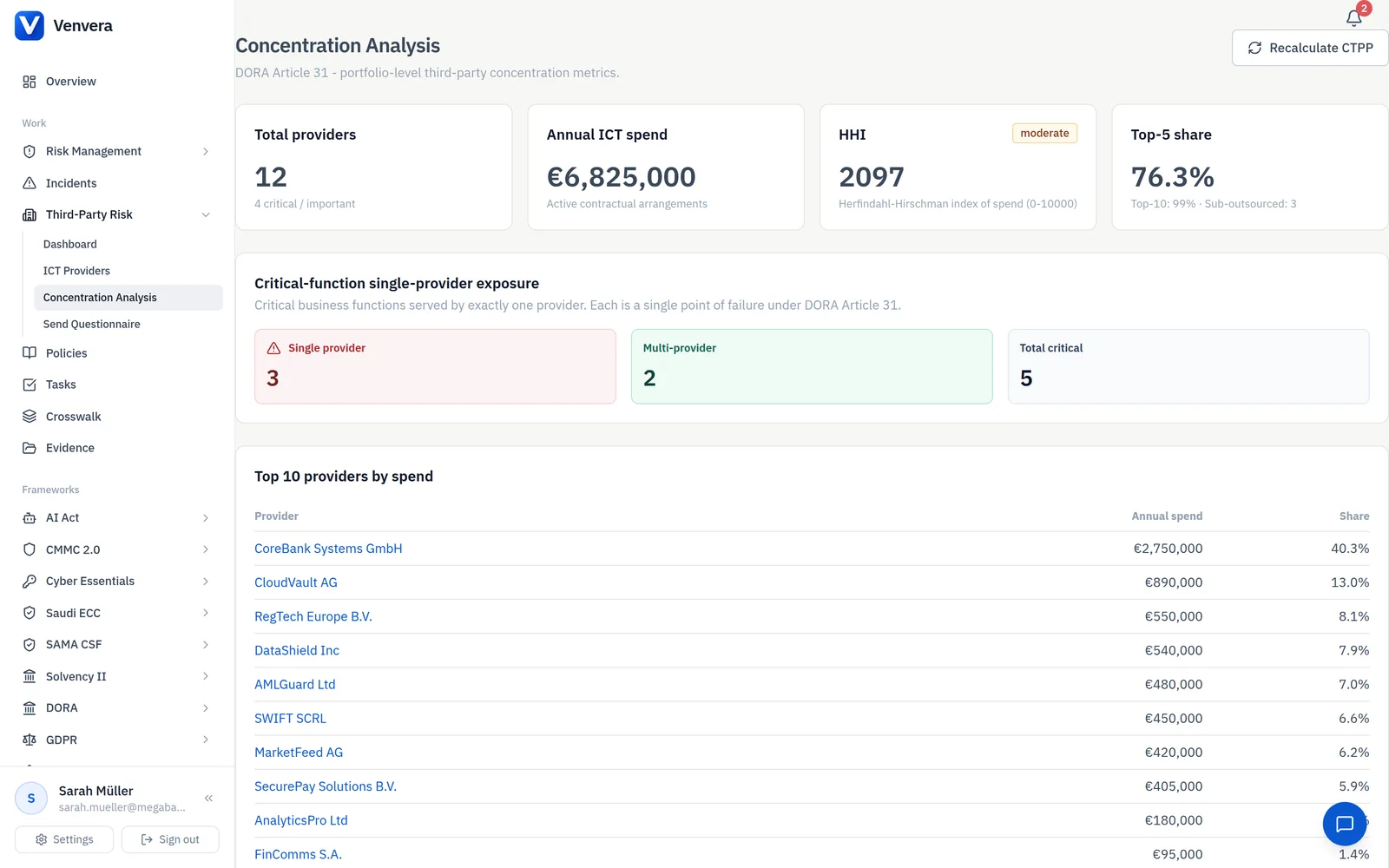
- Concentration-risk analysis across your vendor portfolio, the "too many eggs in one provider" view that Article 29 of DORA expects and that pure per-vendor scoring does not give you.
- The register as an output. When you do need the DORA Register of Information, it should fall out of the same vendor data, not be a separate project. It is one export, not the whole point of the module.
How Venvera approaches third-party risk
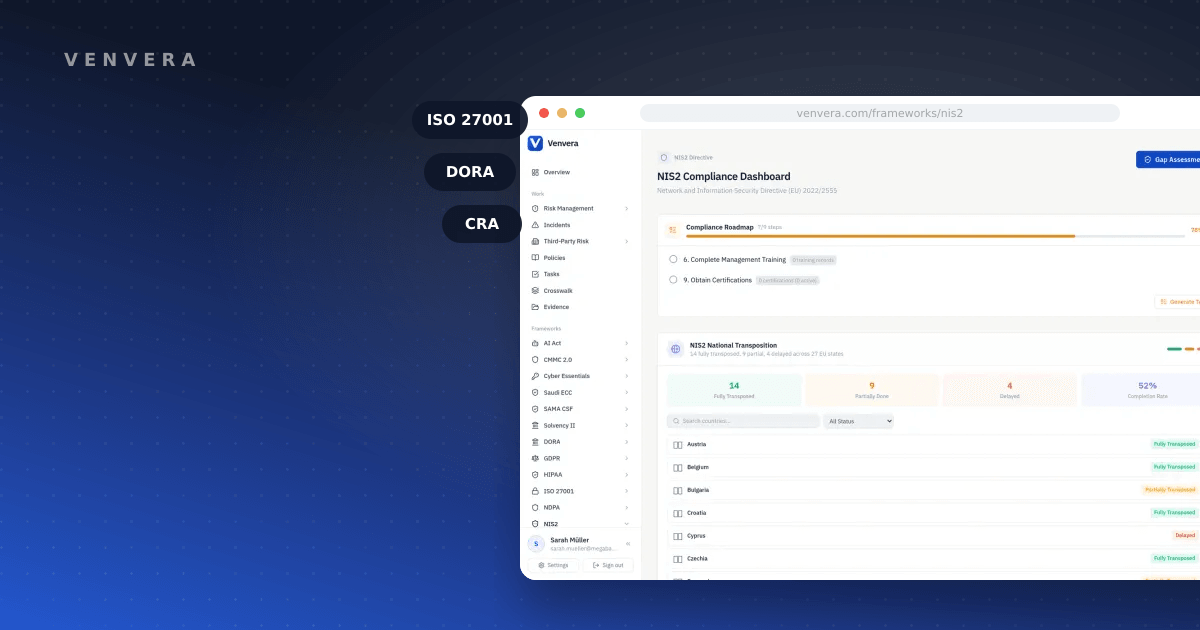
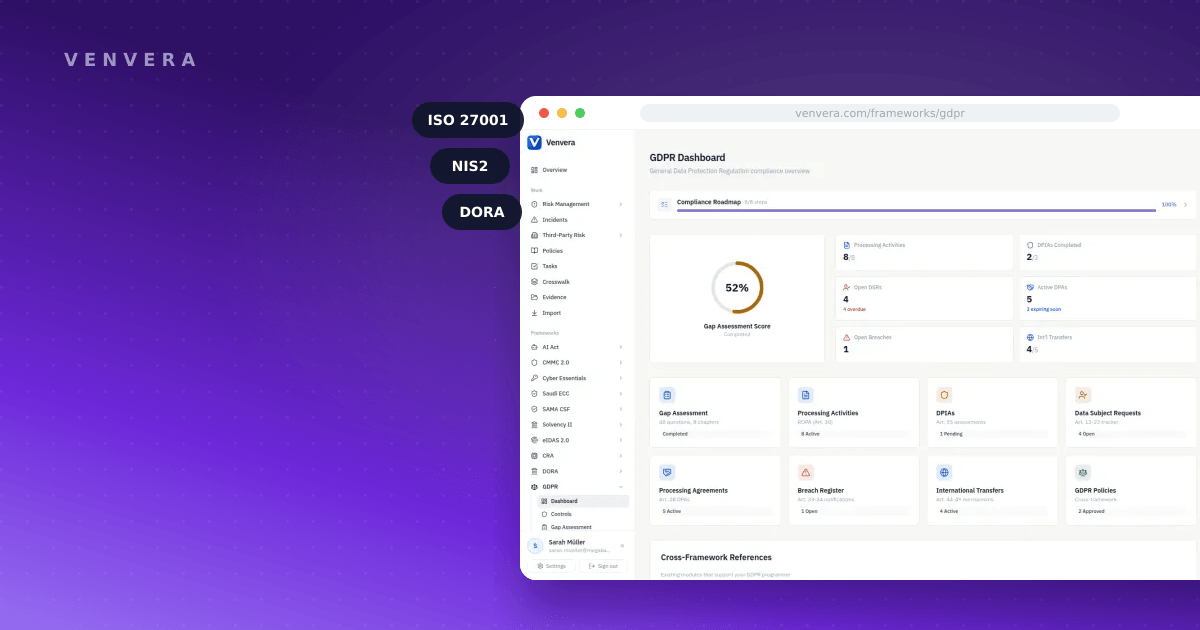
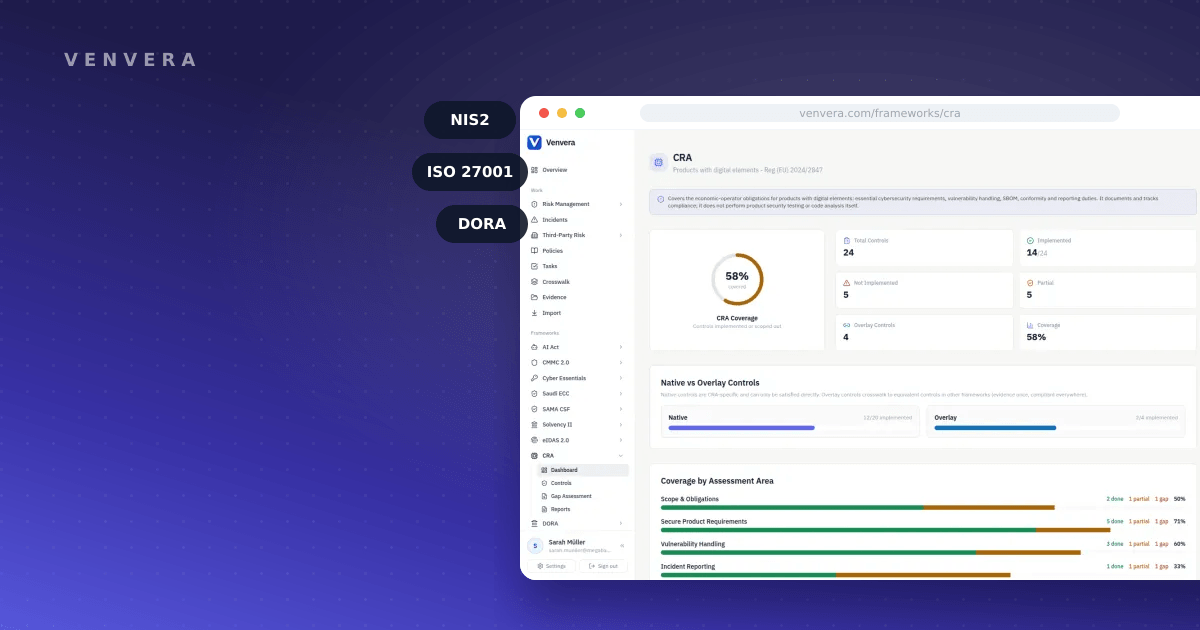
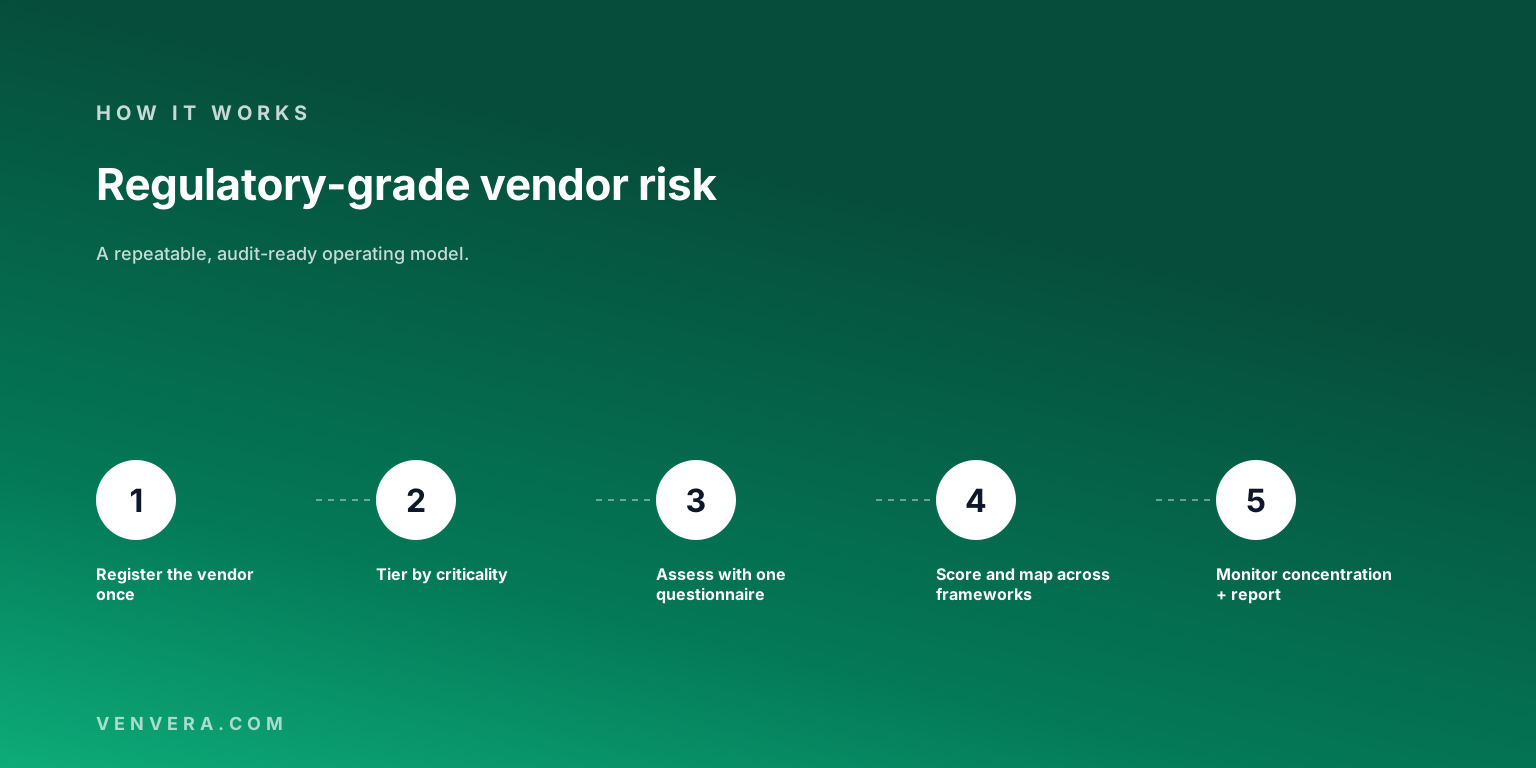
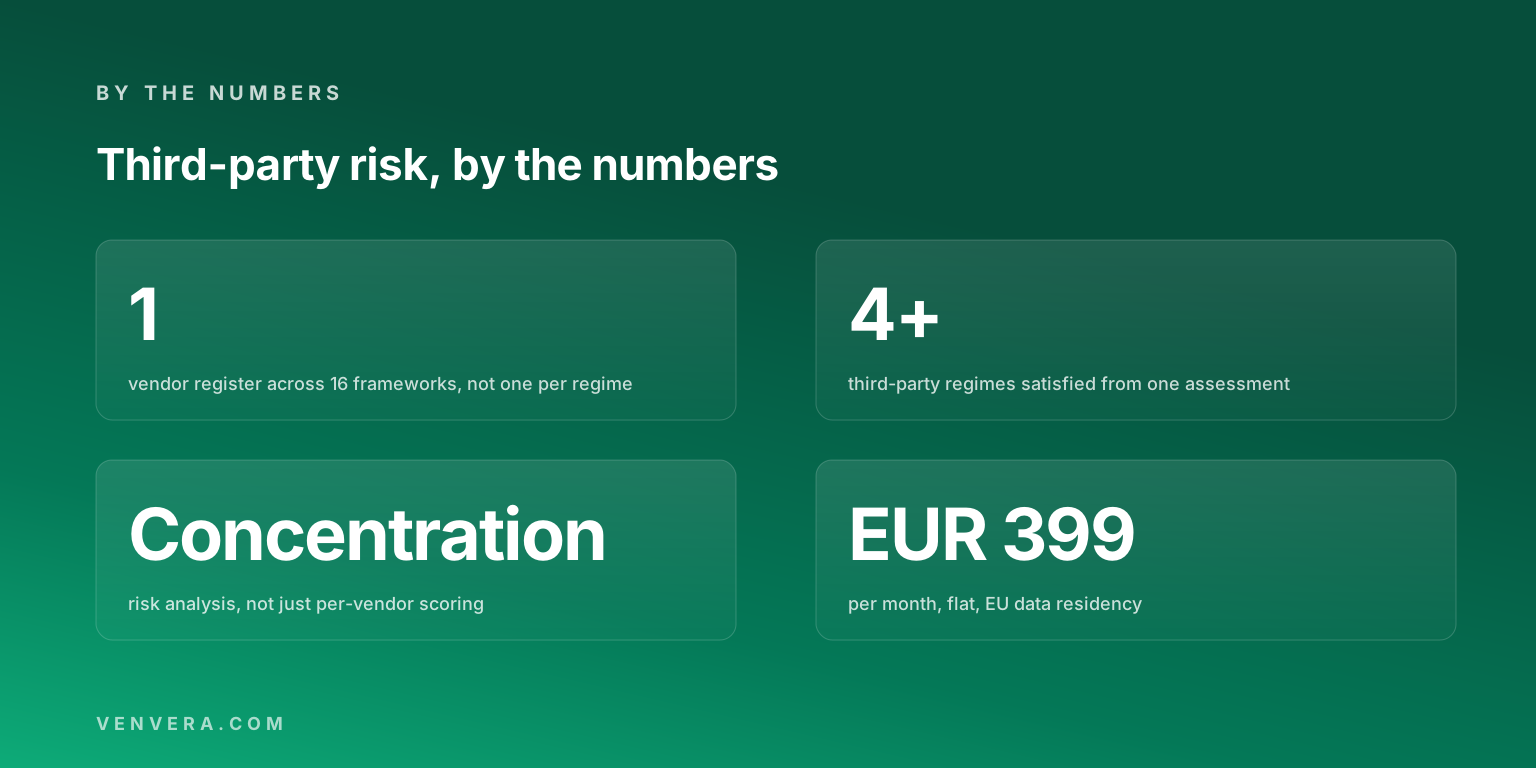
Venvera's third-party risk module is built around one vendor register that serves every framework the organisation carries, not a DORA-only feature. You register a vendor once, tier it by criticality, assess it with one questionnaire, and the automated scoring maps that single assessment across the frameworks in scope, NIS2 supply chain, ISO 27001 supplier controls, DORA outsourcing and GDPR processors, through the same crosswalk that runs the rest of the platform. On top of that sit concentration-risk analysis, board-level vendor reporting, and, when a financial entity needs it, the DORA Register of Information xBRL-CSV export from the same records. It is EU-hosted, with published flat pricing from EUR 399/month.
Honest limits: Venvera does not offer Vanta's AI TPRM Agent for continuous breach monitoring, its auto-discovery of vendors from your stack, or the same integration breadth. If your main pain is "watch hundreds of vendors for posture changes automatically," Vanta leads. If your main pain is "prove multi-framework vendor governance and concentration risk from one register," Venvera leads. They are genuinely different centres of gravity.
Vanta vs Venvera for third-party risk, line by line
| Third-party risk need | Vanta | Venvera |
|---|---|---|
| Vendor discovery + auto-inventory | Strong - auto-discovery, procurement integrations | Manual/imported register |
| Continuous breach monitoring | Strong - AI TPRM Agent, 24/7 | Not an equivalent agent |
| One assessment across NIS2 / ISO / DORA / GDPR | Security-scored, re-documented per framework | One record mapped across frameworks |
| Criticality tiering (regulatory) | Inherent-risk tiers | Regulatory criticality + risk tiers |
| Concentration-risk analysis | Per-vendor focus | Portfolio concentration view |
| DORA Register of Information | Not a stated output | xBRL-CSV export from the same records |
| Hosting / pricing | US company; pricing not public | EU data residency; from EUR 399/mo published |
Vanta rows are from vanta.com (verified 20 July 2026); "not a stated output" means it is absent from the public vendor-risk page, not proven impossible. Re-verify the row that matters to you.
How to run vendor risk once for every framework
Whatever tool you choose, this is the operating model that stops you re-assessing the same vendor per regime.
- Build one register, not one per framework. Every third-party goes in a single inventory with owner, service, data touched and hosting. This record is the spine every regime reads from.
- Tier by criticality up front. Decide which vendors are critical or important to operations and which touch personal data. Tiering drives depth of assessment and which frameworks apply.
- Assess once, map many. Use one questionnaire that captures what NIS2, ISO 27001, DORA and GDPR each need, then map the answers to each framework's control rather than re-interviewing the vendor.
- Watch concentration, not just vendors. Track where too much critical dependence sits with one provider or one region. This is a portfolio view that per-vendor scoring misses.
- Make the register an output, not a project. When a supervisor asks for the DORA Register of Information or a NIS2 supplier list, it should generate from the same data, not trigger a fresh data-gathering exercise.
- Report to the board from the same source. Vendor risk, concentration and remediation should roll up into the same board pack as the rest of your risk.
Which tool fits which buyer
Choose Vanta if
Your priority is continuous, automated vendor security monitoring at scale, you have a large integrated estate Vanta can auto-discover from, and fast questionnaire turnaround with AI drafting is the main win you are buying.
Choose Venvera if
Your priority is regulatory vendor governance across several frameworks at once, you need criticality tiering, concentration risk and multi-framework mapping from one register, you may need the DORA Register of Information, and EU data residency plus published pricing matter.
See the broader Vanta alternative for EU compliance overview, the framework-specific DORA and NIS2 comparisons, or the practical guide to building a compliant vendor register from scratch.
Frequently Asked Questions
Does Vanta do vendor risk management?
Yes, and it does it well for security monitoring. Vanta's Vendor Risk Management auto-discovers vendors, applies AI inherent-risk scoring, collects evidence from vendor Trust Centers, and runs a TPRM Agent that monitors 24/7 for breaches and drafts remediation. Its strength is continuous vendor security monitoring rather than multi-framework regulatory vendor governance.
What is the best Vanta alternative for third-party risk?
If you need vendor risk governed across NIS2, ISO 27001, DORA and GDPR from one register, with criticality tiering and concentration-risk analysis, an EU-native governance platform such as Venvera is a closer fit than a monitoring-first tool. If continuous automated breach monitoring is the main job, Vanta itself may be the right answer. Match the tool to which of the two jobs is yours.
How do I do vendor risk for NIS2, ISO 27001 and DORA at the same time?
Build a single vendor register, assess each vendor once with a questionnaire that covers what all three need, and map the answers to each framework's third-party control rather than running separate assessments. The overlap between NIS2 supply chain, ISO 27001 supplier controls and DORA outsourcing is large, so one assessment can satisfy all three if the tool maps it.
What is concentration risk and why does it matter?
Concentration risk is the exposure created when too much of your critical dependence sits with a single provider, product or region. DORA Article 29 expects financial entities to analyse it explicitly. Per-vendor security scoring does not surface it; you need a portfolio view across your whole third-party base.
Is Venvera's third-party risk only for DORA?
No. The vendor register and assessments serve every framework the organisation carries, including NIS2 supply chain, ISO 27001 supplier controls and GDPR processors, not only DORA. The DORA Register of Information is one export you can produce from the same records when a financial entity needs it, not the purpose of the module.
Primary sources
- NIS2 Directive (EU) 2022/2555, Article 21(2)(d) - supply-chain security. EUR-Lex.
- DORA Regulation (EU) 2022/2554, Articles 28-29 - ICT third-party arrangements and concentration risk. EUR-Lex.
- GDPR Regulation (EU) 2016/679, Article 28 - processors and data-processing agreements. EUR-Lex.
- Vanta - Vendor Risk Management - capabilities quoted above, verified 20 July 2026. vanta.com.
Method note. Vanta capabilities are drawn from vanta.com and classified vendor-stated unless independently confirmed; Venvera capabilities are verified against the product. Both platforms change quickly; re-verify the specific capability that matters before deciding.
Govern every vendor once, for every framework.
Venvera's third-party risk module keeps one vendor register that maps a single assessment across NIS2, ISO 27001, DORA and GDPR, with criticality tiering, concentration-risk analysis, board reporting, and the DORA Register of Information xBRL-CSV export when you need it. Flat pricing from EUR 399/month, EU data residency. Start with a free compliance check, including your vendor exposure.
By Alexander Sverdlov, CEO and Founder, Venvera. Published 20 July 2026 - Last reviewed 20 July 2026.