Best
Most "Vanta alternative" comparisons are easy because the competitor is weak on the framework. GDPR is not one of those. Vanta has a real, capable GDPR compliance software offering, so this guide has to be honest: for a lot of the work, the two platforms are close. The decision comes down to a smaller number of things that matter specifically because GDPR is an EU data-protection law, where your compliance data lives, how you run the breach clock and data-subject requests, and how much you value published EU pricing over automation breadth. This is for the person who has to defend the programme to a supervisory authority, not just pass an audit.
Claims are classified verified (in the vendor's documentation or a product we operate), vendor-stated, or flagged. Vanta's GDPR capabilities are quoted from vanta.com as of 20 July 2026; re-check before relying on any line.
Short answer
- Vanta is a strong fit if you want automation-first GDPR: a data inventory populated from 400-plus integrations, RoPA and DPIA workflows, continuous monitoring and AI drafting, especially alongside an existing SOC 2 or ISO 27001 programme on Vanta.
- Venvera is the better fit if EU data residency for your own GDPR records matters, you want the Article 33 breach clock and data-subject requests as native workflows, and you value published EU pricing and a crosswalk that reuses evidence across ISO 27001, NIS2 and DORA.
- This one is genuinely close. Decide on residency, the breach and DSAR workflows, and pricing transparency, not on who has "GDPR" on the box, because both do.
What GDPR compliance software actually has to do
GDPR is broad, but the software footprint is well defined. A serious GDPR tool has to operate seven things, and you should test any vendor against all seven rather than the marketing headline.
- A personal-data inventory, so you know what personal data you hold, where, and who owns it.
- Records of Processing Activities (Article 30), the RoPA, with purpose, categories, legal basis, recipients and retention.
- Data Protection Impact Assessments (Article 35), the DPIA, for high-risk processing, linked to the risks and controls that mitigate them.
- Lawful basis and consent tracking for each processing activity.
- Data-subject request (DSAR) handling for access, erasure, portability and the other Chapter III rights, within the statutory deadlines.
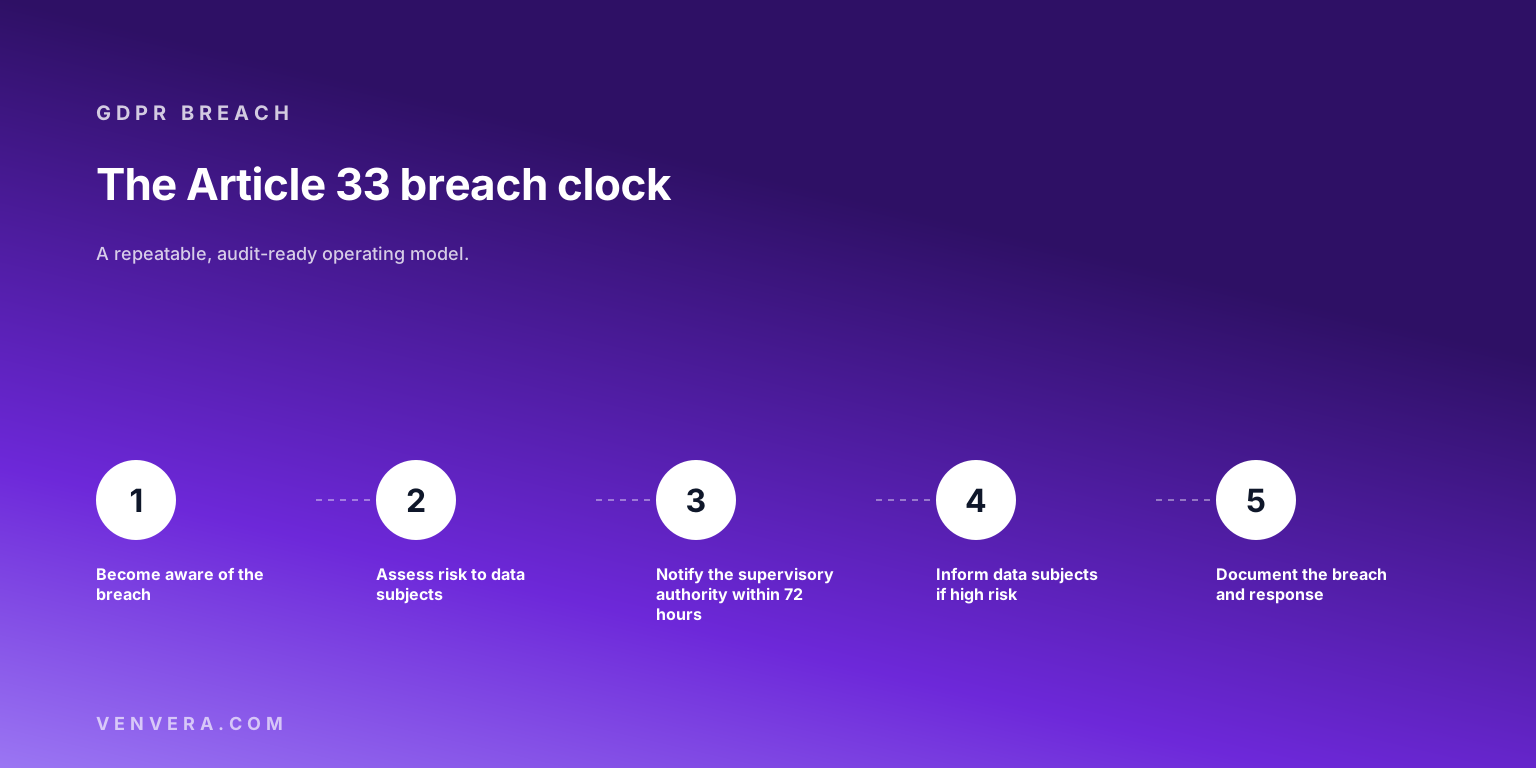
- Breach notification (Articles 33 and 34), the 72-hour clock to the supervisory authority and, for high-risk breaches, to the data subjects.
- Processor management (Article 28), due diligence and data-processing agreements for every vendor that touches personal data.
What Vanta does for GDPR, honestly
Vanta covers most of that list well. From its own documentation (verified on vanta.com, 20 July 2026), it provides a Data Inventory that centralises personal-data records, locations and ownership; RoPA management for the Article 30 records; DPIAs with automated risk prediction; processor and vendor management; pre-built GDPR controls with guided workflows; automated evidence collection across 400-plus integrations; continuous monitoring; and AI features for policy drafting and control mapping. It cites large time savings and roughly 30 to 40 hours to a first programme if starting fresh, faster with existing SOC 2 or ISO 27001 assets.
That is a genuinely capable GDPR product, and the automation, especially populating the data inventory from integrations, is a real strength Venvera does not try to match on breadth. Where the comparison gets interesting is the parts that are less about automation and more about being an EU-native tool for an EU law.
The question an EU data-protection law makes you ask
GDPR is a law about where and how personal data is processed. So the sharpest question to ask a GDPR vendor is one that does not come up with SOC 2: where does the tool itself host your data? Your RoPA, your DPIAs, your personal-data inventory and your breach records are themselves sensitive. A GDPR tool operated by a US company, on US infrastructure, means your data-protection programme runs on a transfer you then have to justify. It is not disqualifying, but for many EU controllers it is the difference between a clean story and an awkward one in front of a supervisory authority.
Two more things are less about automation and more about running the regulation day to day. The Article 33 breach clock is a 72-hour obligation with a risk assessment and, for high-risk breaches, data-subject notification, best run as a live workflow rather than a document. And data-subject requests are a recurring operational duty with statutory deadlines, not a one-time control. These are where an EU-native tool tends to be sharper than a US automation platform with GDPR mapped on.
Data residency also connects to a duty you may already be managing: international transfers under Chapter V. When personal data moves outside the EEA, you need a lawful transfer mechanism, standard contractual clauses, an adequacy decision, or a derogation, plus a transfer impact assessment where required. A tool that keeps your records in the EU means one fewer transfer to paper over, and the transfers you do run should be logged against the processing activities in your RoPA so the story is consistent. This is exactly the kind of operational, EU-specific detail that separates a data-protection platform from a general audit tool with a GDPR label.
How Venvera approaches GDPR
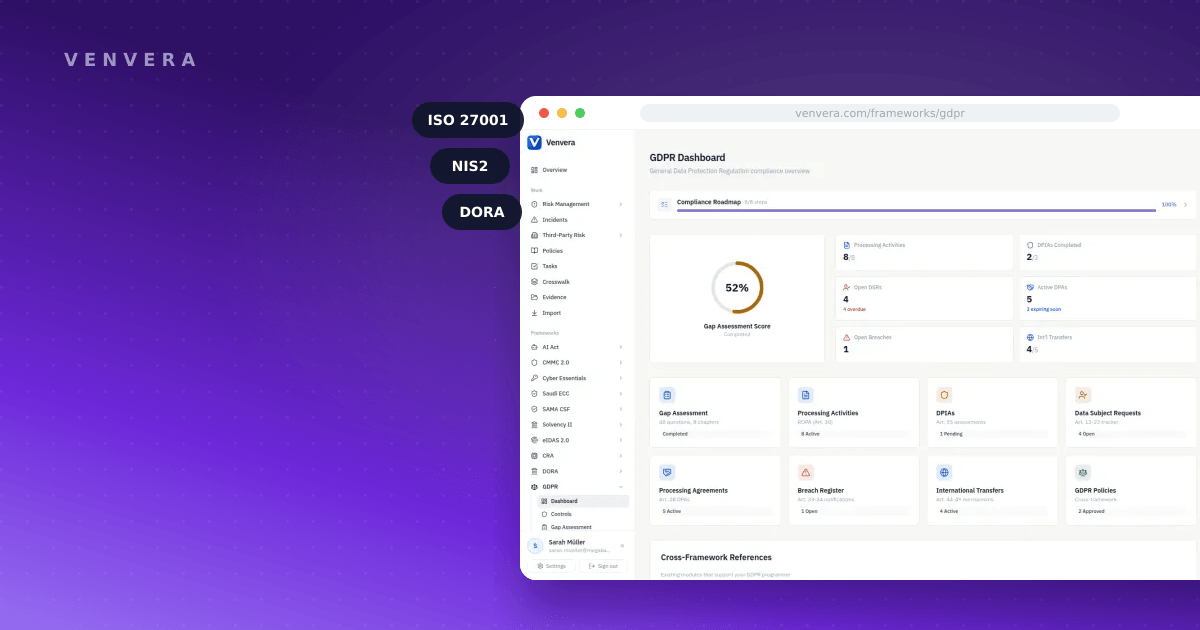
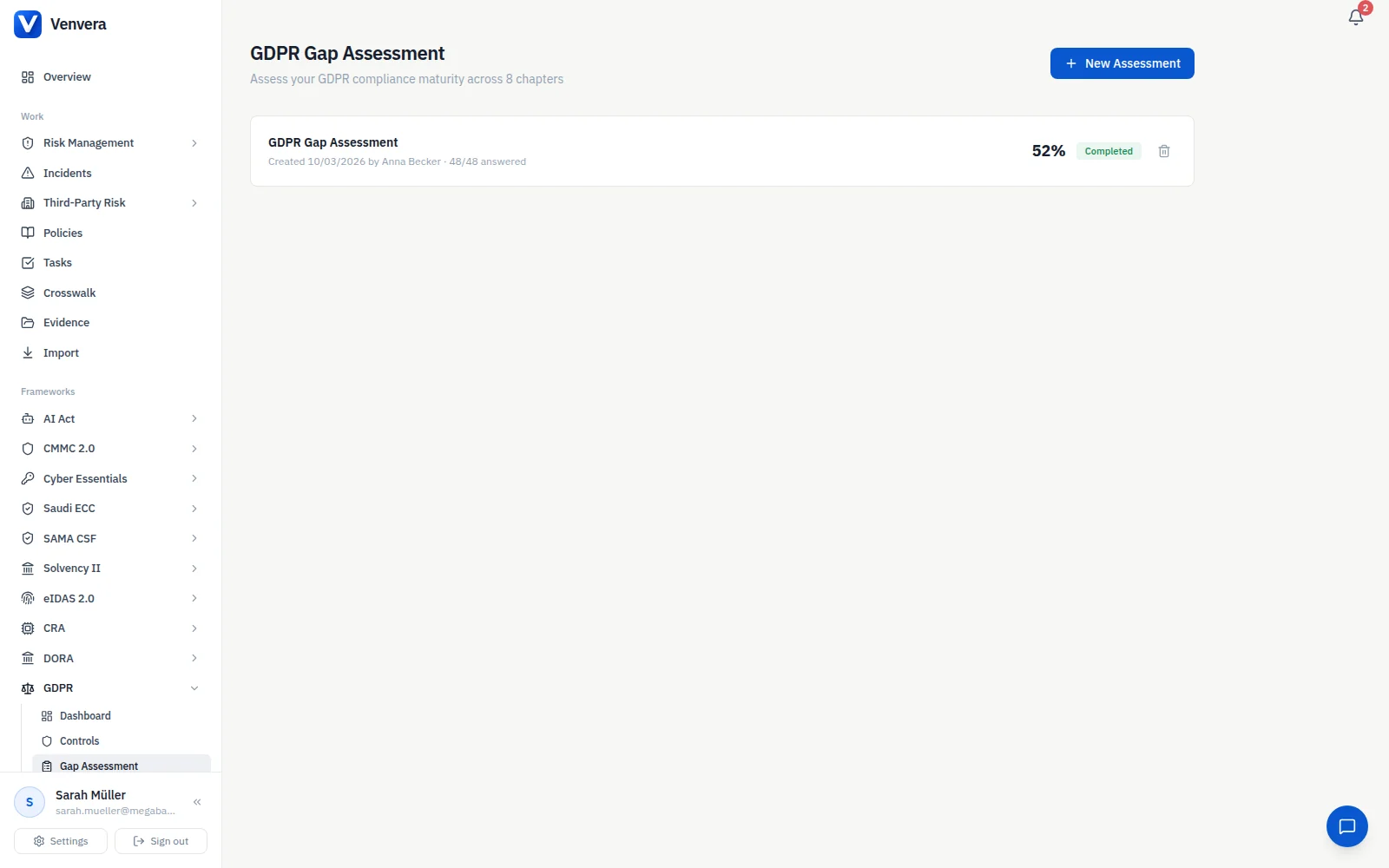
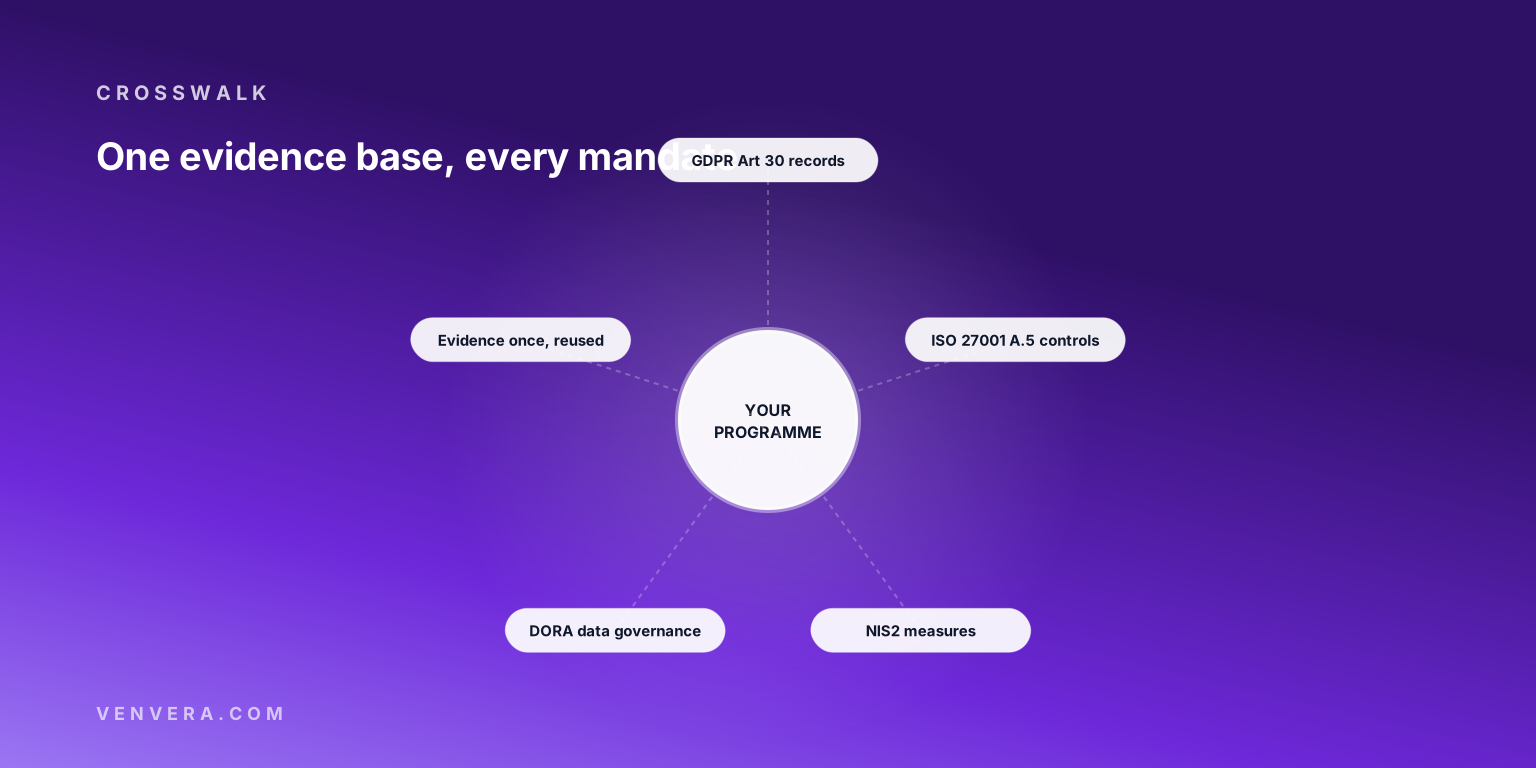
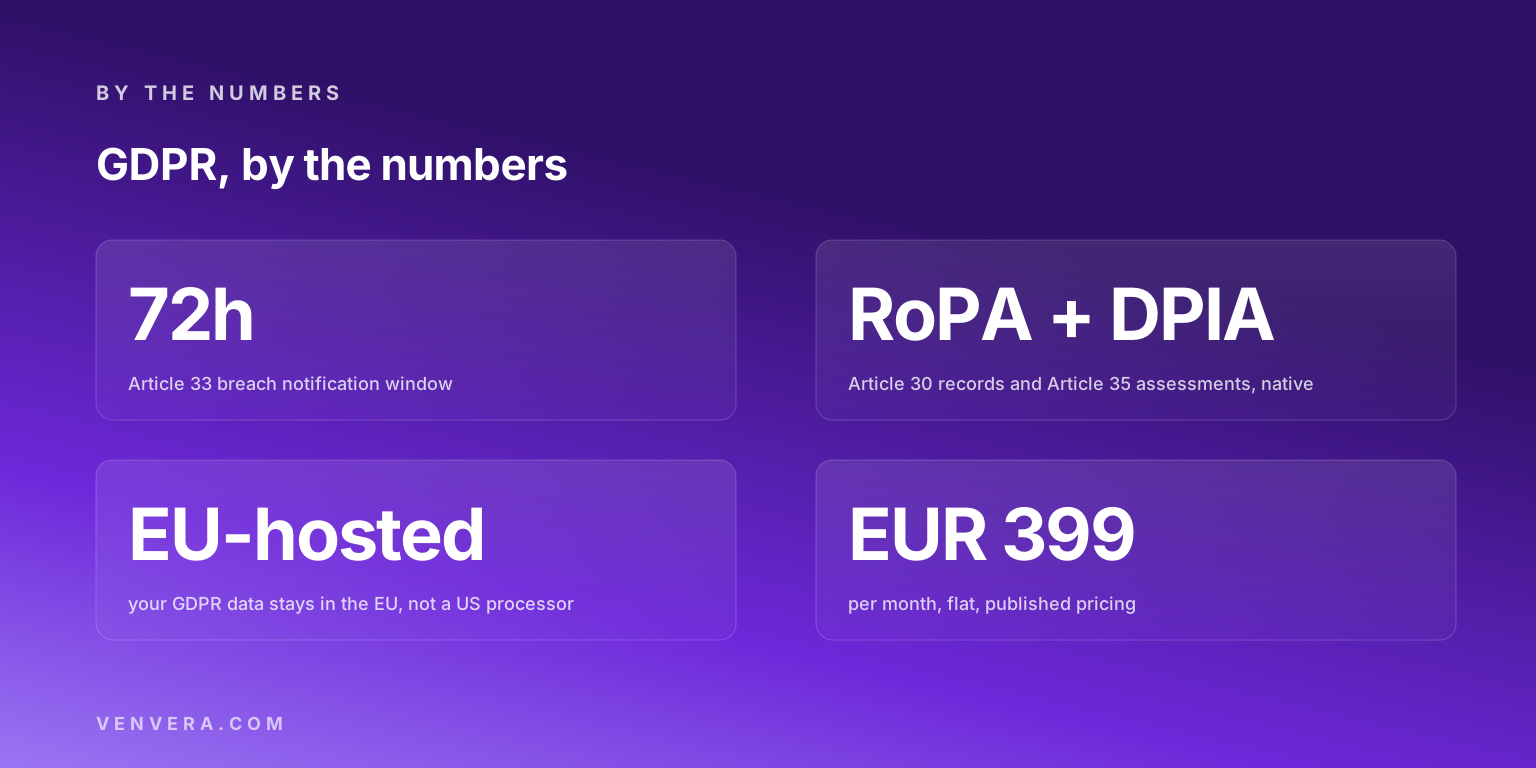
Venvera's GDPR module is EU-native and covers the operational spine directly: processing-activity records for the Article 30 RoPA, DPIAs for high-risk processing, data-subject request handling for the Chapter III rights, breach management on the Article 33 72-hour clock with data-subject notification when required, and processor management for Article 28. It is EU-hosted, so your data-protection records stay in the EU, and it sits inside the same crosswalk as the rest of the platform, so the controls GDPR shares with ISO 27001, NIS2 and DORA reuse the same evidence. Pricing is flat and published from EUR 399/month.
Honest limits: Venvera does not populate the personal-data inventory automatically from a 400-plus integration library the way Vanta can, it has fewer integrations overall, and it does not offer the same breadth of AI automation. If your priority is automated data discovery across a large SaaS estate, Vanta leads. If your priority is running GDPR as an EU-hosted, workflow-driven programme you can defend, Venvera leads.
Vanta vs Venvera for GDPR, line by line
| GDPR need | Vanta | Venvera |
|---|---|---|
| Personal-data inventory | Strong - auto-populated from integrations | Maintained inventory |
| RoPA (Art 30) + DPIA (Art 35) | Yes, with AI risk prediction | Yes, native |
| DSAR handling (Chapter III) | Not detailed on the page | Native data-subject request workflow |
| Breach clock (Art 33, 72h) | Not detailed on the page | 72-hour workflow + data-subject notice |
| Automation / integrations | Strong - 400+ integrations, AI | Narrower catalogue |
| Data residency | US company | EU-hosted |
| Pricing | Not public | From EUR 399/mo published |
Vanta rows from vanta.com (verified 20 July 2026); "not detailed on the page" means the capability is absent from Vanta's public GDPR page, not proven absent from the product. Re-verify the row that matters.
How to actually run GDPR (a programme you can defend)
Whichever tool you choose, the operating model is the same. This order gets you defensible fastest.
- Map the data first. Build the personal-data inventory before anything else; every other obligation reads from it. Automate the discovery if your tool can, but own the result.
- Build the RoPA from the inventory. Turn the inventory into Article 30 records with purpose, legal basis, recipients and retention. This is the document a supervisor asks for first.
- DPIA the high-risk processing. Run Article 35 assessments where processing is high risk, and link each to the controls that mitigate it, so the DPIA is live, not a filed PDF.
- Stand up the breach and DSAR workflows before you need them. Pre-build the 72-hour breach process and the data-subject request handling with their deadlines. Both are worst designed under pressure.
- Govern your processors. Keep the Article 28 due diligence and data-processing agreements current for every vendor touching personal data, ideally from the same vendor register you use for the rest of your third-party risk.
- Reuse the overlap. Many GDPR security controls are shared with ISO 27001 and NIS2. A crosswalk lets one piece of evidence satisfy all three instead of three separate collections.
Which tool fits which buyer
Choose Vanta if
You want automation-first GDPR, especially an auto-populated data inventory and AI drafting, you already run SOC 2 or ISO 27001 on Vanta, and you are comfortable with a US-operated platform and quote-based pricing.
Choose Venvera if
You want your GDPR records EU-hosted, the Article 33 breach clock and DSAR handling as native workflows, evidence reused across ISO 27001, NIS2 and DORA, and flat published pricing, and you weigh a defensible EU-native story above raw automation breadth.
Compare more broadly in our Vanta alternative for EU compliance overview, the NIS2 and third-party risk comparisons, or the wider GDPR compliance software round-up.
Frequently Asked Questions
Does Vanta do GDPR?
Yes, and well. Vanta offers a personal-data inventory, RoPA management, DPIAs with AI risk prediction, processor management and pre-built GDPR controls, with automation across 400-plus integrations. It is a capable GDPR platform, strongest on automated data discovery and evidence collection.
What is the best Vanta alternative for GDPR?
For GDPR specifically, the deciding factors tend to be EU data residency for your own records, the Article 33 breach workflow, DSAR handling and pricing transparency rather than raw feature count. An EU-native platform such as Venvera fits when those matter; if automated data discovery across a large estate is the priority, Vanta itself may be the answer.
Does it matter where my GDPR tool hosts data?
It can. Your RoPA, DPIAs and breach records are themselves sensitive, and a GDPR tool operated on US infrastructure means your data-protection programme runs on an international transfer you have to justify. For many EU controllers, EU hosting removes a question a supervisor might otherwise ask.
What is the GDPR breach notification deadline?
Under Article 33, a controller must notify the competent supervisory authority of a personal-data breach without undue delay and, where feasible, within 72 hours of becoming aware, unless the breach is unlikely to risk individuals' rights. Under Article 34, high-risk breaches must also be communicated to the affected data subjects.
We already have ISO 27001. How much of GDPR is done?
The security measures overlap substantially, but GDPR adds the privacy-specific obligations ISO does not cover: the RoPA, DPIAs, DSAR handling, lawful basis and breach notification to individuals. A crosswalk lets you reuse the shared security controls and focus effort on the privacy-specific parts.
Primary sources
- Regulation (EU) 2016/679 (GDPR) - the governing text, including Article 30 (records), Article 33 and 34 (breach notification), Article 35 (DPIA) and Article 28 (processors). EUR-Lex.
- European Data Protection Board (EDPB) - guidelines on DPIAs, breach notification and records. edpb.europa.eu.
- Vanta - GDPR product page - capabilities quoted above, verified 20 July 2026. vanta.com.
Method note. Vanta capabilities are drawn from vanta.com and classified vendor-stated unless independently confirmed; Venvera capabilities are verified against the product. Both platforms change quickly; re-verify the capability that matters before deciding.
Run GDPR EU-hosted, as a workflow, not a mapping.
Venvera handles GDPR natively: RoPA, DPIAs, data-subject requests, the Article 33 72-hour breach clock and processor management, all EU-hosted, with a crosswalk that reuses your ISO 27001, NIS2 and DORA evidence. Flat pricing from EUR 399/month. See the GDPR module.
By Alexander Sverdlov, CEO and Founder, Venvera. Published 20 July 2026 - Last reviewed 20 July 2026.