
Best
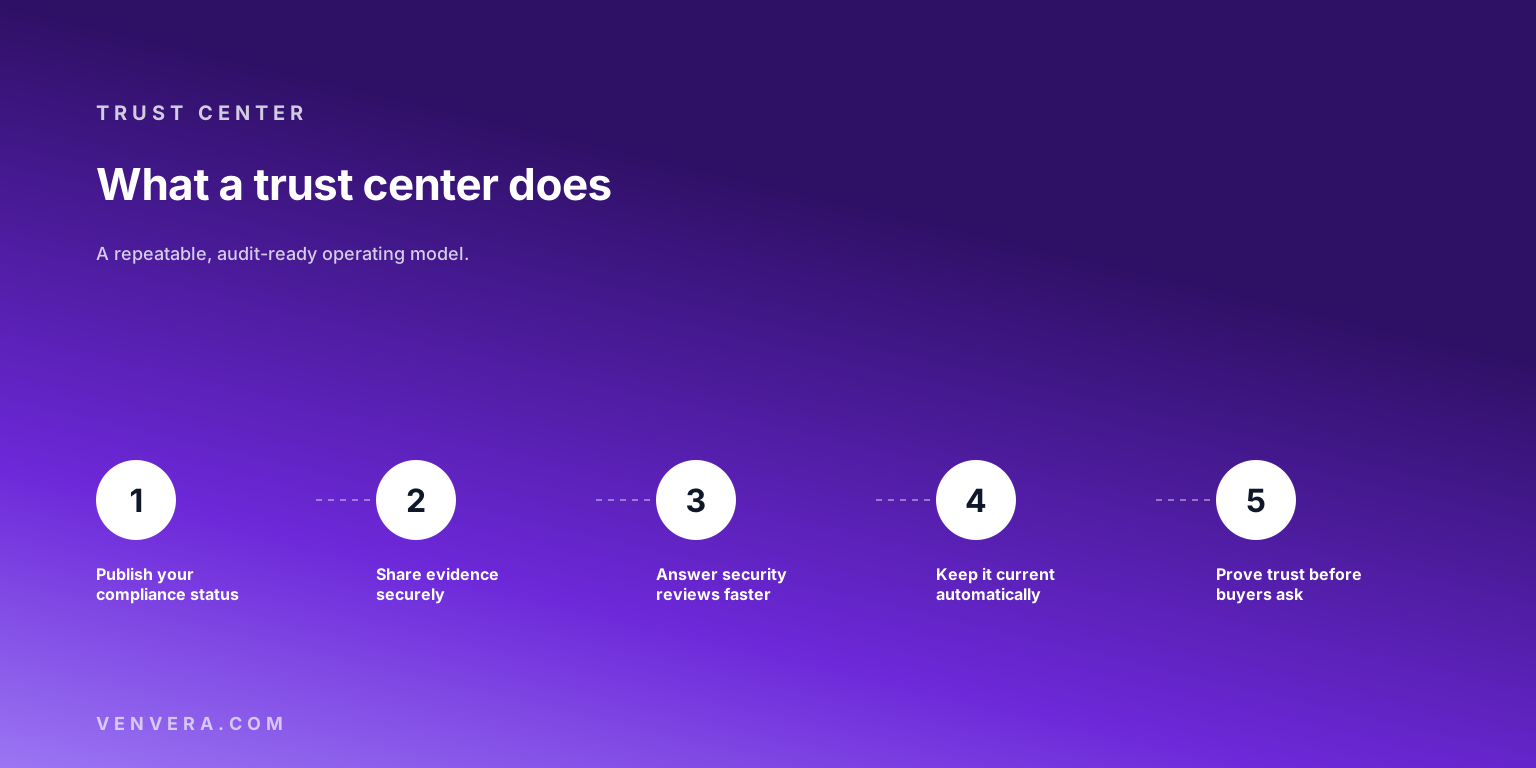
If you are weighing Venvera against Vanta to power a trust center, this is a straight comparison written for the person who has to make the call, not a sales page. A trust center is the customer-facing page that publishes your security and compliance posture so prospects can self-serve proof instead of waiting on your team to email a PDF. The right choice depends on where you operate, how sales-heavy your motion is, and whether you want that page tied to a platform you already run. I will name where Vanta is the stronger product up front, because on trust centers it genuinely is in places. Then I will show where Venvera fits better, which is a narrower but real set of buyers: EU companies that want the page, and the data behind it, hosted in the EU at published flat pricing. No invented facts, no invented prices, just the honest tradeoff.
The quick answer
- Pick Venvera if you are an EU company that wants the trust page and its underlying data hosted in the EU, tied to a single compliance platform you already run, at published flat pricing from EUR 399/month.
- Pick or stay with Vanta if you run a larger, sales-heavy organization that will lean hard on mature security-questionnaire automation, including AI-assisted answering, and want the deepest trust center feature set available.
- The one honest tradeoff: a trust center accelerates security reviews, but it does not replace your underlying certifications. It publishes them. Whatever tool you pick, you still have to earn the SOC 2 or ISO 27001 first.
Keep comparing
Where Vanta is stronger
Let me be plain about this, because it matters for your decision. Vanta has a mature Trust Center product, and on the parts that touch enterprise sales it is more feature-rich than what most alternatives ship, Venvera included. Gated document sharing is well handled: a prospect can request your SOC 2 report, accept an NDA, and get access without a human in the loop. More importantly, Vanta's security-questionnaire automation is genuinely strong, with AI-assisted answering that drafts responses to inbound questionnaires from your existing evidence. For a company fielding dozens of questionnaires a quarter, that capability alone can pay for the platform in saved sales-engineering hours.
Vanta's trust center is also tightly integrated with its own continuous monitoring, so the posture shown on your public page stays current as controls pass or fail behind the scenes. That tight loop, plus the depth of the questionnaire tooling, is why a larger, sales-heavy org will often be right to value Vanta here. If that description is you, take it seriously. Note that Vanta does not publish pricing, so you will need to request a quote to compare the real numbers.
Where Venvera fits better
Venvera's trust center is not trying to out-feature Vanta on questionnaire automation. It is built for a specific buyer: the EU company that wants the trust page, and the data behind it, hosted in the EU rather than the United States. Data residency is not a nice-to-have for a lot of European teams; it is a procurement requirement, and it is easier to satisfy when the trust center lives on the same EU-hosted platform as everything else.
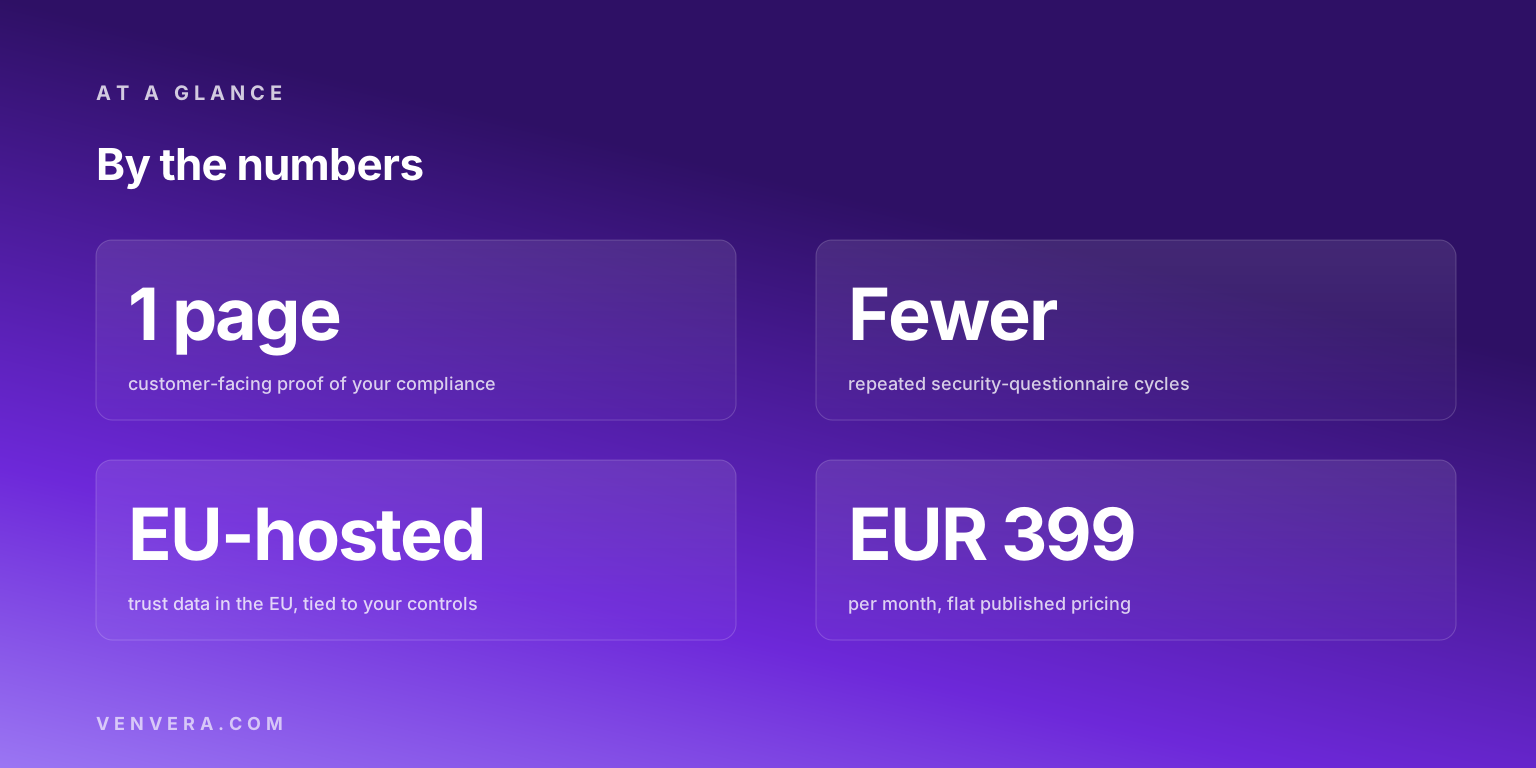
The second difference is where the page gets its numbers. Venvera's trust center is tied directly to the live compliance data in the platform, so what a customer sees reflects the actual, current control status rather than a snapshot someone remembered to update. Because it is one platform you already run for your compliance work, there is no separate tool to buy, integrate, or reconcile. And the price is on the website: from EUR 399/month, with the Professional tier at EUR 899/month. You can budget against that number today without booking a call.
That last point is worth sitting with if you are a small team. Published flat pricing means the number you plan around is the number you pay, and it does not change based on how a sales conversation goes. For a founder or a lean compliance function, being able to open a pricing page, see EUR 399/month or EUR 899/month for Professional, and make the call in an afternoon is a real operational advantage over a quote-only process. It is not the deciding factor for every buyer, but for the EU-first, budget-conscious teams Venvera is built for, it removes a step that otherwise stalls the decision.
A trust center the honest way: what actually matters
Strip away the branding and a trust center does one job: it moves proof of your security posture from a slow, manual email thread into a page prospects can read on their own. Concretely, a good trust center publishes your certifications, your security policies, and your list of subprocessors so a buyer's security reviewer can answer most of their questions without opening a ticket with your team.
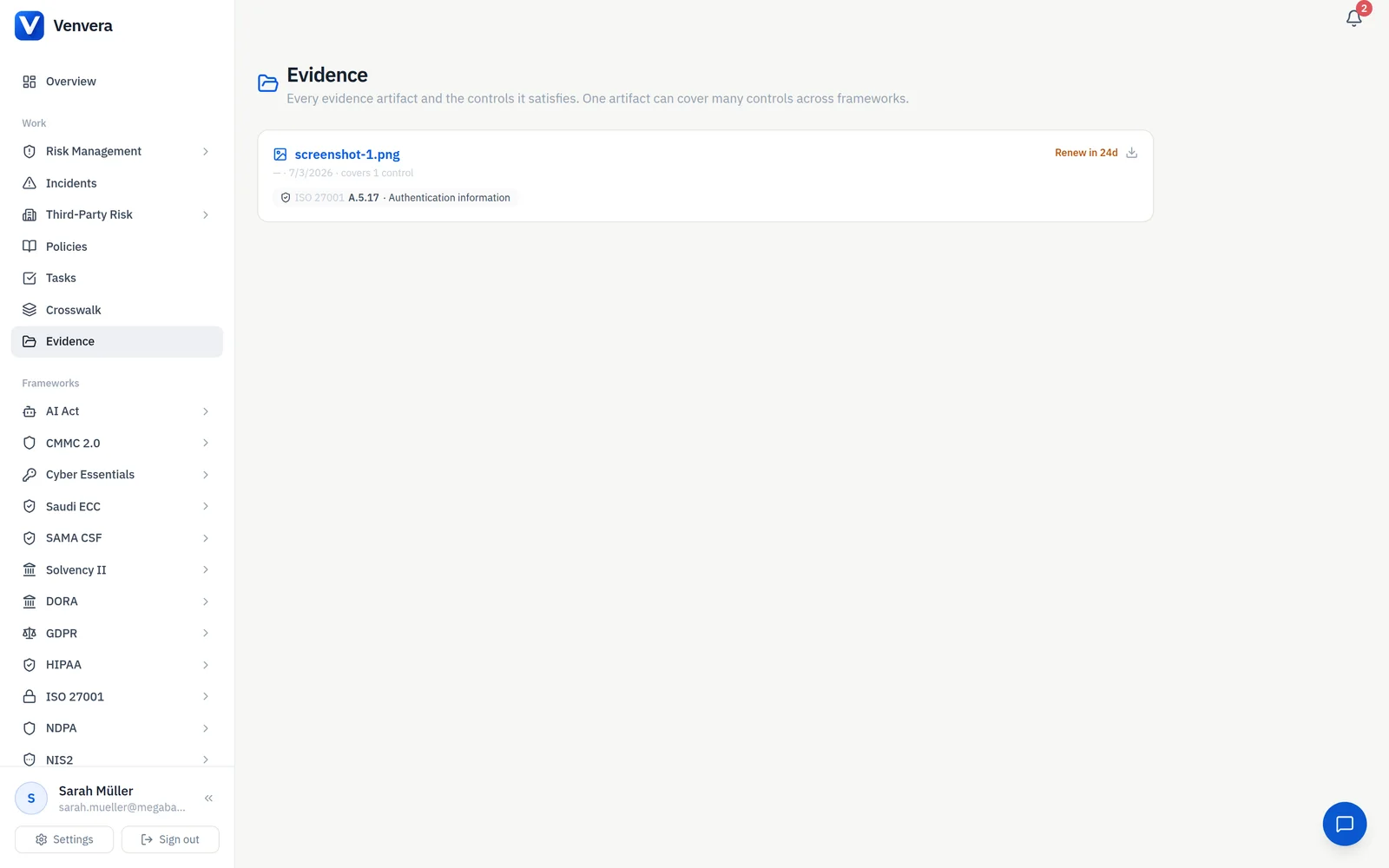
The two features that actually move deal timelines are gated document sharing and questionnaire acceleration. Gated sharing lets you publish sensitive artifacts, like a full SOC 2 Type II report, behind an NDA click so a prospect can self-serve them under terms, instead of you routing every request through legal. Questionnaire tooling reuses your published posture to answer inbound security questionnaires faster, which is often the single slowest step in an enterprise deal. Together these shorten the security review that sits between a verbal yes and a signed contract.
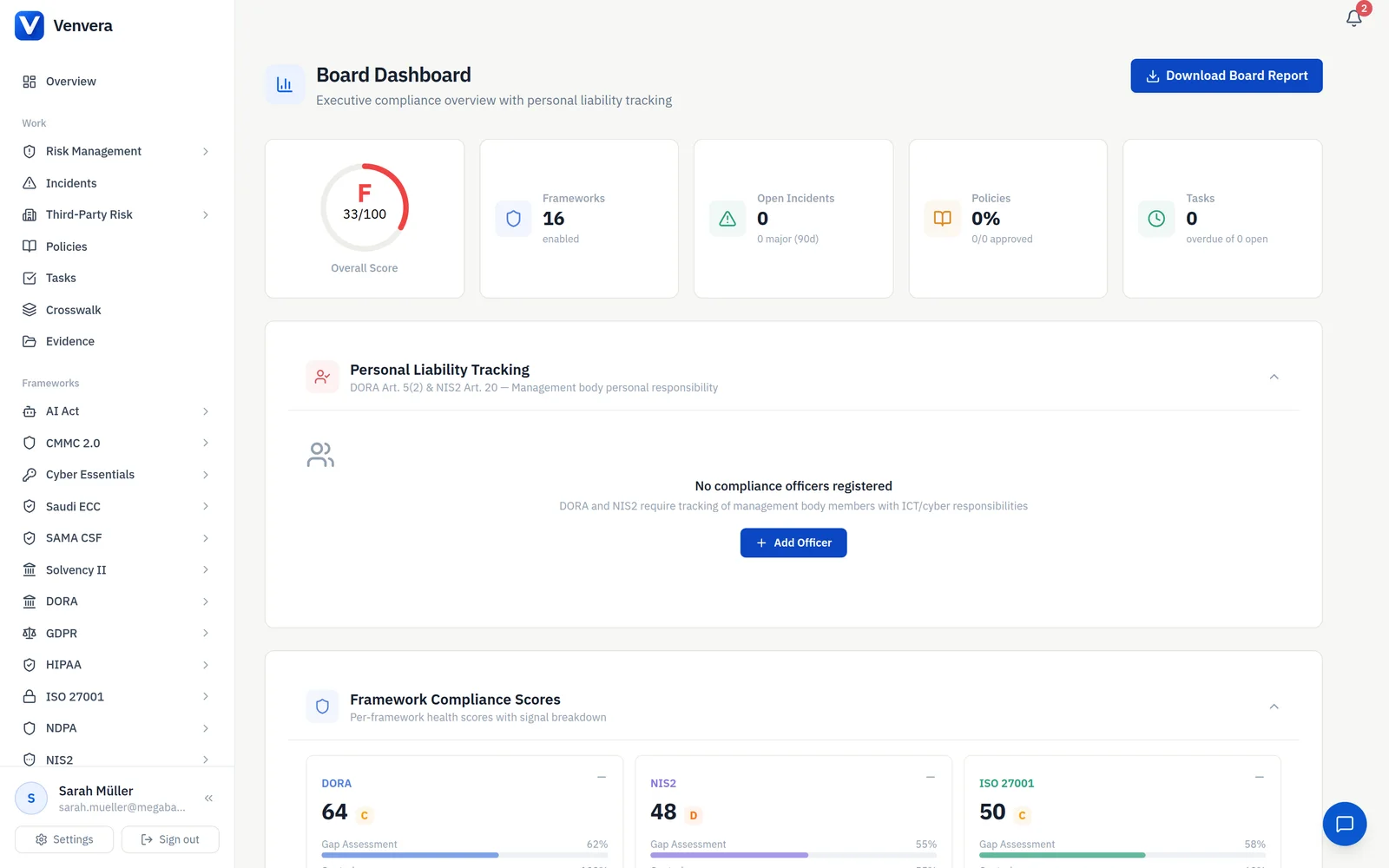
One detail that separates a useful trust center from a decorative one is how fresh the published posture is. A page that lists a certification that lapsed six months ago, or shows a control as passing when it has quietly failed, does more harm than no page at all, because a sharp security reviewer will catch it and lose trust in everything else you claim. This is why both leading options in this comparison tie their public page to something that updates automatically rather than to a document someone edits by hand. When you evaluate any trust center, ask exactly how the posture on the page stays in sync with reality, and how quickly a failed control is reflected. That single question tells you more than any feature list.
Here is the caveat no vendor page leads with: a trust center accelerates reviews, it does not replace the underlying certifications. The page is a display layer. If you do not hold the SOC 2, ISO 27001, or the specific attestation a customer needs, a polished trust center will not conjure it. Earn the certification first, then let the trust center make it easy for buyers to verify. Judge any tool, Venvera or Vanta, on how well it publishes and keeps that proof current, not on whether it can create proof you have not yet earned.
Venvera vs Vanta for a trust center: side by side
| Dimension | Venvera | Vanta |
|---|---|---|
| Hosting location | EU-hosted, trust page and underlying data in the EU | US-based provider |
| Posture data source | Tied to live compliance data in the platform; reflects actual control status | Tightly integrated with Vanta's monitoring; posture stays current |
| Gated document sharing | Yes, share documents under NDA | Yes, mature gated sharing |
| Questionnaire automation | Available as part of the platform | More mature and feature-rich, including AI-assisted answering |
| Single-platform fit | Same platform you already run for compliance; no separate tool | Part of the broader Vanta suite |
| Pricing | Published flat pricing from EUR 399/month, EUR 899/month Professional | Not public, quote-only |
How to choose
Match the tool to your situation rather than to a feature checklist.
You are an EU SaaS company that already runs, or plans to run, its compliance program in one platform. Venvera is the natural fit. The trust page and its data stay in the EU, the posture you publish comes straight from your live control status, and you pay a flat rate you can see on the pricing page.
You are a larger, sales-heavy org fielding constant security questionnaires. Vanta's questionnaire automation and AI-assisted answering are more mature, and that depth will likely save your sales-engineering team more time than a leaner tool. Request a quote, since Vanta does not publish pricing, and compare it against the hours you spend today.
You care most about EU data residency and predictable budgeting. Venvera answers both directly: EU hosting and published flat pricing from EUR 399/month, no call required to learn the number.
You have not yet earned the certification your buyers ask for. Neither tool solves this. Prioritize achieving the SOC 2 or ISO 27001 first, then use whichever trust center makes that proof easiest for prospects to verify.

Frequently Asked Questions
Does a trust center replace my SOC 2 or ISO 27001?
No. A trust center publishes and displays your certifications so buyers can verify them quickly; it does not produce the certification for you. You still have to complete the audit and earn the attestation. The trust center simply makes the proof self-serve once you hold it.
Is Vanta better than Venvera for a trust center?
On some dimensions, yes. Vanta's trust center and especially its security-questionnaire automation, including AI-assisted answering, are more mature and feature-rich, which a larger sales-heavy org will value. Venvera fits better for EU companies that want EU-hosted data, a single platform they already run, and published flat pricing.
Where is Venvera's trust center hosted?
In the EU. Both the customer-facing trust page and the underlying compliance data are EU-hosted, which is often a procurement requirement for European buyers. Vanta is a US-based provider, so if EU data residency is a hard requirement for you, that difference matters.
How much does each option cost?
Venvera publishes flat pricing: from EUR 399/month, with the Professional tier at EUR 899/month, so you can budget without a sales call. Vanta does not publish pricing; it is quote-only, so you would need to request a quote to compare the actual figures.
Will the posture shown on my trust center stay accurate?
With Venvera, the trust center is tied directly to the live compliance data in the platform, so what customers see reflects your actual control status. Vanta keeps its trust center current through tight integration with its own continuous monitoring. Both are built to avoid the stale-snapshot problem, though through different plumbing.
If an EU-hosted trust center tied to a single compliance platform at published flat pricing matches how you want to work, the fastest next step is to see the platform behind the page. Explore how Venvera handles the frameworks your buyers ask about on the frameworks hub, then start a Venvera trial to publish a trust center wired to your own live control status. And if you are the larger, questionnaire-heavy org described above, Vanta may well be the better call - the honest answer is that the right choice depends on which of these buyers you are.