
Best
If you handle payment cards in the EU and you are weighing Vanta against Venvera for PCI DSS, this comparison is written to help you decide, not to crown a winner. Both tools automate evidence collection and map your controls to the 12 PCI DSS requirements. Neither one scans your network as an Approved Scanning Vendor, and neither one signs your Report on Compliance as a Qualified Security Assessor. Those are separate contracts, and any honest comparison has to start there. We will name the places where Vanta is genuinely the stronger choice, because for some buyers it is. Then we will show where Venvera fits better: EU-hosted evidence, published flat pricing, and reuse of the work you already did for ISO 27001 and GDPR. Read the tradeoff, match it to your situation, and choose the tool that removes the most friction for you.
The quick answer
- Pick Venvera if you are an EU merchant or payment service provider that wants PCI evidence hosted in the EU, you run PCI DSS alongside ISO 27001 and GDPR, and you want published flat pricing that starts from EUR 399/month.
- Pick or stay with Vanta if you are a merchant already using Vanta for SOC 2 and you want the broadest automation and the largest integration library, all inside a single tool your team already runs.
- The one honest tradeoff: Venvera does not out-automate Vanta, and Vanta does not publish pricing. Either way, neither product replaces the ASV that scans you or the QSA that assesses you.
Keep comparing
Where Vanta is stronger
We will not pretend otherwise: for automation depth and breadth of integrations, Vanta is ahead. Its integration library is broader, which means more of your evidence can be pulled automatically from the systems you already use, with less manual collection on your side. Vanta grew up around SOC 2 and ISO 27001, and that heritage shows in how mature its evidence automation feels. For a merchant that already runs Vanta for SOC 2, adding PCI DSS in the same tool is genuinely convenient: one login, one set of integrations, one vendor relationship, and one place where auditors and internal owners already know their way around. That convenience has real value, and it is the honest reason many teams should keep using Vanta rather than switch. Venvera does not out-automate Vanta, and if raw automation coverage is your single most important criterion, Vanta is the safer pick. We would rather tell you that now than have you discover it after a migration.
Where Venvera fits better
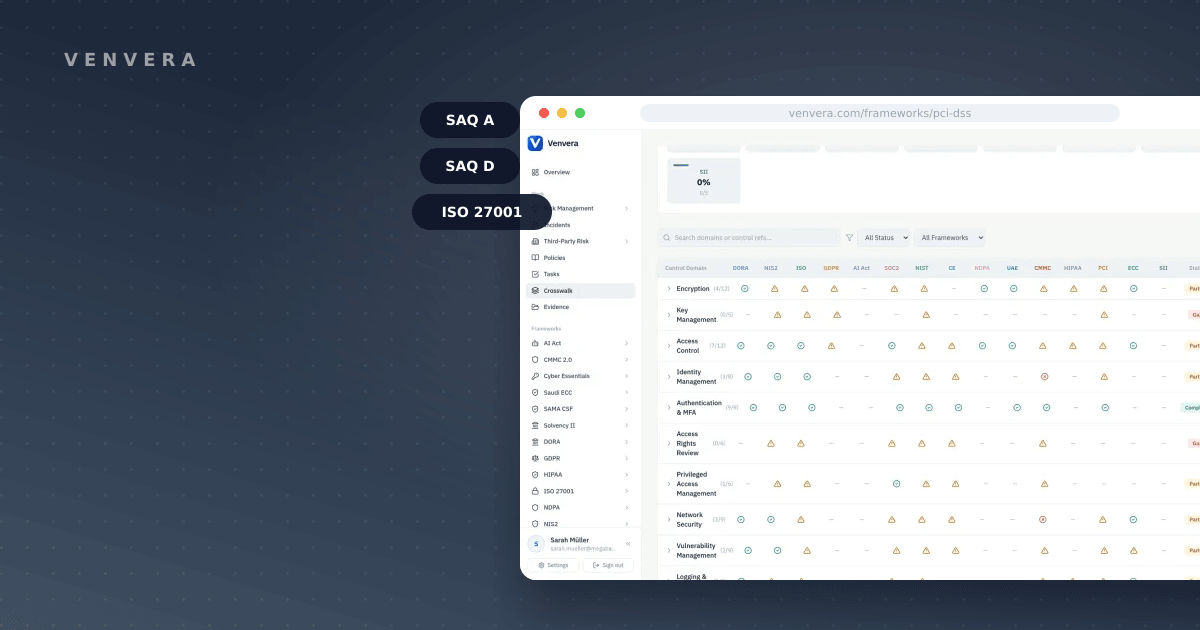
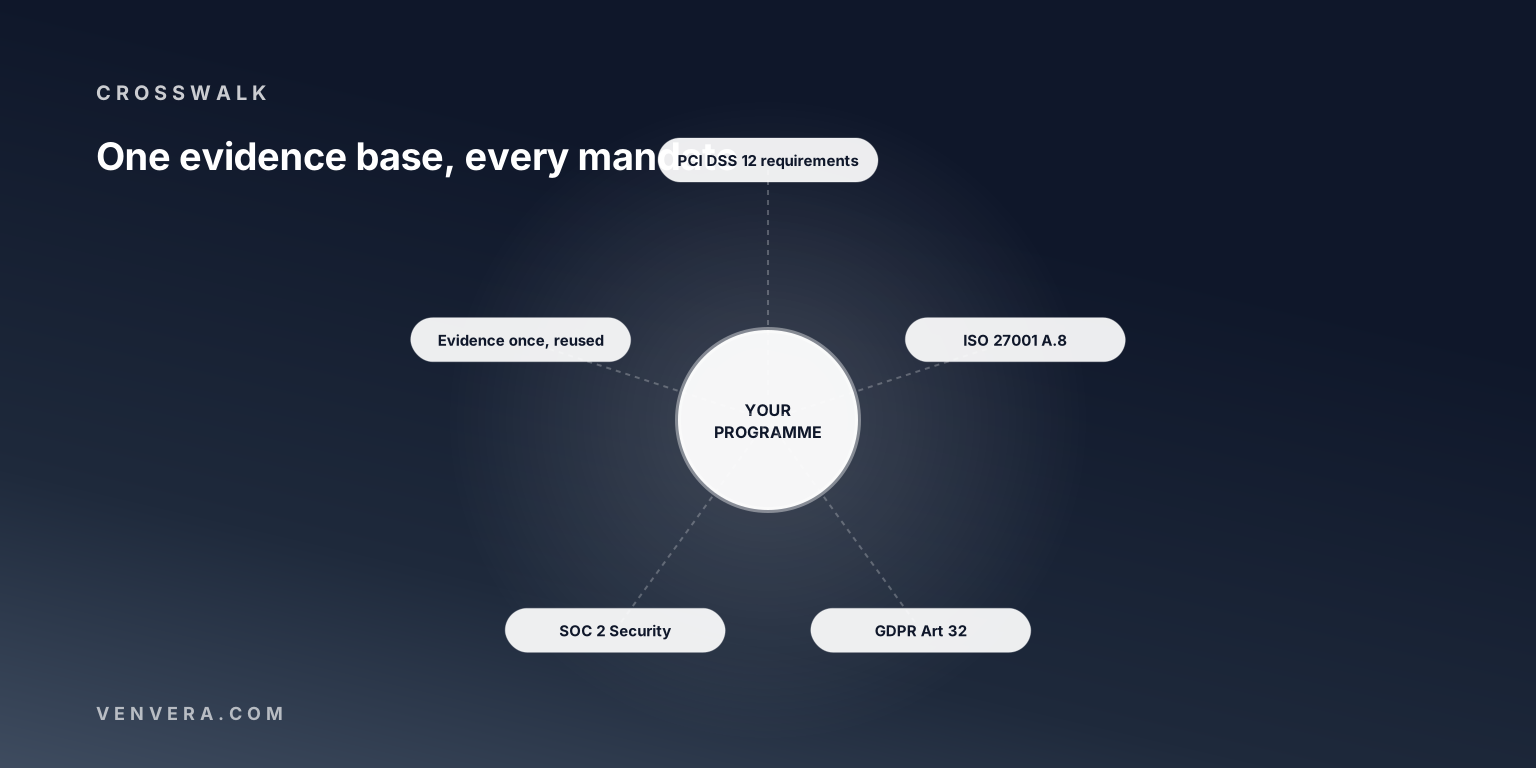
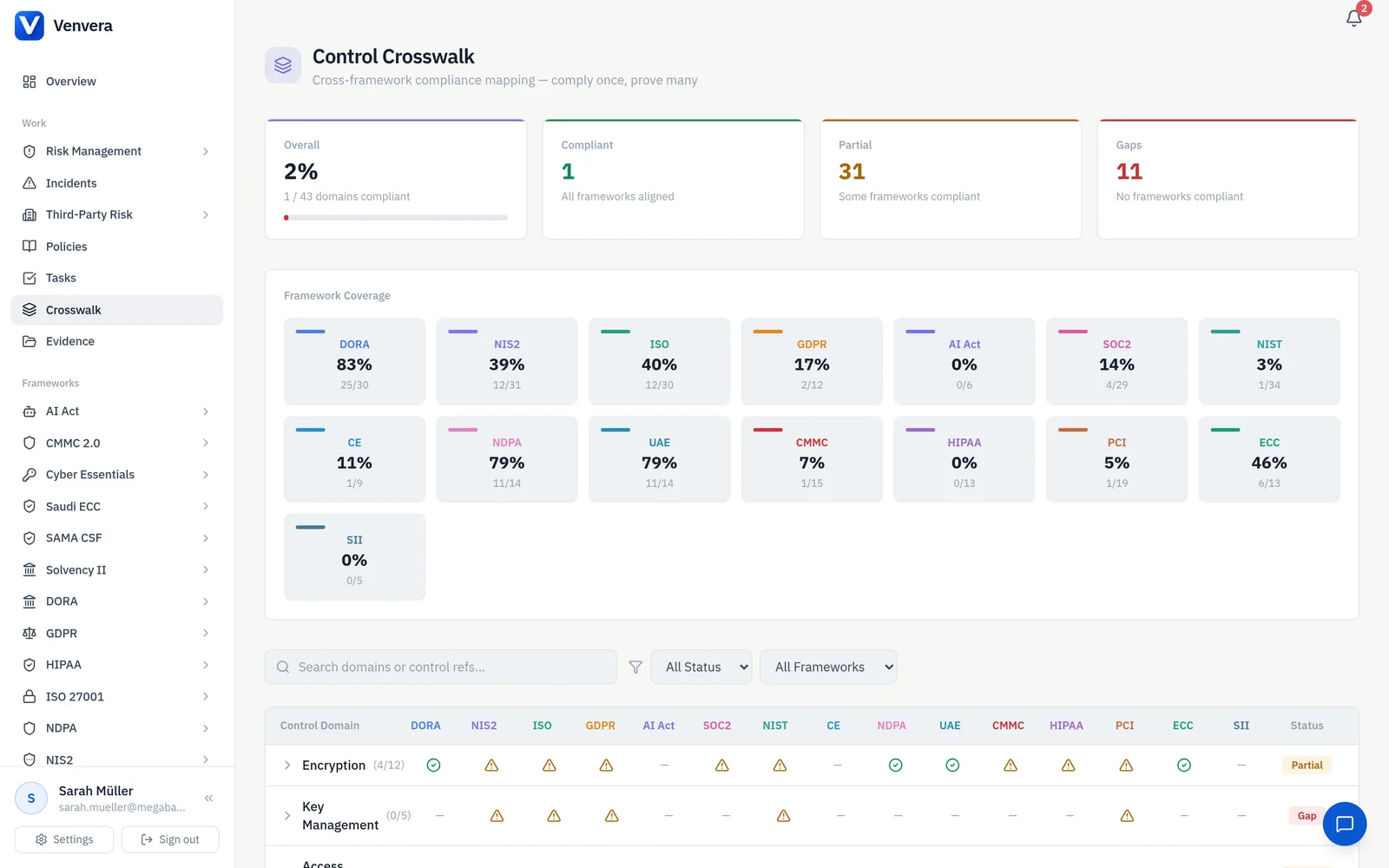
Venvera is built for the EU buyer with more than one framework to satisfy. Your PCI evidence is hosted in the EU, which matters when your legal, procurement, or data protection teams have a firm view on where compliance records live. Venvera maps the 12 PCI DSS requirements once, then reuses the overlap with ISO 27001 and GDPR, so a control you already evidenced for ISO does not get evidenced again from scratch for PCI. In practice, that means the access-control, logging, and vulnerability-management controls that PCI shares with ISO 27001 carry their evidence across instead of being rebuilt in a second silo. That reuse is the practical payoff: less duplicated work across the frameworks you actually run together, and one source of truth when an auditor asks the same question in two contexts. Pricing is published and flat, starting from EUR 399/month, with the Professional tier at EUR 899/month, so you can size the plan to your team and budget without waiting on a quote or a sales call. If your world is EU hosting, overlapping frameworks, and predictable cost, Venvera removes more friction than a tool anchored in the US and priced by negotiation.

PCI DSS the honest way: what actually matters
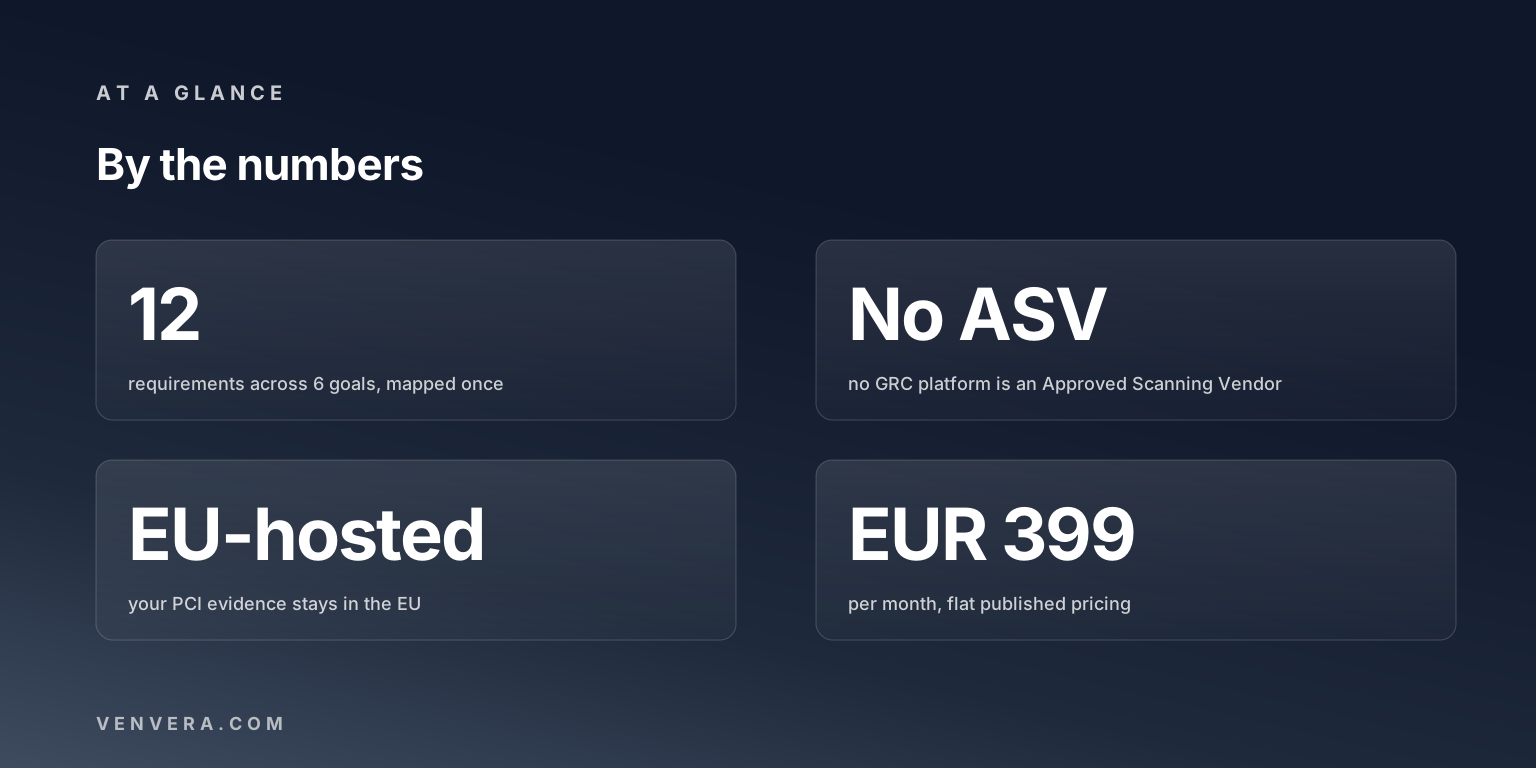
PCI DSS v4.0.1 is organised as 12 requirements grouped under 6 goals, covering how you build and maintain a secure network, protect stored cardholder data, run a vulnerability management programme, control access, monitor and test, and maintain an information security policy. That structure is stable and well documented. The part that trips people up is not the requirements themselves but how you validate against them.
Most merchants validate with a Self-Assessment Questionnaire, and the SAQ type depends on how you handle card data. A fully outsourced e-commerce shop that never touches card data typically uses SAQ A, while a business that stores, processes, or transmits cardholder data itself works up to SAQ D, which is the most demanding. Higher-volume merchants validate through a Report on Compliance rather than a self-assessment, which is a heavier exercise with formal sign-off. Separately, many merchants must run quarterly external vulnerability scans performed by an Approved Scanning Vendor, and that cadence is recurring, not a one-time hurdle you clear and forget. Knowing which of these paths applies to you is the first real decision, and it shapes how much evidence work any tool has to help you carry. A fully outsourced SAQ A merchant and a store-it-yourself SAQ D merchant are running very different programmes, and no software changes which one you are; it only changes how efficiently you evidence it.
Here is the caveat worth repeating, because it is the one vendors are tempted to blur: no GRC or compliance-automation platform, Vanta or Venvera, is an ASV or a QSA. ASV scanning and QSA assessment are separate engagements you contract for on their own. Software helps you organise evidence, track requirements against the 12 areas, and stay audit-ready between validations. It does not run your quarterly scan and it does not sign your assessment. Any vendor that implies its subscription makes those obligations disappear is selling you a story, so read the fine print on both sides of this comparison. Budget for the ASV and the QSA as line items of their own, and treat the software as the thing that keeps you organised between and during those engagements, not as a replacement for them.
Venvera vs Vanta for PCI DSS: side by side
| Dimension | Venvera | Vanta |
|---|---|---|
| Data residency | EU-hosted PCI evidence | US-based |
| PCI DSS coverage | v4.0.1, 12 requirements mapped once | PCI DSS 4.0 supported |
| Framework overlap | Reuses ISO 27001 and GDPR overlap | SOC 2 and ISO heritage, PCI one of several |
| Automation and integrations | Solid, narrower catalogue | Broader automation, larger integration library |
| Pricing | From EUR 399/month, EUR 899 Professional | Not public |
| ASV scanning | Not included, separate ASV contract | Not included, separate ASV contract |
| QSA assessment | Not included, separate QSA | Not included, separate QSA |
How to choose
Instead of a feature race, match your situation to one of these scenarios. The right answer is rarely about which tool has more boxes ticked; it is about which one fits the way your organisation already buys, hosts, and audits. Most teams land cleanly in one of the four cases below.
You already run Vanta for SOC 2 and want to add PCI. Stay with Vanta. The convenience of one tool, one set of integrations, and a team that already knows the interface outweighs almost everything else. Adding a second vendor for PCI alone rarely pays off in this case.
You are an EU merchant or payment service provider and residency matters. Venvera fits better. EU-hosted evidence keeps your legal and data protection teams comfortable, and you avoid moving compliance records across the Atlantic to satisfy an auditor.
You run PCI DSS next to ISO 27001 and GDPR. Venvera fits better. Mapping the requirements once and reusing the overlap cuts the duplicated evidence work that is the real cost of running several frameworks at once.
Automation coverage is your single top priority. Lean Vanta. Its integration library is broader, and if pulling the maximum amount of evidence automatically is what you optimise for, that depth wins. Whichever way you go, budget separately for the ASV scan and, at higher volumes, the QSA engagement.
Frequently Asked Questions
Does Venvera or Vanta make me PCI compliant without an ASV or QSA?
No. Neither platform is an Approved Scanning Vendor or a Qualified Security Assessor. Both help you organise evidence and stay audit-ready, but you still contract an ASV for quarterly external vulnerability scans and, at higher levels, a QSA for the assessment. Any tool that implies otherwise is overstating what software can do.
Which SAQ type do I need?
It depends on how you handle card data. A fully outsourced e-commerce merchant that never touches cardholder data usually qualifies for SAQ A, while businesses that store, process, or transmit card data themselves work up toward SAQ D. Higher-volume merchants validate through a Report on Compliance instead of a self-assessment. Both Venvera and Vanta help you evidence the requirements behind whichever path applies to you.
Can I reuse my ISO 27001 work for PCI DSS?
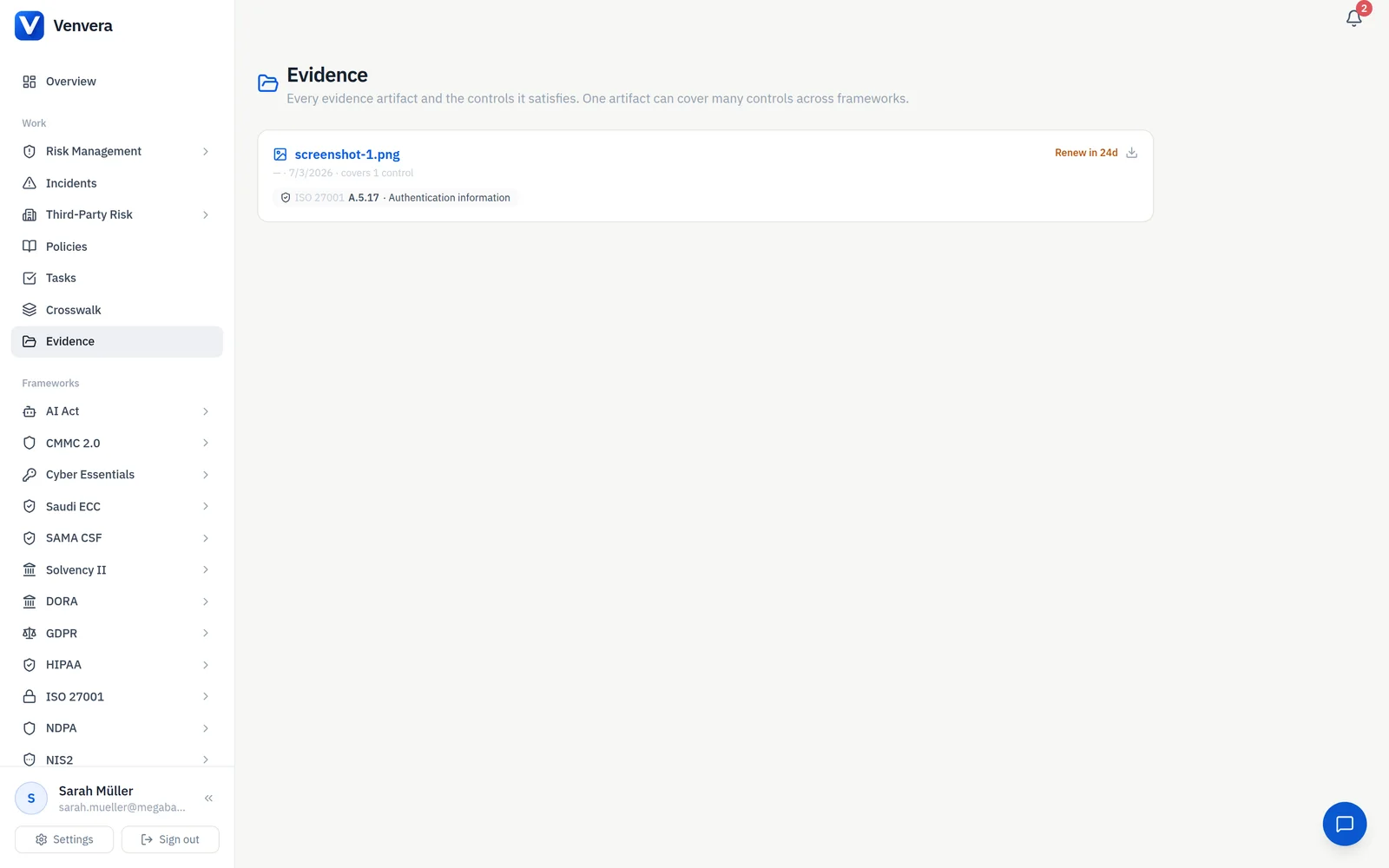
Yes, and this is where Venvera is designed to help. It maps the 12 PCI DSS requirements once and reuses the overlap with ISO 27001 and GDPR, so controls you already evidenced for those frameworks are not evidenced again from scratch. That reuse is most valuable when you genuinely run these frameworks together rather than one at a time.
Is Venvera cheaper than Vanta?
We cannot make a direct comparison, because Vanta does not publish pricing and works on a quote-only basis. Venvera publishes flat pricing that starts from EUR 399/month, with the Professional tier at EUR 899/month. If predictable, published cost is important to your buying process, that transparency is a point in Venvera's favour.
Where is my PCI evidence stored?
With Venvera, your PCI evidence is hosted in the EU. Vanta is US-based. If your organisation has a firm position on keeping compliance records inside the EU, that difference can be decisive regardless of any feature-by-feature comparison.
If you want the full requirement-by-requirement view, see the Venvera PCI DSS framework page, and if you are still building a shortlist, the roundup of PCI DSS compliance software is a fair place to compare options. When you are ready, you can start a Venvera trial and map your first requirements against the ISO 27001 and GDPR work you have already done, remembering that your ASV and, where required, your QSA stay separate engagements that no software replaces.