
Best
A buyer's guide comparing five platforms for the EU AI Act (Regulation (EU) 2024/1689) on the capabilities that decide readiness: AI system registration, risk classification, conformity assessment and human oversight, with EU data hosting in mind.

The EU AI Act is different from previous EU regulation: it is about the AI systems themselves. Each system needs to be classified by risk level, assessed for conformity where required, documented technically, and monitored for human oversight, with obligations differing across prohibited, high-risk, limited-risk and minimal-risk categories. For organisations embedding AI in core decisions, getting this right is not optional.
A common opening question is whether a dedicated tool is needed at all, or whether AI governance can sit in an existing GRC spreadsheet. Once an organisation catalogues the AI systems actually in use, across areas such as credit scoring, fraud detection, customer chatbots, document processing and risk modelling, a spreadsheet usually stops being enough.
The AI Act tooling market is still young, and many GRC platforms are catching up. This guide compares five platforms on the capabilities that matter for the AI Act, with a transparent methodology, an evidence key and buyer-fit conclusions, so you can avoid choosing a tool that treats AI compliance as an afterthought.
🔍
Selection Criteria
What to look for in AI Act compliance software
AI Act compliance is a new discipline, and the tooling requirements differ from traditional GRC. These are the six criteria used in this comparison:
1. AI system register
The foundation is knowing what AI systems you operate. A platform needs a structured register capturing each system's purpose, provider, deployment context, data inputs, outputs and the decisions it influences, not just a simple asset inventory.
2. Risk classification
The AI Act defines four risk categories: prohibited, high-risk, limited-risk and minimal-risk. A tool should guide classification using the criteria including Annex III, determine each system's category and flag the corresponding obligations. Misclassification has consequences.
3. Conformity assessment
High-risk AI systems require conformity assessment before deployment and after significant changes. A platform should manage the workflow: requirements checklist, evidence collection, assessment documentation and CE-marking tracking where self-assessment applies.
4. Technical documentation
Article 11 requires technical documentation for high-risk AI systems, covering system design, development methodology, training data, performance metrics and monitoring. A tool should structure this to meet the requirements.
5. Human oversight tracking
Article 14 requires human oversight for high-risk AI systems. A platform should track what measures are in place, who is responsible, what training they have received and how human review decisions are documented, forming an audit trail.
6. Dataset documentation
For high-risk AI, Article 10 requires documentation of training, validation and testing datasets, including data-governance practices, bias assessment and representativeness. A tool should capture and organise this per the regulation's structure.
How this comparison was produced
Methodology
| Date reviewed | July 2026. |
| Reviewer | Alexander Sverdlov, founder of Venvera. |
| Conflict of interest | Venvera publishes this comparison and is one of the products assessed. A full disclosure is shown with this article. |
| How capabilities were assessed | Venvera was assessed directly in its own product. The other four platforms were not hands-on tested; their capabilities were read from each vendor's public documentation. This is a comparison, not a hands-on test of competitors. |
| Products compared | Venvera, OneTrust, Vanta, Drata, Sprinto (5 platforms). |
| Evaluation criteria | AI system register, risk classification (Annex III), conformity assessment, technical documentation (Article 11), human oversight (Article 14), dataset documentation (Article 10), cross-framework evidence reuse, EU data hosting and pricing. The assessment is qualitative; no numeric weighting was applied. |
| Pricing source | Venvera pricing is from its own public pricing. Competitor pricing is generally not published; where that is the case it is shown as quote-based. |
| Limitations | The AI Act's obligations phase in over 2025 to 2027, and vendor capabilities change quickly in this young market. Statements about the other platforms reflect public documentation reviewed in July 2026 and should be verified with each vendor. Where a capability could not be confirmed from that documentation, it is marked "not confirmed" rather than assumed absent. |
🏆
Platform Reviews
Five EU AI Act platforms compared
Publisher's own product
Venvera
Best for: AI Act run alongside GDPR and DORA, EU-hosted, with cross-framework evidence reuse.
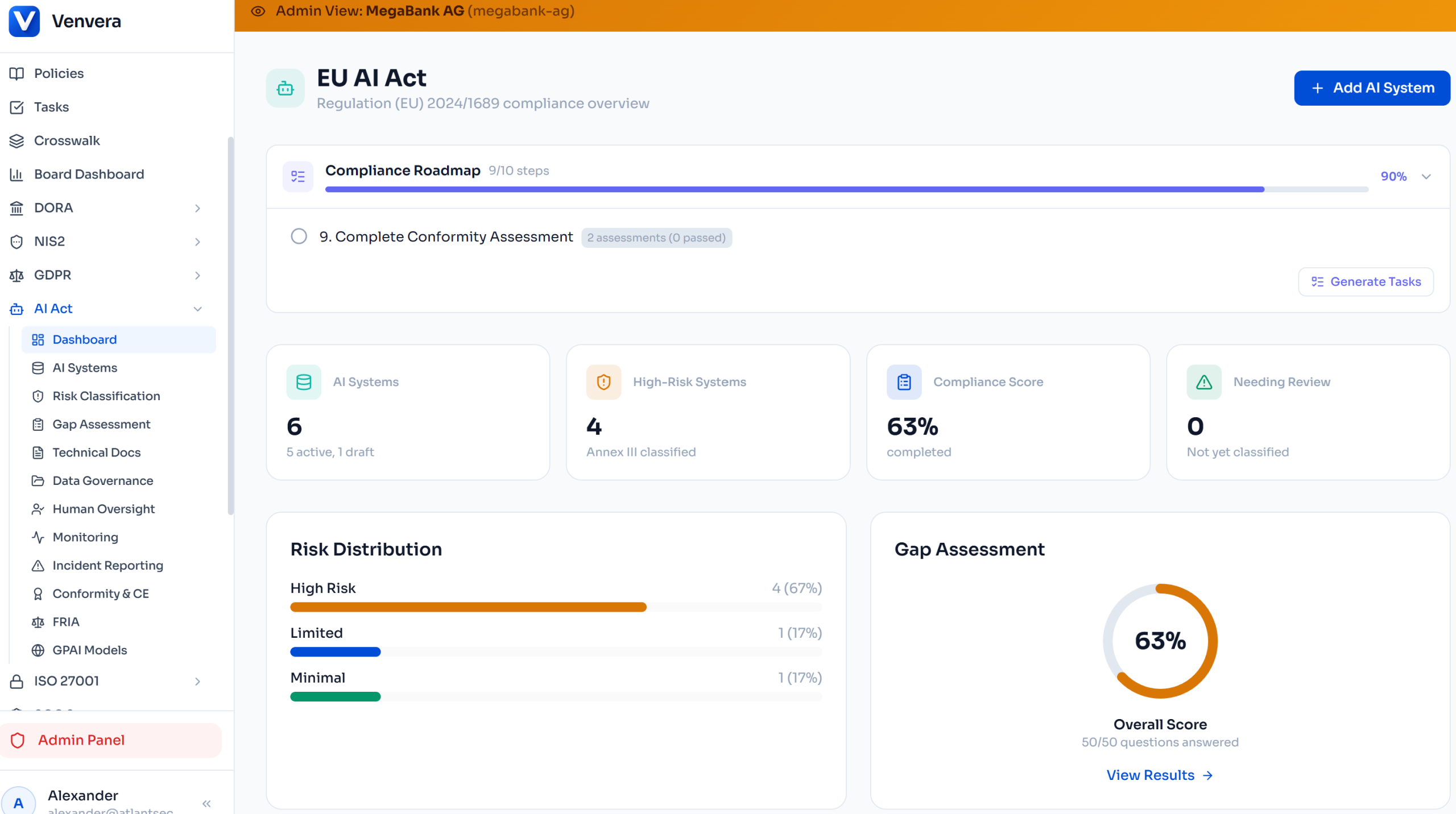
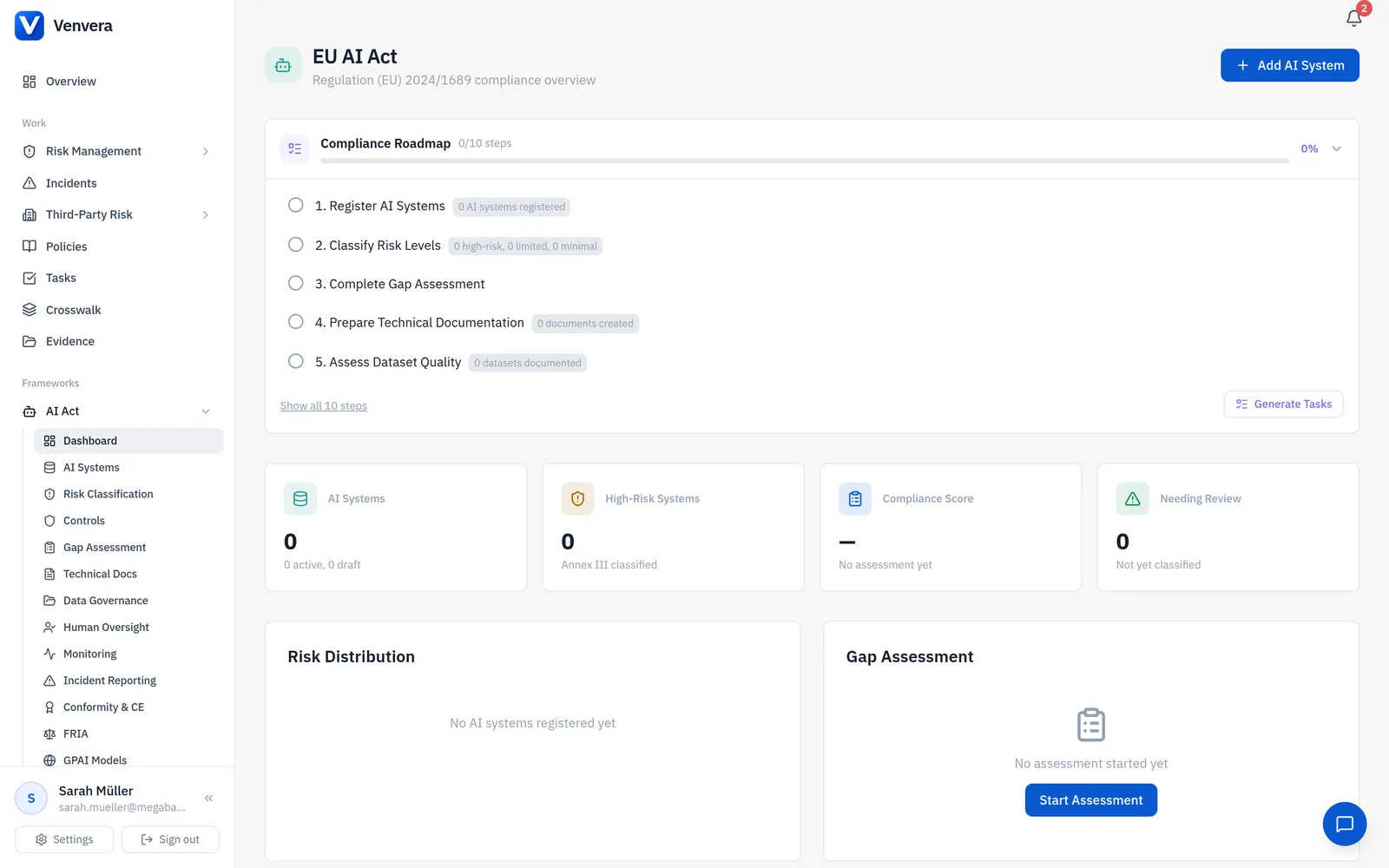
Venvera includes dedicated EU AI Act tooling alongside its broader framework coverage. In the product, the AI Act module provides a structured AI system register, risk classification using the Annex III criteria, conformity assessment tracking for high-risk systems and human oversight documentation. These are verified in the Venvera product as of July 2026.
For financial institutions, the value is in reuse across DORA and GDPR. AI systems that process personal data trigger GDPR obligations, and AI systems that form part of ICT services trigger DORA requirements. Venvera's pre-built cross-framework mappings connect these, so registering an AI system can surface both the AI Act conformity requirements and the related GDPR and DORA obligations, rather than managing them as separate projects.
The platform supports technical documentation structured to Article 11, dataset documentation for training and validation data, and tracking of post-market monitoring. Data is hosted in Amsterdam, providing European data residency for your AI governance records. Pricing starts at €399/month for one framework and €899/month for three, so AI Act work can sit alongside an existing DORA or GDPR subscription within the same workspace.
Strengths (verified in product)
- Dedicated AI system register
- Risk classification workflows (Annex III)
- Conformity assessment tracking
- Human oversight documentation
- Cross-framework reuse (AI Act, GDPR, DORA)
- Technical documentation management
- European hosting (Amsterdam)
Considerations
- AI Act tooling still evolving with the regulation
- No automated AI model auditing
- Newer platform building market presence
OneTrust
Best for: large enterprises with big AI portfolios and dedicated AI governance programmes.
OneTrust's public documentation describes dedicated AI Governance modules with AI system inventories, impact assessments, bias-monitoring frameworks and model-card documentation, building on its strength in privacy impact assessments. It is among the more feature-rich dedicated AI tooling described in the enterprise GRC space.
The recurring considerations are cost and complexity: the AI Governance module is separate from the privacy, GRC and ethics modules, so a deployment covering AI Act, GDPR and broader GRC reaches enterprise pricing, with dedicated project teams and configuration time. For organisations with large AI portfolios and enterprise budgets it is a strong option; for a handful of AI systems it may be more than needed. Confirm scope and cost with OneTrust.
Described in public docs
- Dedicated AI Governance module
- Algorithmic impact assessments
- Bias-monitoring frameworks
- Model-card documentation
- Integration with ML platforms
Considerations
- Enterprise pricing
- AI module separate from GRC module
- Configuration effort
- May be more than smaller AI portfolios need
Vanta
Best for: SOC 2 and ISO 27001-first teams adding basic AI governance.
Vanta's public documentation describes AI governance features for AI system inventorying and policy management, using its existing compliance infrastructure to define AI-related controls, collect evidence and track status, with some integration-based discovery of AI tools in use.
For the AI Act specifically, a structured conformity-assessment workflow, Annex III risk classification and AI-specific technical documentation management were not confirmed from the public documentation reviewed in July 2026. It works well for organisational governance (policies, responsibilities, training) and can be a starting point for teams whose main need is SOC 2 or ISO 27001, with AI Act-specific requirements confirmed or supplemented separately.
Described in public docs
- AI system inventory capabilities
- Policy management for AI
- Integration-based discovery
- Familiar platform for existing users
Not confirmed for AI Act
- Annex III risk classification
- Conformity assessment workflow
- AI-specific technical documentation
- Human oversight tracking
- Default EU data hosting
Drata
Best for: continuous-monitoring teams adding AI policy oversight.
Drata's public documentation describes AI governance focused on policy compliance and risk assessment, defining AI-specific controls within its continuous monitoring framework, such as whether AI usage policies are followed, whether approved tools are used and whether access controls around AI systems are maintained.
For the EU AI Act specifically, structured risk classification per the AI Act's categories, conformity-assessment workflows and AI-specific technical documentation were not confirmed from the public documentation reviewed in July 2026. It suits organisations wanting basic AI governance visibility within an existing compliance dashboard; those with high-risk AI systems will likely need to supplement it.
Described in public docs
- AI policy compliance monitoring
- Integration with existing controls
- Access-control tracking for AI tools
- Familiar continuous-monitoring approach
Not confirmed for AI Act
- AI Act risk classification
- Conformity assessment
- Technical documentation per Art. 11
- Dataset documentation
Sprinto
Best for: startups establishing basic AI governance hygiene.
Sprinto's public documentation describes emerging AI governance features as part of an expanding framework library, centred on AI acceptable-use policies, vendor management for AI tool procurement and basic risk-assessment questionnaires. For startups and small companies wanting foundational AI governance, it is an affordable starting point.
For EU AI Act compliance specifically, structured risk-classification workflows, conformity-assessment capabilities, technical documentation per Article 11 and human oversight tracking were not confirmed from the public documentation reviewed in July 2026. It may suit organisations that need basic AI governance hygiene while they evaluate more comprehensive options. Confirm the current position with Sprinto.
Described in public docs
- Affordable pricing
- Basic AI policy management
- Suited to startup governance
- Quick to deploy
Not confirmed for AI Act
- Risk classification
- Conformity assessment
- Technical documentation
- Human oversight tracking
📊
Head-to-Head
Feature comparison
How to read this table. Venvera entries are verified in the Venvera product (July 2026). Entries for the other platforms come from public vendor documentation reviewed in July 2026 and should be verified with the vendor. "Not confirmed" means the capability was not found in that public documentation; it is not a statement that the feature is absent.
| Feature | Venvera | OneTrust | Vanta | Drata | Sprinto |
|---|---|---|---|---|---|
| AI system register | Full (verified) | Described (public docs) | Basic (public docs) | Basic (public docs) | Not confirmed |
| Risk classification (Annex III) | Structured (verified) | Described (public docs) | Not confirmed | Not confirmed | Not confirmed |
| Conformity assessment | Full workflow (verified) | Described (public docs) | Not confirmed | Not confirmed | Not confirmed |
| Technical documentation (Art. 11) | Structured (verified) | Described (public docs) | Basic (public docs) | Not confirmed | Not confirmed |
| Human oversight tracking | Full (verified) | Described (public docs) | Not confirmed | Not confirmed | Not confirmed |
| Dataset documentation | Structured (verified) | Described (public docs) | Not confirmed | Not confirmed | Not confirmed |
| Bias monitoring | Framework (verified) | Advanced (public docs) | Not confirmed | Not confirmed | Not confirmed |
| Cross-framework evidence reuse | Yes, incl. GDPR and DORA (verified) | Moderate (public docs) | Basic (public docs) | Basic (public docs) | Limited (public docs) |
| EU data hosting | Amsterdam (verified) | EU option (public docs) | EU default not confirmed | EU option (public docs) | EU default not confirmed |
| Starting price | From €399/mo | Not publicly listed | Not publicly listed | Not publicly listed | Not publicly listed |
🔗
Regulatory Intersection
The AI Act does not exist in a vacuum
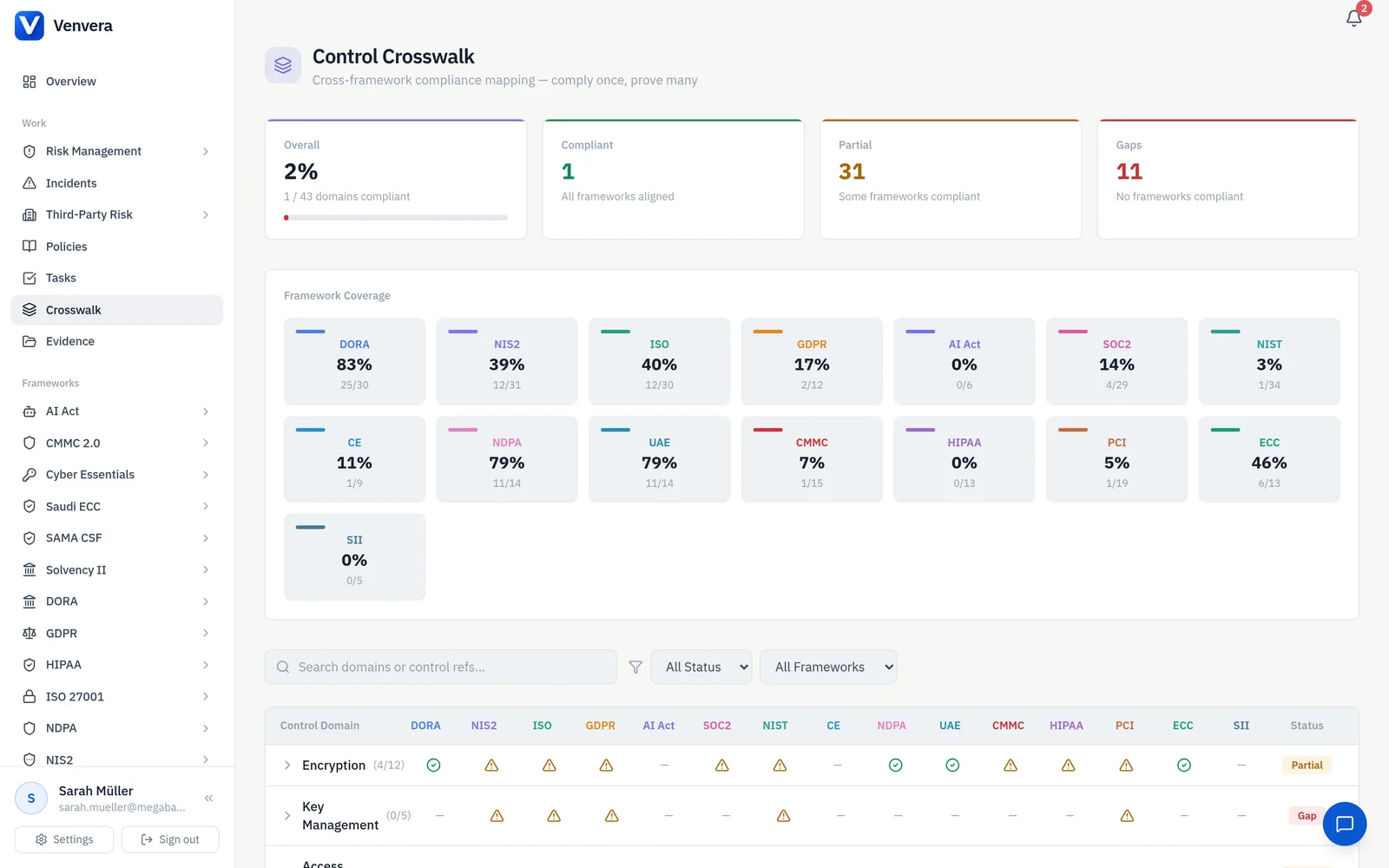
Many AI systems sit at the intersection of several regulations. A credit-scoring AI system, for example, can trigger obligations under the AI Act (potential high-risk classification, conformity assessment), GDPR (automated decision-making, DPIA, processing records) and DORA (ICT risk management where it is part of financial-services delivery). Managing these as separate projects is hard to sustain.
Illustrative scenario: an AI credit-scoring system
A worked example, not a real customer. Confirm the exact obligations for your own system.
A single AI credit-scoring system can trigger requirements across several regulations:
| Regulation | Requirements that may be triggered |
|---|---|
| EU AI Act | High-risk classification (Annex III), conformity assessment, technical documentation, human oversight, post-market monitoring |
| GDPR | Art. 22 (automated decision-making), DPIA, processing-activity record, legal basis, data-subject rights |
| DORA | ICT risk management, RoI entry where third-party AI is used, resilience testing, change management |
| ISO 27001 | A.8.3 access control, A.8.24 cryptography, A.5.23 information security for cloud services |
With cross-framework control mapping, registering this AI system once can surface the related entries across the applicable frameworks, so evidence such as the conformity-assessment record and human-oversight documentation may support the related DORA and GDPR requirements rather than being re-created. Each framework has its own specific wording, so whether an item fully satisfies a given obligation should be confirmed per requirement.
This is why integrated multi-framework support matters for AI Act readiness. Siloing AI governance from broader regulatory work tends to duplicate effort and risks missing the cross-regulatory connections that auditors and supervisors increasingly expect to see.
💰
Cost Analysis
Pricing
AI Act tooling is a young market and pricing varies with depth. Venvera publishes its pricing; the other platforms generally require a sales conversation, so their figures are shown as not publicly listed rather than estimated.
| Platform | Pricing model | Published starting price | Notes |
|---|---|---|---|
| Venvera | Transparent tiered pricing | From €399/mo (1 framework) | AI Act runs alongside other frameworks in one workspace |
| OneTrust | Quote-based (per module) | Not publicly listed | AI Governance, Privacy and GRC are separate modules |
| Vanta | Quote-based | Not publicly listed | Confirm AI Act depth for the scope you need |
| Drata | Quote-based | Not publicly listed | Basic AI-specific features per public docs |
| Sprinto | Quote-based | Not publicly listed | Positioned for startups; limited AI Act depth |
How AI Act tooling tends to be priced
Several vendors position dedicated AI governance as a separate, chargeable module. Venvera includes AI Act work within its single subscription rather than as an add-on. As the AI Act's obligations phase in over 2025 to 2027 and organisations discover more high-risk AI systems than expected, whether AI governance is a separate line item or part of the base platform is worth checking with each vendor.
✅
Conclusion
Which of the five fits you
AI Act compliance is a new discipline and the tooling market is still maturing. No single tool is right for everyone, so match the platform to your situation:
- AI Act run with GDPR and DORA, EU-hosted, with evidence reuse: Venvera, with the AI system register, Annex III classification, conformity assessment and cross-framework mapping verified in the product. As the publisher, we note the disclosure shown with this article.
- Large enterprise with a big AI portfolio and a dedicated AI governance programme: OneTrust, subject to confirming module scope and cost.
- SOC 2 or ISO 27001-first team adding basic AI governance: Vanta, confirming or supplementing AI Act-specific requirements.
- Continuous-monitoring team adding AI policy oversight: Drata, with high-risk AI systems likely needing supplementary tooling.
- Startup establishing basic AI governance hygiene: Sprinto as an affordable starting point while you evaluate deeper options.
The AI Act's obligations phase in through 2027, so choose a platform ready for the full scope, not just today's minimum. Whichever you shortlist, verify the AI Act-specific claims that matter to you directly with each vendor before committing.
See how Venvera handles the EU AI Act
Register AI systems, classify risk, track conformity assessments, and connect AI governance to GDPR and DORA in one workspace, hosted in Amsterdam. From €399/month.
Book a demo →Comparison compiled July 2026 from public vendor documentation and the Venvera product. Competitor capabilities were not hands-on tested. Confirm current pricing and features with each vendor.