Best

Short answer: Vanta is a strong fit for SaaS companies that want automation-first SOC 2 and ISO 27001 readiness with a large integrations library. Venvera is built around EU regulatory frameworks such as DORA, with a relational Register of Information, native xBRL-CSV export and cross-framework evidence reuse.
Both tools address governance, risk and compliance, but they were designed for different problems. Vanta grew up automating SOC 2 evidence collection. DORA is an EU regulation with specific, machine-readable reporting requirements defined by the European Supervisory Authorities: a relational Register of Information with entity identifiers, an xBRL-CSV export that validates against ESA schemas, and a defined incident taxonomy. This article compares the two across the dimensions that matter for a DORA programme, and classifies every claim by how it was verified.
Methodology
Compiled in July 2026 from Vanta’s public documentation and hands-on use of the Venvera product. Venvera capabilities described here are verified in the product. Vanta was not hands-on tested by us; every Vanta line is classified as either described in Vanta’s public documentation or not confirmed from the public documentation reviewed in July 2026. Vendor features change, so verify current details with Vanta before deciding.
⚠
CONTEXT
This is the DORA-specific comparison. For the full multi-framework picture see our Vanta alternative for EU compliance, or the risk-management comparison.
What DORA asks for that SOC 2 tooling does not
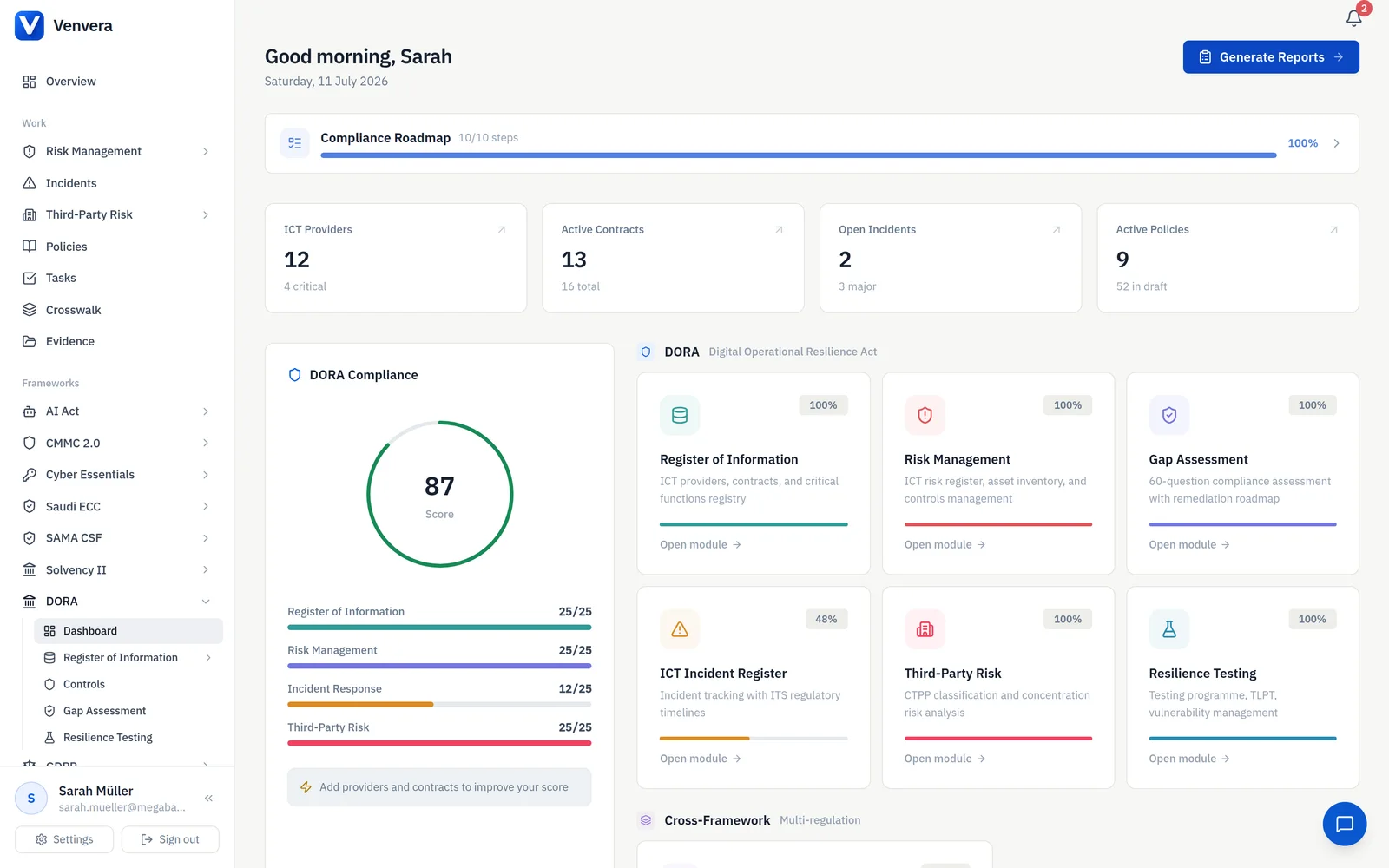
DORA is a regulation rather than a controls framework. Its Register of Information is not a vendor list; it is a multi-table relational dataset with ESA-defined fields linking ICT service providers to contractual arrangements, to the business functions they support, and to sub-outsourcing chains. Each entity needs the right regulatory identifiers, and the register has to be producible in the ESAs’ xBRL-CSV format on request.
Why this matters
DORA has applied since 17 January 2025. In-scope financial entities are expected to maintain a Register of Information that can be produced in the ESAs’ xBRL-CSV format on request. Choosing tooling that models the register in that shape from the start reduces last-minute rework.
🔍
DIMENSION BY DIMENSION
How each platform maps to DORA requirements
🗒
Register of Information
DORA Article 28 needs a relational register linking ICT providers, contracts, business functions and sub-outsourcing chains. Venvera provides this relational register (verified in product). A submission-ready register of this shape was not confirmed from Vanta’s public documentation reviewed in July 2026 (verify with Vanta).
📄
xBRL-CSV export
The ESAs require the register in xBRL-CSV with validated entity codes and defined table structures. Venvera exports xBRL-CSV (verified in product). This export was not confirmed from Vanta’s public documentation reviewed in July 2026.
🇧
ESA entity codes
Every entity in DORA reporting needs the right identifiers: LEI codes, EBA and EIOPA identifiers, ESMA classifications and jurisdiction mappings. Venvera ships an entity-code library (verified in product). Coverage of these codes was not confirmed from Vanta’s public documentation reviewed in July 2026.
🚨
ICT incident reporting
DORA’s incident taxonomy uses specific severity dimensions such as transaction count, service availability, economic impact, data integrity and geographic spread. Venvera implements the DORA taxonomy and reporting templates (verified in product). Vanta documents incident and security workflows (verify); the DORA-specific classification was not confirmed from public documentation reviewed in July 2026.
🔗
ICT concentration risk
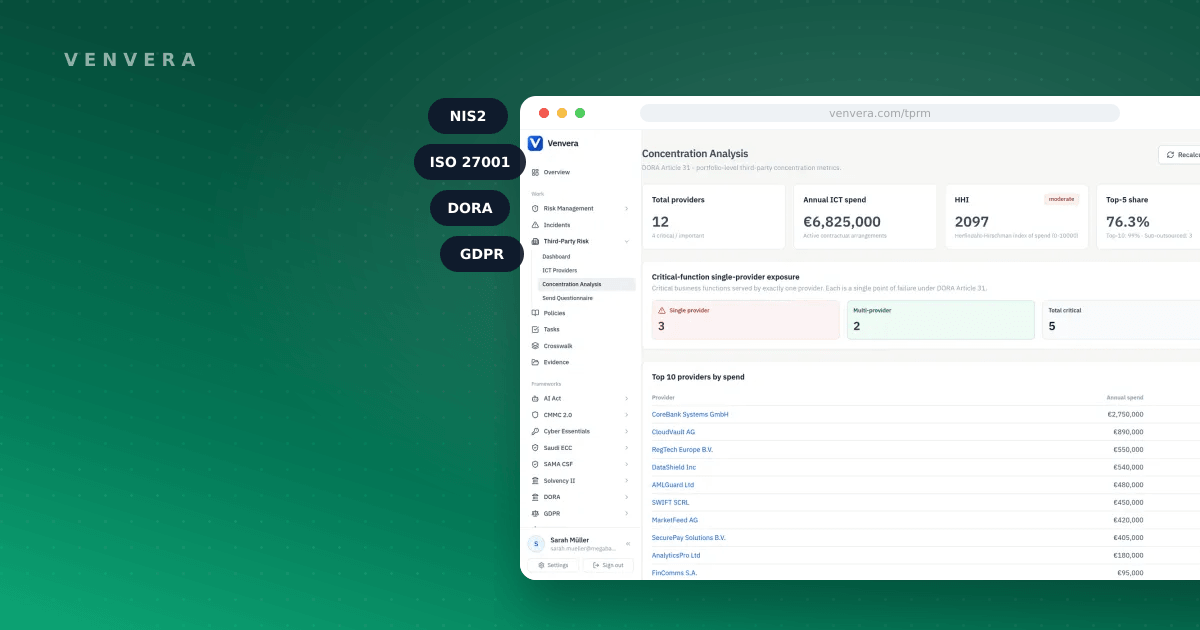
DORA calls for multi-dimensional analysis of ICT provider concentration across jurisdiction, criticality and substitutability. Venvera supports concentration-risk analysis (verified in product). An equivalent analysis was not confirmed from Vanta’s public documentation reviewed in July 2026.
🛠
Third-party risk and TLPT
DORA requires ICT third-party risk management and, for some entities, Threat-Led Penetration Testing aligned to TIBER-EU. Venvera tracks third-party risk and TLPT programmes (verified in product). Vanta documents vendor and third-party risk management (verify); DORA-specific TLPT programme tracking was not confirmed from public documentation reviewed in July 2026.
📊
COMPARISON TABLE
Vanta vs Venvera for DORA, line by line
Venvera lines are verified in the product. Vanta lines are marked either as described in Vanta’s public documentation (verify) or as not confirmed from the documentation reviewed in July 2026. Not confirmed means we did not find it, not that it is absent.
| DORA dimension | Venvera | Vanta |
|---|---|---|
| Register of Information (Art. 28) | Verified in product | Not confirmed (Jul 2026) |
| xBRL-CSV export | Verified in product | Not confirmed (Jul 2026) |
| ESA entity codes (LEI, EBA, EIOPA) | Verified in product | Not confirmed (Jul 2026) |
| ICT incident classification and reporting | Verified in product | Incident workflows per Vanta docs (verify); DORA taxonomy not confirmed (Jul 2026) |
| ICT concentration risk analysis | Verified in product | Not confirmed (Jul 2026) |
| Third-party risk and TLPT programme | Verified in product | Vendor risk per Vanta docs (verify); TLPT tracking not confirmed (Jul 2026) |
| EU framework coverage (DORA, NIS2, GDPR) | Verified in product | Framework library per Vanta docs (verify) |
| SOC 2 and ISO 27001 automation and integrations | Supported (verified in product) | Automation-first, large integrations library per Vanta docs (verify) |
| Cross-framework evidence reuse | Verified in product | Described in Vanta docs (verify) |
| EU data residency | Amsterdam, AES-256-GCM (verified) | Not confirmed (Jul 2026) |
| Pricing model | Published at /pricing | Quote-based, not publicly listed (verify) |
| Support model | Contact Venvera for current terms | Per Vanta docs (verify) |
🔗
CROSS-FRAMEWORK REUSE
Reusing DORA work across other frameworks
In Venvera, a control implemented once can satisfy requirements in more than one framework through the built-in crosswalk (verified in product). An ICT security control written for DORA Article 9(4), for example, can map to the related requirements in ISO 27001, SOC 2, NIS2 and NIST CSF, so the same evidence is reused rather than recollected for each standard. If your obligations span several EU frameworks alongside DORA, that reuse is where a cross-framework platform earns its place.
🇪
DATA RESIDENCY
Where your DORA data is hosted
Venvera runs from Amsterdam, with AES-256-GCM encryption at rest and in transit and per-tenant encryption keys (verified in product). For Vanta, EU data residency for this data was not confirmed from the public documentation reviewed in July 2026; verify the current hosting and residency options with Vanta. For a European financial entity, where compliance data is stored is a question worth confirming with any vendor.
💰
PRICING
How the two price
Venvera publishes its plans on the pricing page. Vanta’s pricing is quote-based and is not publicly listed, so a like-for-like number depends on a sales conversation; confirm current figures directly with Vanta. Rather than compare headline prices, weigh each tool against the frameworks you actually report on and the work each removes.
✅
BUYER FIT
Which tool fits which buyer
Vanta fits when you...
- Are a SaaS company pursuing SOC 2 or ISO 27001 with automation first
- Value a large library of integrations for automated evidence collection
- Do not need EU-specific regulatory reporting such as the DORA Register of Information
Venvera fits when you...
- Are an EU financial entity in scope for DORA
- Need a submission-ready Register of Information with xBRL-CSV export
- Also report under GDPR, NIS2 or ISO 27001 and want to reuse evidence across them
- Want EU data residency and published pricing
Vanta pioneered SOC 2 automation and its integrations library is a documented strength; for a SaaS product that mainly needs SOC 2 Type II or ISO 27001 it is a strong choice. DORA is a different, EU-specific regulatory problem, which is where a purpose-built EU platform such as Venvera fits. Many teams will find one clearly closer to their obligations than the other; the right answer depends on your frameworks, not on a single winner.
See how Venvera handles DORA
Relational Register of Information, native xBRL-CSV export, ESA entity codes and cross-framework evidence reuse.
Hosted in Amsterdam. See plans on the pricing page.
Book a demo →