
Best
A buyer's guide comparing five platforms for the NIS2 Directive (Directive (EU) 2022/2555) on what actually decides readiness: Article 21 risk measures, the incident-reporting clocks, supply chain security and management-body accountability.

NIS2 brought thousands of organisations into cybersecurity regulation for the first time, and many did not realise they were in scope.
Quick answer
The right NIS2 platform treats the directive as a first-class framework rather than a checklist added to SOC 2 tooling. Among the five compared here: Venvera (the publisher of this comparison) covers NIS2 natively, including Article 21 risk measures, the 24-hour and 72-hour incident-reporting timelines and supply chain security, and is designed for reuse across overlapping EU frameworks; OneTrust suits large essential entities already running its GRC suite; ServiceNow GRC fits enterprises willing to build NIS2 workflows on a platform they already own; and Vanta and Drata automate technical evidence collection well but, from their public documentation, rely on more general framework support for NIS2 substance. Which fits depends on your size, existing stack and the other frameworks you run.
The original NIS Directive from 2016 was narrow, covering critical-infrastructure operators and a few digital service providers, so most companies could reasonably ignore it. NIS2 expanded the scope to cover 18 sectors, including medium-sized companies (from 50 employees and €10 million turnover), which brought many organisations into scope for the first time.
The October 2024 transposition deadline came and went, with member states implementing national legislation at different speeds. Organisations that had been watching were prepared; others had to work out whether they were an "essential entity" or an "important entity", or in scope at all, while also learning what the directive requires.
The tool you choose for NIS2 should resolve that confusion rather than add to it. This guide sets out what the directive needs, how it was assessed, and how five platforms compare.
"We are only a software company" is not a scope test
Illustrative scenario (not a real customer).
Consider a mid-sized software company that supplies laboratory information management systems to hospitals and diagnostic labs. Its leadership assumes NIS2 is "for energy companies and telecoms" and does not apply.
NIS2 Annex I includes "health" as a sector for essential entities, and Annex II includes "digital infrastructure" and "ICT service management" for important entities. A company providing SaaS to healthcare providers, processing diagnostic data, could be caught as a provider of digital infrastructure or as a managed service provider under ICT service management, depending on the member state's transposition.
The trigger is often external: an essential-entity customer, such as a hospital, has to assess the cybersecurity of its suppliers under NIS2 supply chain requirements, and sends a questionnaire. A supplier that assumed it was exempt then discovers a gap: risk-management measures only partly in place, an incident-response process that does not meet the early-warning requirement, no formal supply chain programme for its own vendors, and no evidence of management-body engagement.
The lesson is simple: work out scope from the sectors and thresholds, not from a self-image. Doing it early, with a platform that structures the work, is far cheaper than an emergency remediation later.
Essential vs important: the distinction that confuses everyone
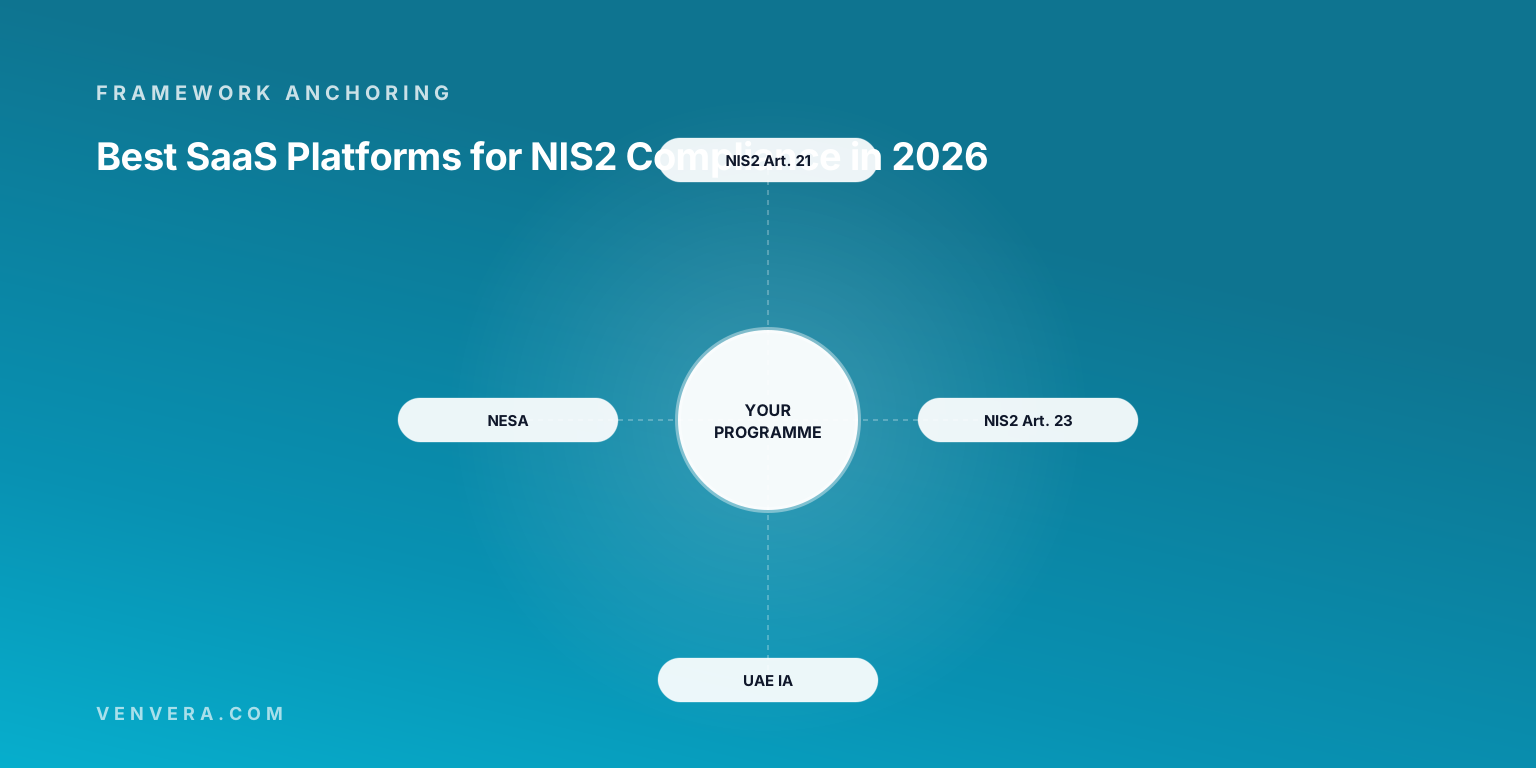
Essential entities (Annex I) are those whose disruption would cause serious harm to society or the economy: energy, transport, banking, financial market infrastructure, health, drinking water, wastewater, digital infrastructure, ICT service management (B2B), public administration and space. Large enterprises in these sectors (250+ employees or €50M+ turnover) are automatically essential. Some entities are essential regardless of size, such as qualified trust service providers and DNS service providers.
Important entities (Annex II) cover a broader range: postal services, waste management, chemical manufacturing, food production, and manufacturing of medical devices, computers, electronics, machinery and motor vehicles, plus digital providers such as online marketplaces, search engines and social networking platforms. Medium-sized enterprises in essential sectors (50 to 249 employees or €10M to €50M turnover) are classified as important.
Why this matters for choosing software
The obligations are largely the same for both categories; the difference is in supervision and penalties. Essential entities face proactive supervision and administrative fines with a maximum of at least €10 million or 2% of total worldwide annual turnover, whichever is higher. Important entities face reactive supervision and a maximum of at least €7 million or 1.4% of turnover. A platform should handle both regimes, because the security measures under Article 21 are the same regardless of classification.
Member states also have discretion in how they classify entities, so interpretations can differ between, for example, Belgium, Germany, the Netherlands and France. A good NIS2 platform should help you navigate that ambiguity rather than pretend it does not exist.
The incident-reporting timelines that will ruin your weekend
NIS2's incident-reporting requirements are more demanding than many realise until an incident actually happens. Here is how they work.
24h
Early warning
From becoming aware of the significant incident
You must notify your national CSIRT or competent authority within 24 hours. This is a heads-up rather than a full analysis, but it should indicate whether the incident is suspected to be caused by unlawful or malicious acts and whether it could have cross-border impact. Twenty-four hours is short when you are simultaneously containing an active incident and drafting a regulatory notification, so an automated process helps.
72h
Incident notification
More detail
Within 72 hours, you provide a more detailed notification: an initial assessment of severity and impact, indicators of compromise where available, and an update on containment. The clock runs from awareness, not from completing your investigation. If you are also a GDPR controller, you may be running two parallel notification timelines with different authorities.
1m
Final report
Comprehensive post-incident report
Within one month, you owe a final report: a detailed description of the incident including severity and impact, the type of threat or root cause, applied and ongoing mitigation, and cross-border impact if applicable. This is the report regulators scrutinise. A tool that helps you build it incrementally, collecting evidence and tracking the timeline as you go, avoids reconstructing it later from memory and chat messages.
There is a DORA interaction to keep in mind. Financial entities subject to both NIS2 and DORA follow DORA's incident-reporting timeline, which for major ICT-related incidents requires an initial notification within hours rather than the 24 hours under NIS2. Article 4 of NIS2 treats DORA as lex specialis for financial entities, so where DORA's requirements are at least equivalent they apply in place of the corresponding NIS2 obligations.
A platform that understands this relationship avoids duplicate work by tracking the stricter timeline where both apply.
Supply chain security: the requirement everyone underestimates
Article 21(2)(d) of NIS2 requires entities to address "supply chain security, including security-related aspects concerning the relationships between each entity and its direct suppliers or service providers." That sounds straightforward. It is not.
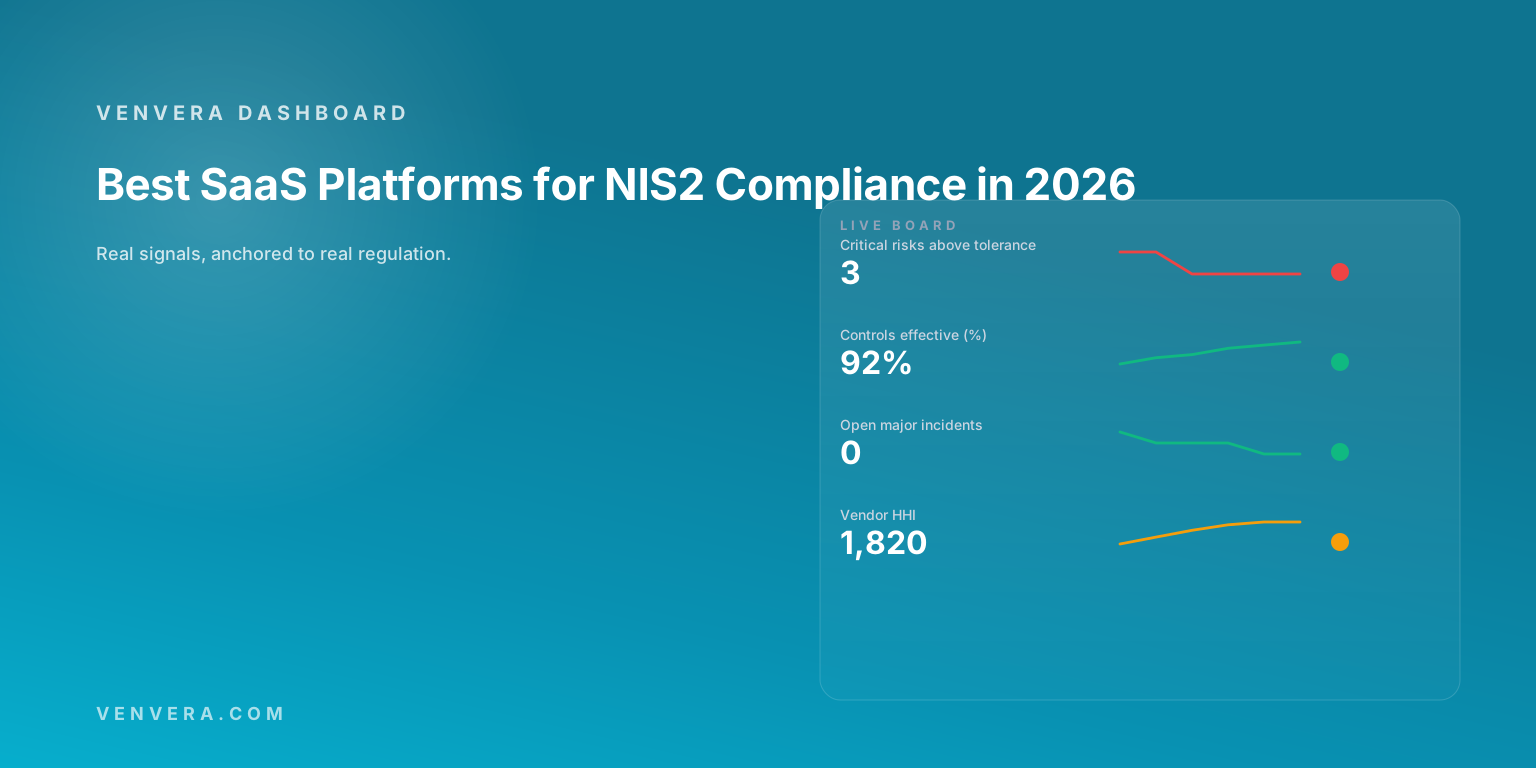
In practice you need to assess the cybersecurity posture of your critical suppliers, include cybersecurity requirements in your contracts, monitor compliance, and be able to demonstrate all of this to regulators. For a company with 50 suppliers, that is manageable. For one with several hundred, it is a substantial ongoing programme.
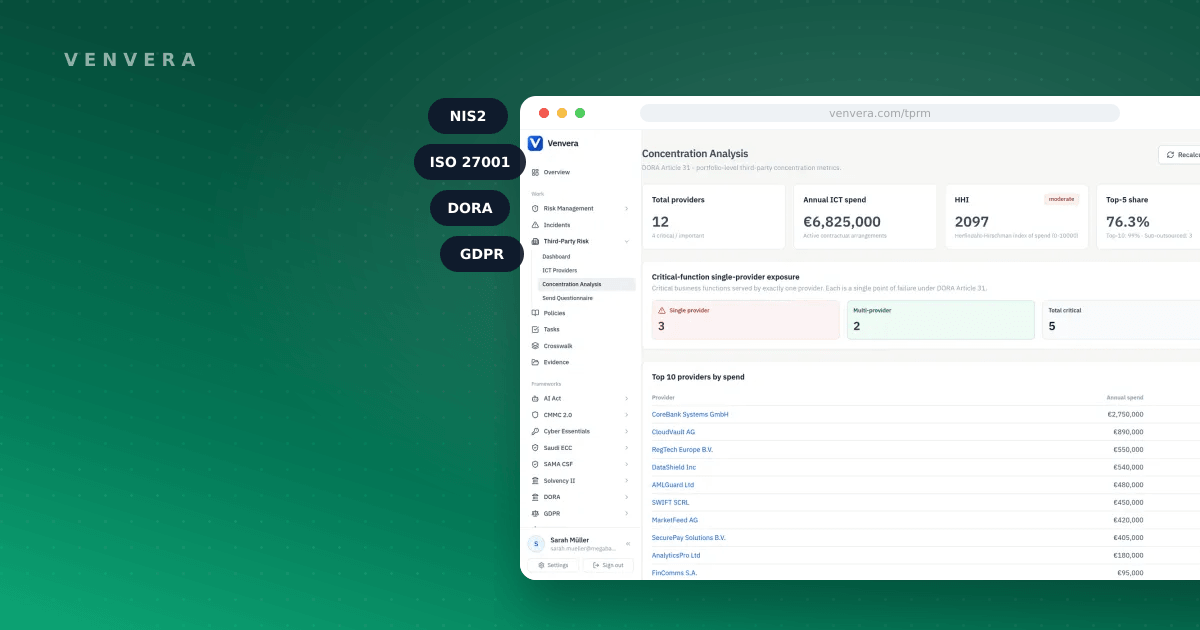
This is where proper tooling earns its keep. A platform with supply chain security tracking, vendor-assessment workflows, contract-clause monitoring, and integration with broader risk management makes the requirement workable. A spreadsheet with no field for cybersecurity assessment status does not.
How this comparison was produced
Methodology
| Date reviewed | July 2026. |
| Reviewer | Alexander Sverdlov, founder of Venvera. |
| Conflict of interest | Venvera publishes this comparison and is one of the products assessed. A full disclosure is shown with this article. |
| How capabilities were assessed | Venvera was assessed directly in its own product. The other four platforms were not hands-on tested; their capabilities were read from each vendor's public documentation. This is a comparison, not a hands-on test of competitors. |
| Products compared | Venvera, OneTrust, Vanta, ServiceNow GRC, Drata (5 platforms). |
| Evaluation criteria | Article 21 risk measures, the 24-hour and 72-hour incident-reporting timelines, supply chain security, management-body accountability (Article 20), cross-framework evidence reuse (including DORA), EU data hosting and pricing. The assessment is qualitative; no numeric weighting was applied. |
| Pricing source | Venvera pricing is from its own public pricing. Competitor pricing is generally not published; where that is the case it is shown as quote-based. |
| Limitations | Vendor capabilities and plans change, and NIS2 transposition varies by member state. Statements about the other platforms reflect public documentation reviewed in July 2026 and should be verified with each vendor. Where a capability could not be confirmed from that documentation, it is marked "not confirmed" rather than assumed absent. |
Five platforms compared
Assessed against real NIS2 requirements. Venvera capabilities are verified in the product; the others are read from public vendor documentation reviewed in July 2026.
Venvera
Best for: NIS2 run alongside GDPR, DORA or ISO 27001, where evidence can be reused across frameworks.
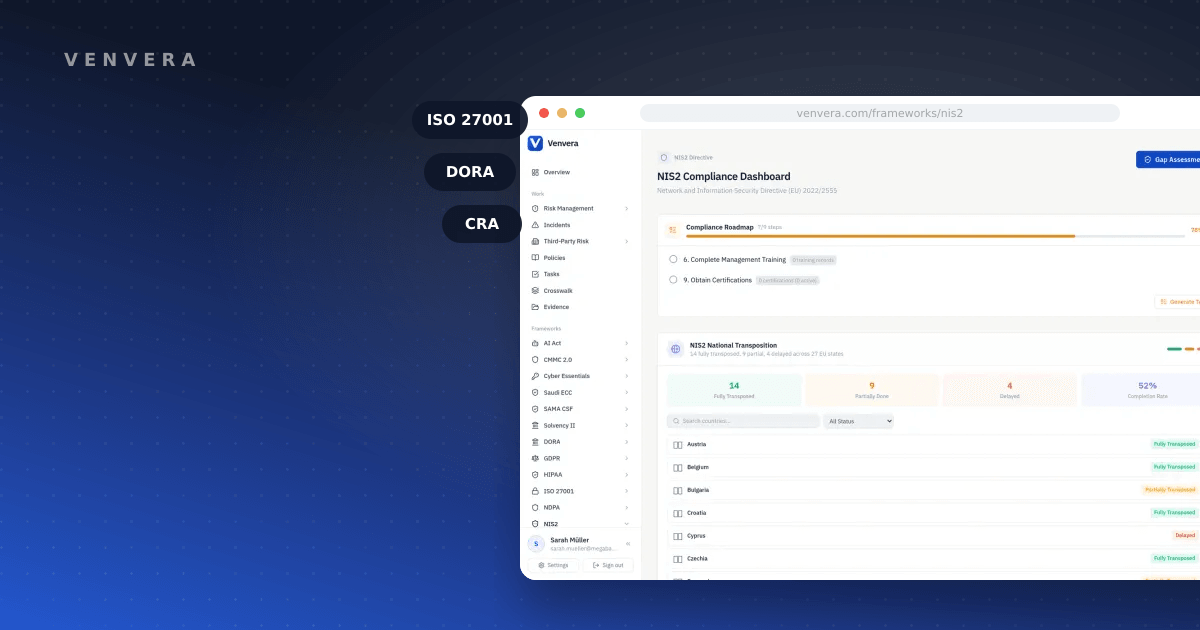
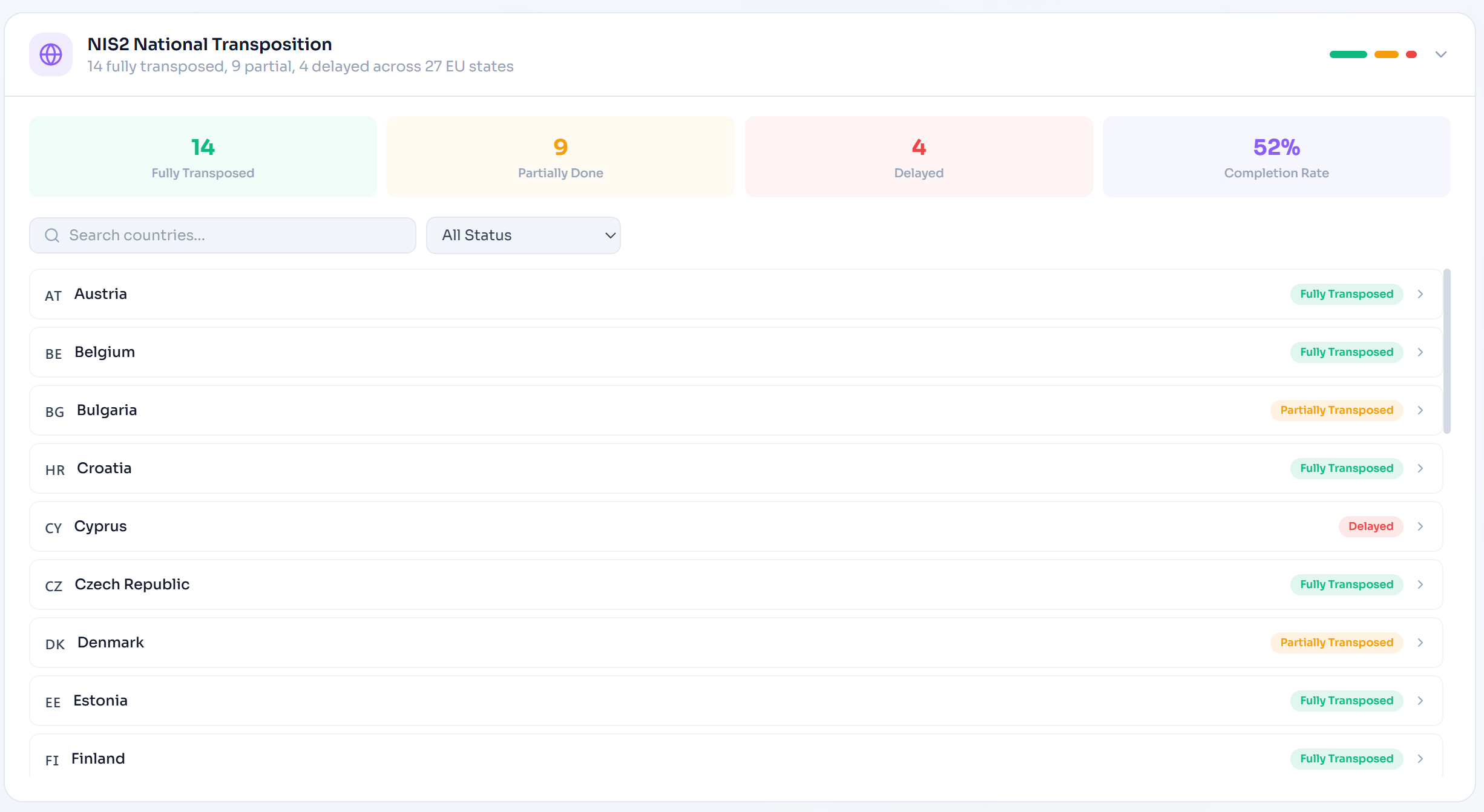
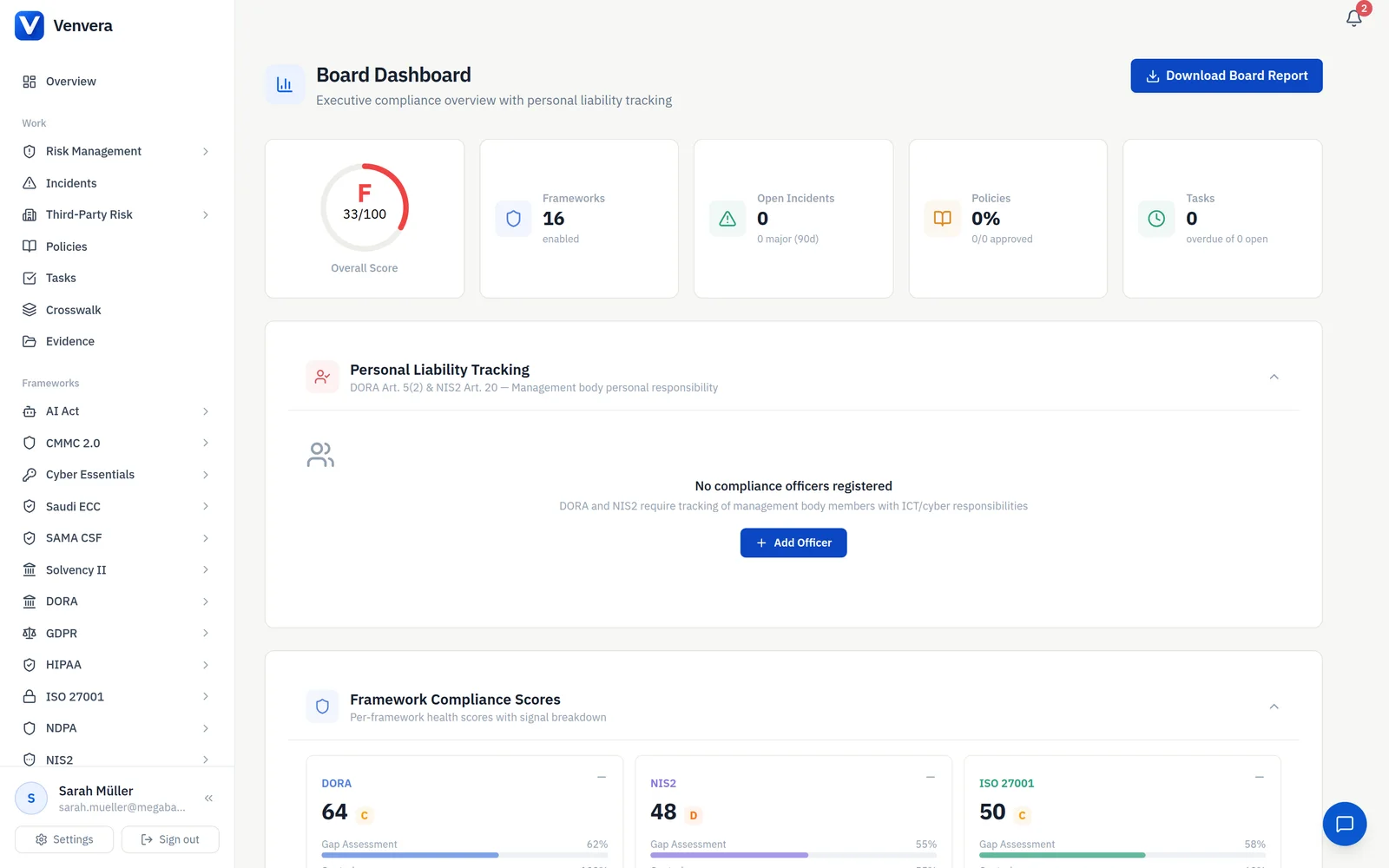
Venvera treats NIS2 as a first-class framework. In the product, its NIS2 module covers the risk-management measures under Article 21, with structured tracking, evidence linking, status management and owner assignment for each measure.
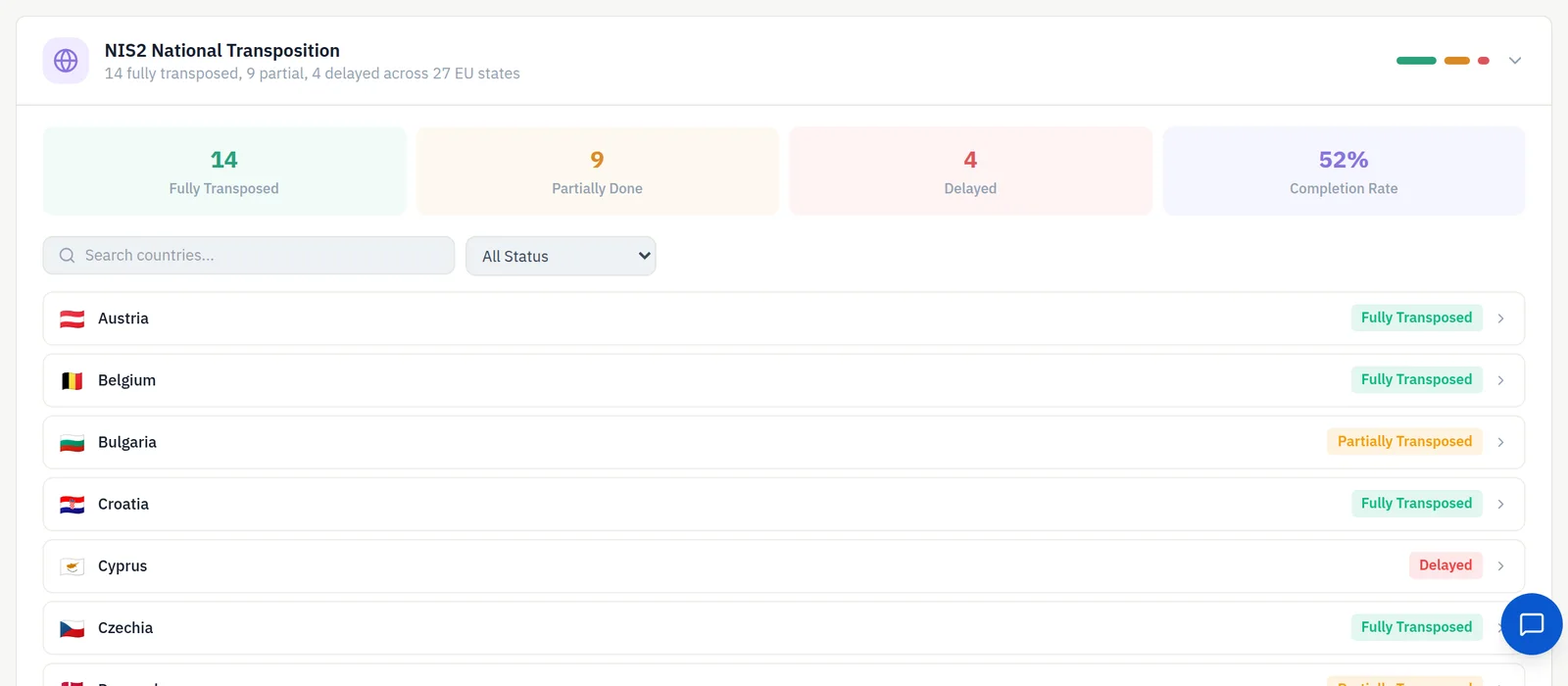
Incident reporting follows the NIS2 timeline: 24-hour early warning, 72-hour notification and a one-month final report, with deadline tracking and templates structured to match what national CSIRTs expect. Where an entity is also subject to DORA, the platform can track DORA's stricter initial-notification timeline and show how satisfying it relates to the NIS2 24-hour requirement.
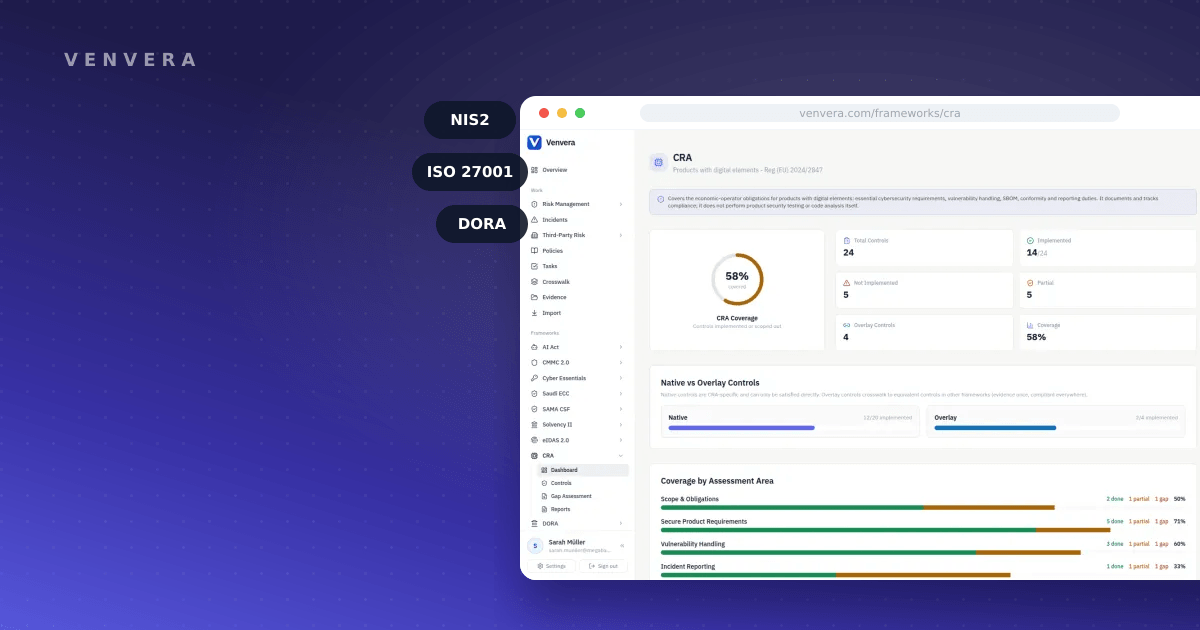
Supply chain security tracking, management-body obligation documentation, gap assessments and posture KPIs are included, along with pre-built cross-framework control mappings connecting NIS2 to GDPR, DORA, ISO 27001 and other frameworks so evidence can be reused where requirements overlap.
Pricing starts at €399/month for one framework and €899/month for three, with multiple EU and international frameworks available in one workspace, hosted in Amsterdam.
Considerations: it is a newer platform with less brand recognition than the largest incumbents, and its integration ecosystem is still growing. For organisations whose main need is NIS2, especially alongside GDPR, DORA or ISO 27001, it is a strong fit at this price point.
OneTrust
Best for: large essential entities already running OneTrust GRC.
OneTrust's public documentation describes NIS2 capabilities within its GRC platform: risk-assessment templates aligned with Article 21, third-party risk management covering supply chain requirements, and incident-management workflows that can be configured for the 24-hour, 72-hour and one-month timeline. It has an established European presence and understanding of EU regulatory context.
If you are a large essential entity already running OneTrust for privacy, extending it for NIS2 keeps everything in one ecosystem and leverages existing team knowledge. For the many mid-sized organisations newly captured by NIS2 with lean compliance teams, the main considerations are enterprise pricing, implementation time and platform complexity. Confirm the current position and cost with OneTrust.
Vanta
Best for: SOC 2 and ISO 27001-first teams automating technical evidence.
Vanta's automation is well regarded for SOC 2 and ISO 27001: it connects to cloud infrastructure, collects evidence that controls are operating, and presents a real-time dashboard, saving manual evidence-collection work.
For NIS2, that automation helps with the technical-hygiene parts, such as network-security monitoring, vulnerability scanning and access-control verification. Native support for the 24-hour incident early-warning workflow, management-body obligation tracking under Article 20, supply chain security assessment and cross-regulatory mapping to DORA was not confirmed from the public documentation reviewed in July 2026. Default data hosting in the EU was also not confirmed. Verify these with Vanta if NIS2 substance, rather than technical evidence, is your priority.
ServiceNow GRC
Best for: large ServiceNow environments building NIS2 workflows in-house.
ServiceNow is a highly capable platform with a powerful workflow engine and strong integration across IT service management, security operations and change management. For large enterprises that already run it, building NIS2 workflows on top has a certain logic.
The word "building" is doing the work. An out-of-the-box NIS2 module, and the 24-hour, 72-hour and one-month incident-reporting timeline as delivered functionality, were not confirmed from the public documentation reviewed in July 2026; these are typically configured. Article 21 risk measures, management-body tracking, supply chain workflows and CSIRT cooperation would generally be set up as custom work. Add platform licensing and configuration effort, and it fits best where a large ServiceNow investment and build capacity already exist.
Drata
Best for: continuous infrastructure monitoring.
Drata is strong at continuous monitoring: agents watch your configurations and flag drift out of compliance, which is valuable for SOC 2. For NIS2, monitoring is necessary but not sufficient.
NIS2 is largely about whether your organisation can detect a significant incident, notify the CSIRT within 24 hours, produce a detailed notification within 72 hours and deliver a final report within a month, whether your management body has engaged with cybersecurity, and whether you have assessed supply chain security. A 24-hour early-warning workflow, management-body obligation tracking and comprehensive supply chain features were not confirmed from the public documentation reviewed in July 2026; cross-regulatory mapping to DORA appears limited. EU hosting is available as an option. Confirm the current position with Drata.
What matters for NIS2: head-to-head
How to read this table. Venvera entries are verified in the Venvera product (July 2026). Entries for the other platforms come from public vendor documentation reviewed in July 2026 and should be verified with the vendor. "Not confirmed" means the capability was not found in that public documentation; it is not a statement that the feature is absent.
| NIS2 requirement | Venvera | OneTrust | Vanta | ServiceNow | Drata |
|---|---|---|---|---|---|
| Art. 21 risk measures | Full (verified) | Described (public docs) | Partial (public docs) | Not confirmed (build) | Partial (public docs) |
| 24h early warning | Native (verified) | Configurable (public docs) | Not confirmed | Not confirmed (build) | Not confirmed |
| 72h incident notification | Native (verified) | Configurable (public docs) | Not confirmed | Not confirmed (build) | Not confirmed |
| Supply chain security | Full (verified) | Described (public docs) | Basic (public docs) | Not confirmed (build) | Basic (public docs) |
| Management body tracking (Art. 20) | Full (verified) | Partial (public docs) | Not confirmed | Not confirmed (build) | Not confirmed |
| DORA cross-mapping | Yes (verified) | Moderate (public docs) | Not confirmed | Not confirmed (build) | Not confirmed |
| EU data hosting | Amsterdam (verified) | EU option (public docs) | EU default not confirmed | Region choice (public docs) | EU option (public docs) |
| Starting price | From €399/mo | Not publicly listed | Not publicly listed | Not publicly listed | Not publicly listed |
The DORA overlap that is easy to manage badly
This deserves its own section because it is where duplicate effort tends to accumulate.
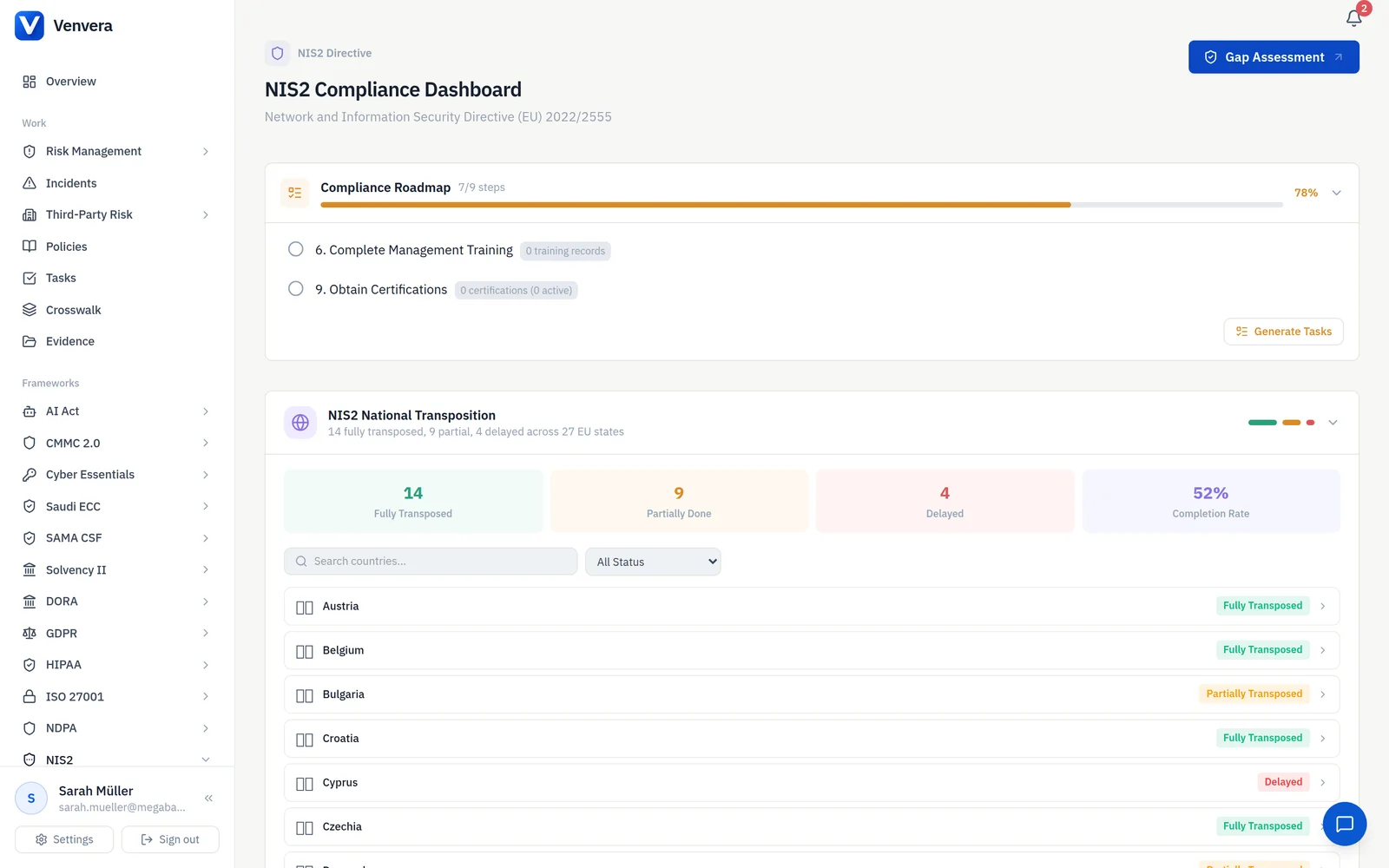
NIS2 and DORA overlap substantially. Both require risk-management frameworks, incident reporting, supply chain security, business continuity and management accountability. For financial entities subject to both, the potential for duplicate work is significant.
Article 4 of NIS2 addresses this: DORA is lex specialis for financial entities, and where DORA's requirements are at least equivalent to NIS2's, compliance with DORA can satisfy the corresponding NIS2 obligation. In practice this only simplifies matters if your platform understands the relationship; managing NIS2 and DORA in separate systems tends to produce two teams documenting the same measure twice.
Venvera's cross-framework mappings are designed to handle this. Implementing a business-continuity measure for DORA can surface the related NIS2 Article 21(2)(c) requirement as addressed, and an incident report meeting DORA's timeline can be shown to relate to the NIS2 24-hour requirement. Whether a specific DORA measure fully satisfies a specific NIS2 obligation should still be confirmed per requirement.
What to do this week
NIS2 is in force and enforcement is ramping up. If you have not started, here is a five-day sequence to get moving.
Monday: determine if you are in scope
Check your sector against Annexes I and II, and your size against the thresholds (from 50 employees or €10M turnover for most sectors). Check your member state's transposition legislation for national variations. If you are unsure, treat scope as likely and confirm.
Tuesday: classify yourself
Essential or important? This determines your supervision regime and penalty exposure. Get legal advice where it is ambiguous, which is common for companies that straddle sector boundaries or serve essential entities.
Wednesday: run a gap assessment
Map your current posture against the risk-management measures in Article 21. "We have a policy" is not the same as an implemented, operational measure. Ask what evidence shows each measure is actually working.
Thursday: test your incident response
Could you file a 24-hour early warning right now? Not "do you have a process" but "if there were a breach at 10pm tonight, could a notification reach your CSIRT by 10pm tomorrow?" If the answer relies on manual coordination and searching for contact details, the process is not ready.
Friday: choose your tool
You now know your gaps and whether you need NIS2 alone or NIS2 with DORA, GDPR or ISO 27001. Match a platform to your size, stack and budget using the buyer-fit conclusions below, and start.
Which of the five fits you
NIS2 is the broadest cybersecurity regulation the EU has enacted: 18 sectors, many previously unregulated companies, real penalties, management accountability and proactive supervision for essential entities. No single tool is right for everyone, so match the platform to your situation:
- NIS2 alongside GDPR, DORA or ISO 27001, with evidence reuse: Venvera, with Article 21 coverage, NIS2 incident reporting and cross-framework mappings verified in the product. As the publisher, we note the disclosure shown with this article.
- Large essential entity already running OneTrust GRC: OneTrust, subject to confirming cost and configuration effort.
- Large ServiceNow environment with build capacity: ServiceNow GRC to keep NIS2 workflows in one platform.
- SOC 2 or ISO 27001-first team automating technical evidence: Vanta or Drata, confirming or supplementing the NIS2-specific operational parts.
Whichever you shortlist, verify the NIS2-specific claims that matter to you directly with each vendor before committing.
See how Venvera handles NIS2
Manage Article 21 risk measures, incident reporting (24h, 72h and one month) and supply chain security alongside GDPR, ISO 27001 and DORA, with evidence reused across overlapping frameworks. From €399/month, hosted in Amsterdam.
Book a demo →Comparison compiled July 2026 from public vendor documentation and the Venvera product. Competitor capabilities were not hands-on tested. NIS2 transposition varies by member state. Confirm current pricing and features with each vendor.