

Best
For many UK SaaS companies, SOC 2 is the first attestation a US enterprise buyer asks for. It rarely stays the only requirement. A German enterprise customer may ask for ISO 27001; an EU financial customer may ask for DORA-aligned evidence; a UK public sector tender may require Cyber Essentials. The tool that handled your SOC 2 audit well is not automatically the tool that covers what comes next.
Quick answer
Which SOC 2 platform fits a UK SaaS company depends on what sits alongside the attestation. Vanta is well suited to teams that want deep cloud integrations and an established auditor marketplace. Sprinto is a good fit for a first SOC 2 on a startup budget. StrikeGraph suits mid-market teams that want structured certification guidance. Venvera, the platform behind this guide, is well suited to teams that need SOC 2 together with ISO 27001, GDPR and the UK's Cyber Essentials scheme off one control set, with EU-based hosting. The comparison below covers all five and how each is priced.
The pattern across the market is that single-framework tools charge separately for each additional framework, and coverage of EU-specific regimes varies. Organisations that operate internationally, serve regulated clients, or handle sensitive data tend to find that SOC 2 is a first checkpoint rather than the finish line.
This guide compares five compliance platforms for SOC 2 in 2026, with attention to what happens when your obligations expand beyond a single framework.
Key Insight
SOC 2 shares significant control overlap with ISO 27001, NIST CSF and CMMC Level 2. A platform that maps these relationships can reduce duplicated work when you add a second or third framework, because much of the same evidence applies to more than one.
🔍
Evaluation Criteria
What to Look For in a SOC 2 Compliance Platform
Before the comparison, it is worth setting out what separates a genuinely useful SOC 2 platform from one that just checks boxes. These are the criteria that tend to matter most for a growing SaaS company.
Multi-Framework Support
Can you add ISO 27001, NIST CSF, GDPR or DORA without starting from scratch, and are further frameworks included or priced separately?
Cross-Framework Mapping
Does implementing one control link to related requirements across other frameworks? This is the main efficiency multiplier.
Evidence Collection
Automated evidence gathering from cloud providers, identity systems and HR tools. Manual uploads should be the exception, not the rule.
Continuous Monitoring
Real-time control monitoring with alerting when controls drift out of compliance, not just point-in-time snapshots.
Data Sovereignty
Where is your compliance data stored? For UK and EU organisations, UK or EU hosting is increasingly a hard requirement.
Transparent Pricing
Pricing you can understand up front. Check for per-framework fees, per-user surcharges and integration costs before you sign.
| How we compared these platforms | |
|---|---|
| Basis of comparison | Produced from publicly available vendor documentation plus direct knowledge of the Venvera product. It is not based on hands-on testing of competitor platforms. |
| Date of review | July 2026. Product capabilities and pricing change, so treat everything here as a snapshot. |
| Evaluation criteria | SOC 2 Trust Services Criteria support, evidence automation, continuous monitoring, multi-framework and cross-framework reuse, data residency and pricing model. |
| Please verify | Venvera is the publisher of this guide. Competitor capabilities and pricing should be confirmed directly with each vendor before you decide. |
🏆
Platform Reviews
Five SOC 2 Compliance Platforms Compared
OUR PLATFORM
Venvera
Best for: UK and EU teams that need SOC 2 alongside ISO 27001, GDPR and Cyber Essentials off one control set, with EU-based hosting.
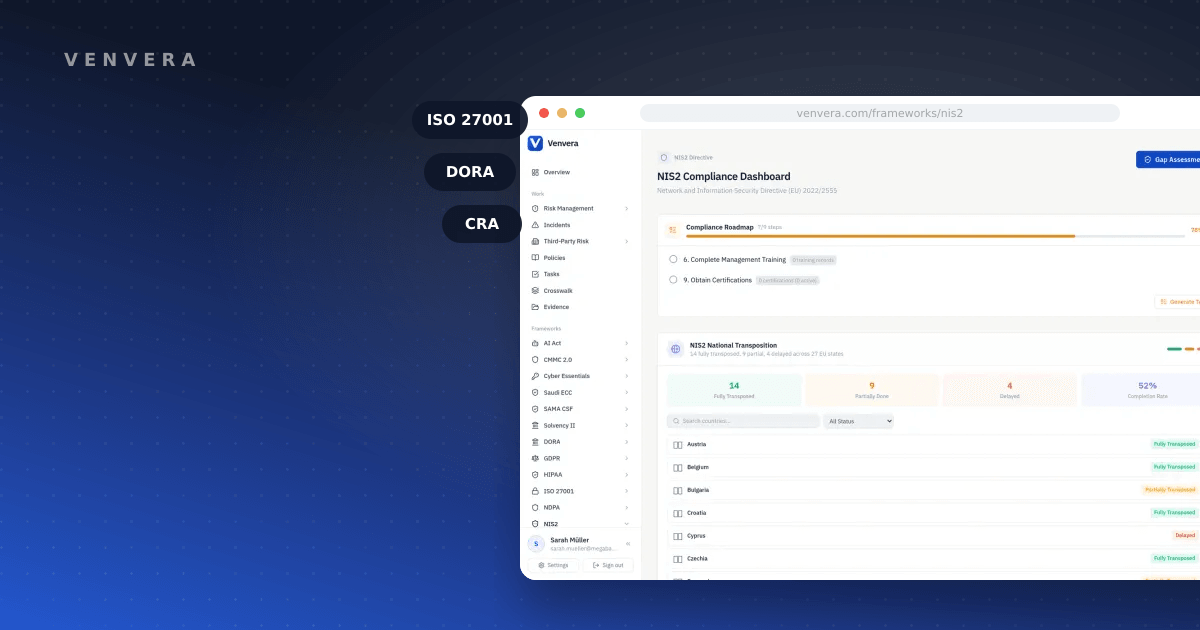
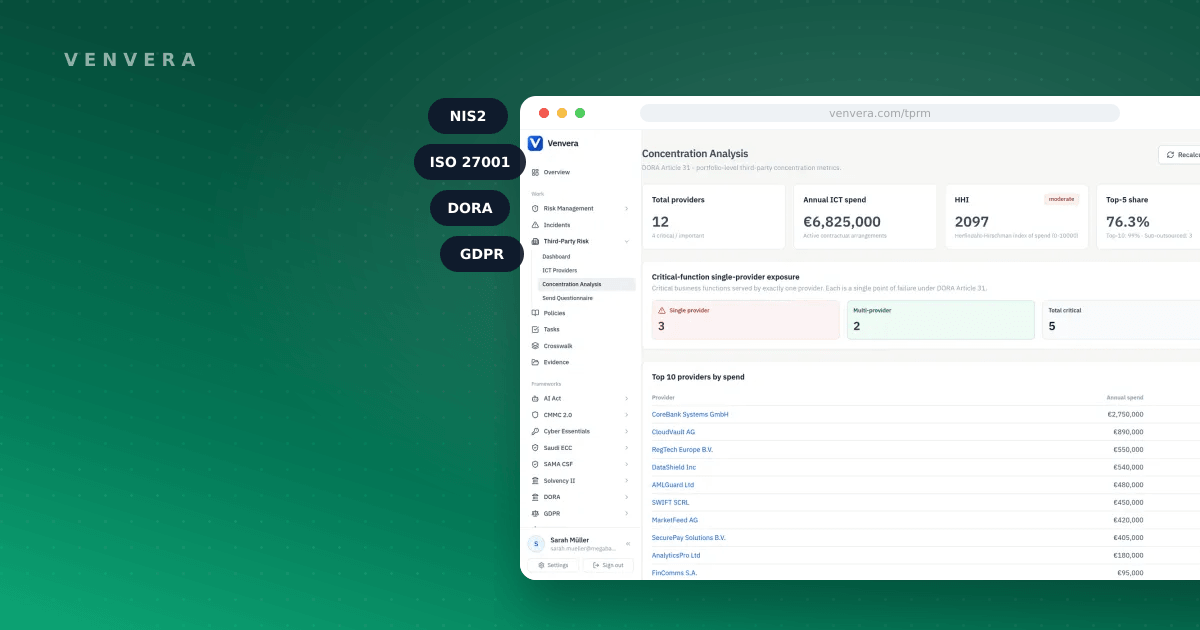
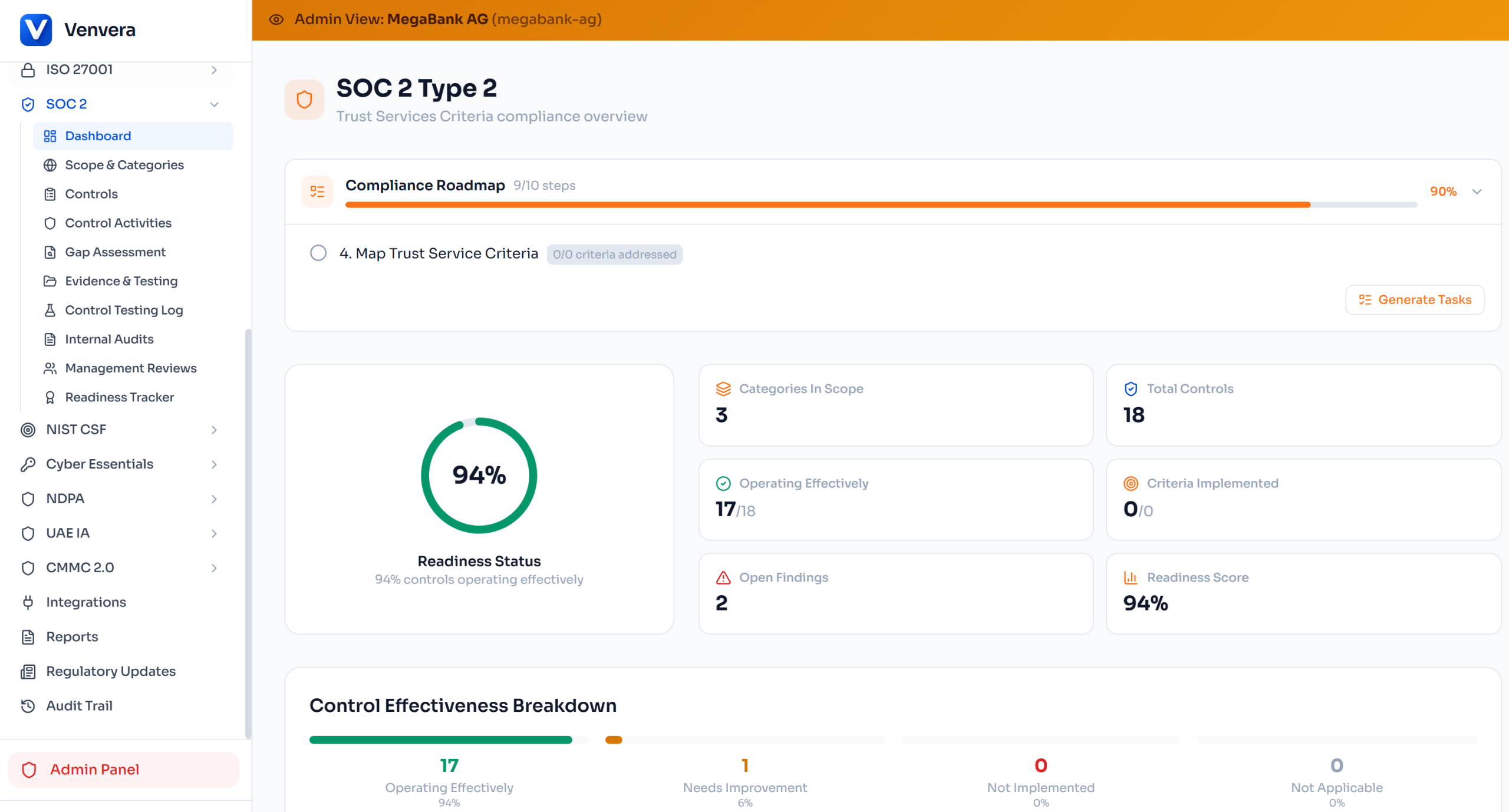
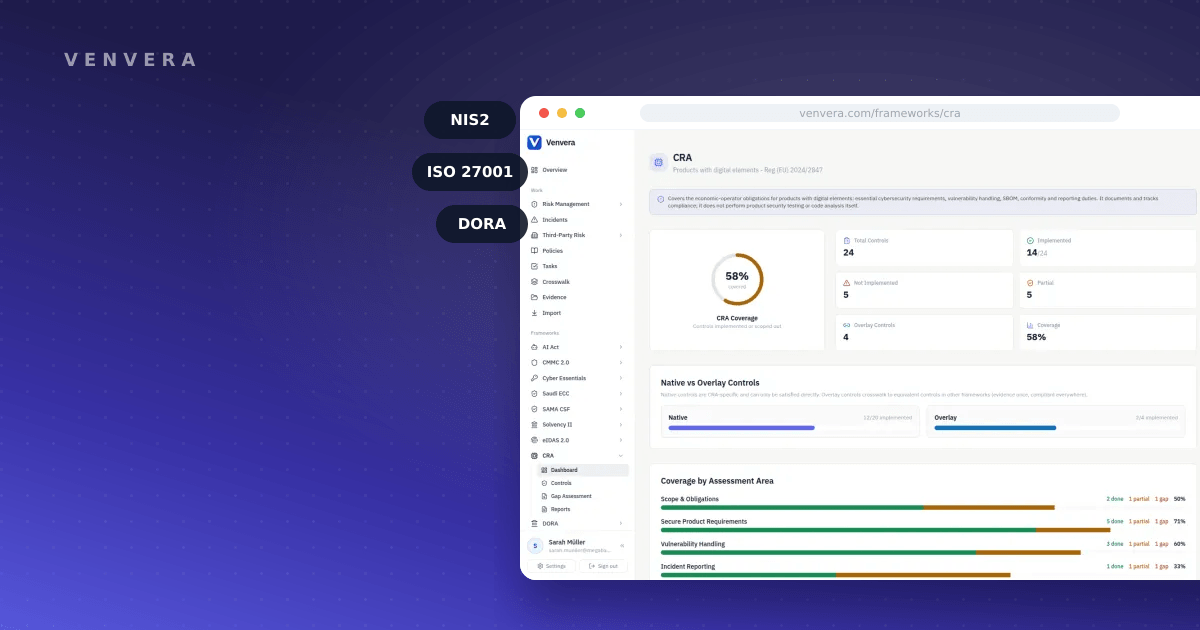
Venvera is a multi-framework platform that covers SOC 2 alongside frameworks such as ISO 27001, NIST CSF, GDPR, NIS2, DORA, the EU AI Act, Cyber Essentials and CMMC in a single subscription, with published pricing from €399/mo.
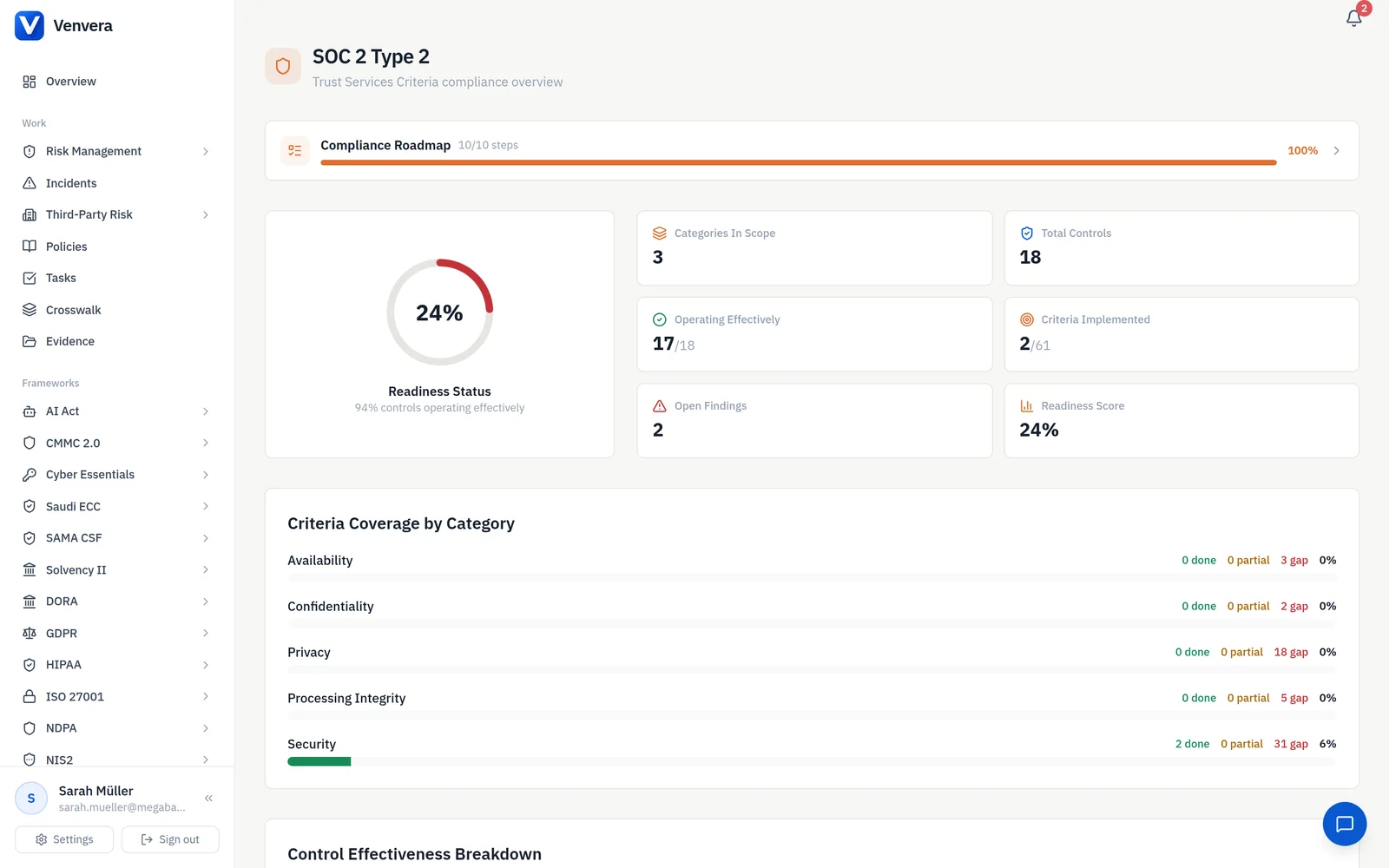
The cross-framework control mapping is the distinguishing feature. With pre-built mappings, a SOC 2 control such as CC6.1 (Logical Access Security) is linked to related requirements in ISO 27001, NIST CSF and CMMC, so the same evidence supports readiness across each rather than being re-collected per framework.
Data residency is native: Venvera is hosted in Amsterdam with EU data residency, which matters for UK and EU entities that prefer not to store compliance evidence on US-hosted platforms.
Multi
Frameworks in one subscription
Pre-built
Cross-framework mappings
EU
Data residency
Vanta
Best for: teams that want deep cloud integrations and an established auditor marketplace for their SOC 2.
Vanta is one of the best-known names in SOC 2 automation. Its public documentation describes strong integrations with cloud providers (AWS, GCP, Azure), identity platforms and HR tools, reliable continuous monitoring, and an auditor marketplace. For a startup focused on SOC 2 for a first enterprise deal, it is a strong option.
For buyers with international or multi-regulatory obligations, the points to confirm are how additional frameworks are priced and how deep the coverage of EU-specific regimes such as DORA runs, since these are not fully clear from the public documentation reviewed in July 2026. Check them with Vanta if they are on your roadmap.
Strength
Cloud integrations
Strength
Auditor marketplace
Verify
EU framework depth
Drata
Best for: teams that value continuous monitoring and a polished interface for their SOC 2 programme.
Drata's public materials describe a polished platform with continuous monitoring and deep infrastructure-level integrations that collect evidence from cloud environments and flag configuration drift in real time, with an interface compliance teams tend to like.
Drata lists SOC 2, ISO 27001, GDPR, HIPAA and other frameworks. For EU-specific regimes such as NIS2, DORA and the AI Act, the depth of coverage and how frameworks are priced are not fully confirmed from the public documentation reviewed in July 2026, so confirm these with Drata if they matter to you.
Strength
Continuous monitoring
Strength
Clean interface
Verify
EU regulation depth
Sprinto
Best for: startups and small teams getting a first SOC 2 on a limited budget.
Sprinto is positioned as the budget-friendly option for startups and small companies getting their first SOC 2. Its public materials describe competitive pricing, fast onboarding and a guided workflow that is accessible for teams without dedicated compliance staff.
The questions to confirm are depth for more complex requirements and coverage of EU-specific frameworks, which are not confirmed from the public documentation reviewed in July 2026. If your needs will stay close to SOC 2 and perhaps ISO 27001 for a while, Sprinto is worth evaluating; if NIS2, CMMC or DORA are likely, check fit with Sprinto directly.
Strength
Budget-friendly
Strength
Fast onboarding
Verify
Framework breadth
StrikeGraph
Best for: mid-market teams that want structured, certification-oriented guidance through the audit.
StrikeGraph focuses on the certification process itself. Its public materials describe guiding mid-market companies through audits with a structured workflow from gap analysis to audit readiness, which appeals to teams that want guidance rather than a blank canvas. For SOC 2 specifically it handles the Trust Services Criteria and integrates with auditors.
Coverage beyond SOC 2 and ISO 27001, including EU-specific frameworks and the depth of cross-framework mapping, is not confirmed from the public documentation reviewed in July 2026. If you expect to operate across several frameworks and jurisdictions, confirm that scope with StrikeGraph.
Strength
Certification workflow
Strength
Mid-market focus
Verify
Framework breadth
📊
Head-to-Head
Full Platform Comparison Table
Venvera entries reflect its own product. Competitor entries reflect the public documentation reviewed in July 2026: "Confirmed" means the capability is described there, and "Verify with vendor" means it was not confirmed and should be checked directly, not that it is unsupported.
| Feature | Venvera | Vanta | Drata | Sprinto | StrikeGraph |
|---|---|---|---|---|---|
| SOC 2 Support | Yes | Confirmed | Confirmed | Confirmed | Confirmed |
| ISO 27001 | Included | Confirmed | Confirmed | Confirmed | Confirmed |
| NIST CSF | Included | Verify with vendor | Verify with vendor | Verify with vendor | Verify with vendor |
| DORA | Included | Verify with vendor | Verify with vendor | Verify with vendor | Verify with vendor |
| Cyber Essentials | Included | Verify with vendor | Verify with vendor | Verify with vendor | Verify with vendor |
| Framework breadth | Multi-framework | Verify with vendor | Verify with vendor | Verify with vendor | Verify with vendor |
| Cross-Framework Mapping | Pre-built | Verify with vendor | Verify with vendor | Verify with vendor | Verify with vendor |
| EU Data Hosting | Amsterdam | Verify with vendor | Verify with vendor | Verify with vendor | Verify with vendor |
| Pricing Model | Published, from €399/mo | Per-framework (verify) | Per-framework (verify) | Verify with vendor | Verify with vendor |
🔗
The Multiplier Effect
Why Cross-Framework Mapping Matters for SOC 2 Teams
SOC 2 controls do not exist in isolation. The Trust Services Criteria reflect broad cybersecurity principles that overlap with controls in other major frameworks. Implement SOC 2 properly and you are already doing a substantial portion of the work needed for ISO 27001, NIST CSF and CMMC.
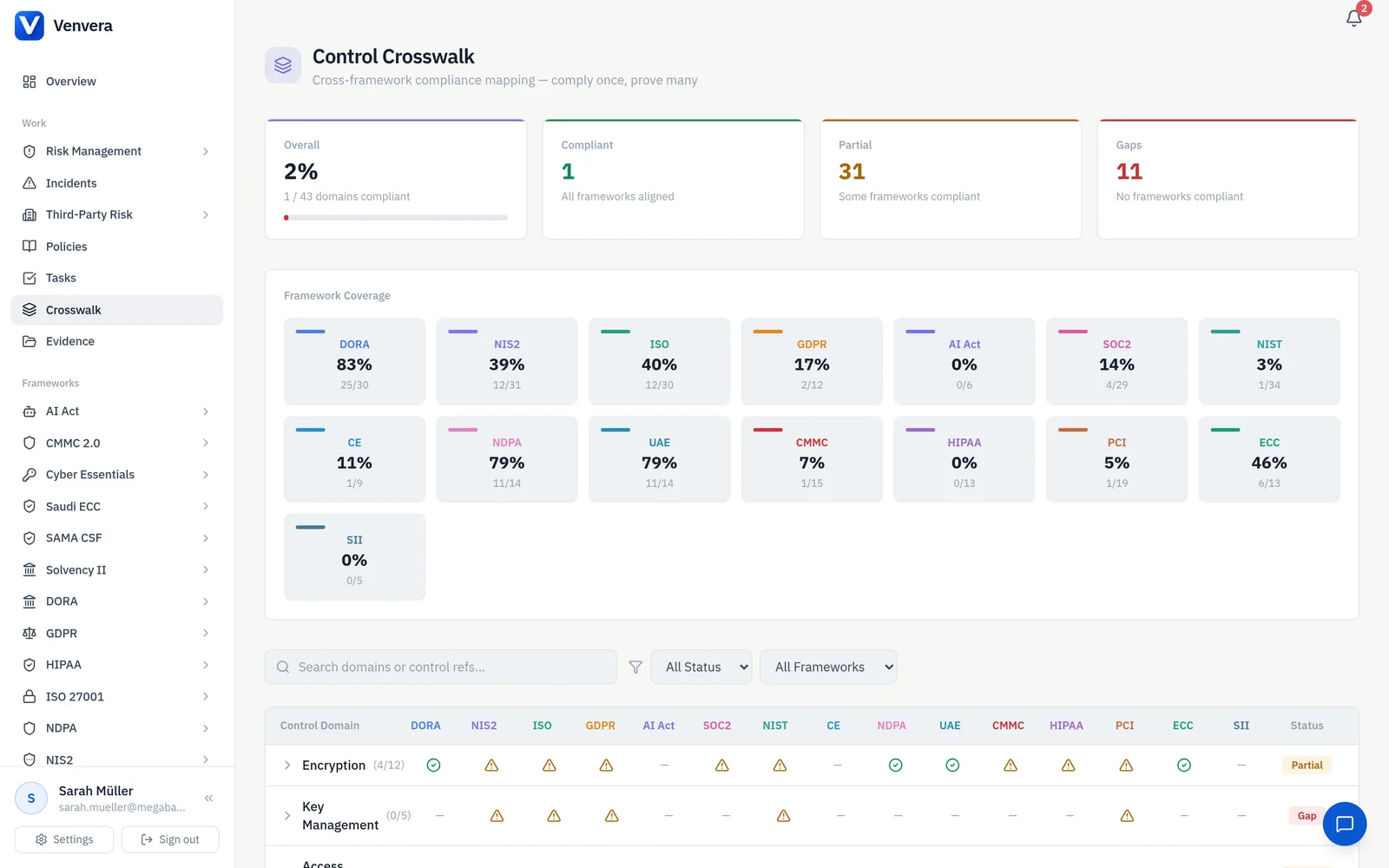
The issue is that many platforms treat each framework as a separate silo. You implement SOC 2 CC6.1 for logical access controls, then, when you add ISO 27001, you implement A.9.1.1 for access control policy, which is substantially the same control with the same evidence. Without mapping, that work is repeated.
Venvera's cross-framework mapping links these controls so the evidence is reused. Here are illustrative examples of how SOC 2 controls overlap with other frameworks:
| SOC 2 Control | ISO 27001 | NIST CSF | CMMC |
|---|---|---|---|
| CC6.1 Logical Access | A.5.15, A.8.3 | PR.AC-1, PR.AC-4 | AC.L2-3.1.1 |
| CC7.2 Monitoring | A.8.15, A.8.16 | DE.CM-1, DE.CM-7 | AU.L2-3.3.1 |
| CC8.1 Change Management | A.8.32 | PR.IP-3 | CM.L2-3.4.3 |
| CC9.1 Risk Mitigation | A.5.7, A.8.8 | ID.RA-1, ID.RA-5 | RA.L2-3.11.1 |
| CC3.1 Risk Assessment | A.6.1 (Clause 6.1.2) | ID.RA-3, ID.RA-4 | RA.L2-3.11.2 |
The takeaway
With cross-framework mapping, SOC 2 work provides readiness evidence towards ISO 27001, NIST CSF, CMMC and other frameworks. Instead of duplicating evidence collection per framework, you implement once and reuse. For teams that know they will need more than SOC 2, that reuse is the main efficiency gain. The article references above are illustrative; confirm the current mapping for your scope in the platform.
💰
Cost Analysis
Comparing the Cost of SOC 2 Software
Pricing transparency varies across this market. Most vendors do not publish detailed pricing and quote a base price for SOC 2, with costs layered on as your needs expand. Rather than repeat unverified figures, the practical approach is to ask each vendor for a written quote covering every framework you expect to need.
Consider a company that needs SOC 2, ISO 27001 and NIST CSF. With a per-framework model you pay for each framework separately, plus any per-user surcharges; adding DORA or CMMC later either adds cost or is not supported, depending on the platform. With a platform that includes several frameworks in one subscription, the total is more predictable. Confirm the current numbers with each vendor before deciding.
Venvera's model includes multiple frameworks in one subscription with published pricing from €399/mo, no separate per-framework fees, and EU data residency. For organisations needing three or more frameworks, that model is worth comparing against per-framework quotes on a like-for-like basis.
🇬🇧
The UK Angle
SOC 2 for UK SaaS companies: what changes?
SOC 2 is an American attestation, but UK SaaS companies pursue it because their customers ask for it. US enterprise buyers, and UK enterprises with American parents or US-heavy customer bases, expect a SOC 2 report during procurement, and the UK has no domestic equivalent attestation to offer instead. Cyber Essentials certifies baseline technical controls and ISO 27001 certifies a management system, but neither substitutes for a SOC 2 Type II report in a US-led vendor review.
As a UK buyer, three things are worth checking before you sign with any platform on this list. First, where the platform hosts your evidence: UK or EU data residency keeps your own GDPR position clean when audit evidence includes employee and customer data. Second, whether support hours overlap GMT, because audit-week questions cannot wait for a US West Coast morning. Third, whether the evidence you collect for SOC 2 can be reused for Cyber Essentials and Cyber Essentials Plus, the UK government-backed scheme many public sector tenders require, as well as for ISO 27001.
The practical play is to run SOC 2 and Cyber Essentials off one control set instead of two separate projects. Venvera maps both in the same subscription, so the access control, patching and malware protection evidence behind your SOC 2 controls also answers the Cyber Essentials question set. If you are evaluating a US-focused platform, confirm whether it includes a Cyber Essentials module, since that determines whether you need a second tool at renewal.
Last reviewed July 2026 · Comparison produced from public vendor documentation and the Venvera product · Confirm current details with each vendor · venvera.com